Автоматизация процесса
Медиа коммерческой фотографии
01. Media Concept
Create a space where people can understand the principles and the influence of photography on people. Understand why advertising captivates us and compels us to buy a product.
Objective: to cultivate an informed understanding of commercial photography as a communication tool. Goal: to teach students how to analyze visual solutions, understand their connection to branding, and perceive photography not only aesthetically but also professionally. Core Thematic Areas: -Analyzing advertising campaigns and brand visual strategies. -The journey from concept to final frame. -Light, color, composition, and texture as tools of visual language. -Interviews with photographers and other industry professionals. -Practical case studies, shooting processes, and working with references. -Investigating the influence of photography on brand perception. Target Audience: students in creative disciplines, emerging photographers, designers, art directors, marketing specialists, and anyone interested in visual culture. Main Platforms: Telegram — the editorial core of the media; Pinterest — the visual archive and reference collection.
02. Data Sources for Media
Four groups of sources can be identified for working with «Visual Code.»
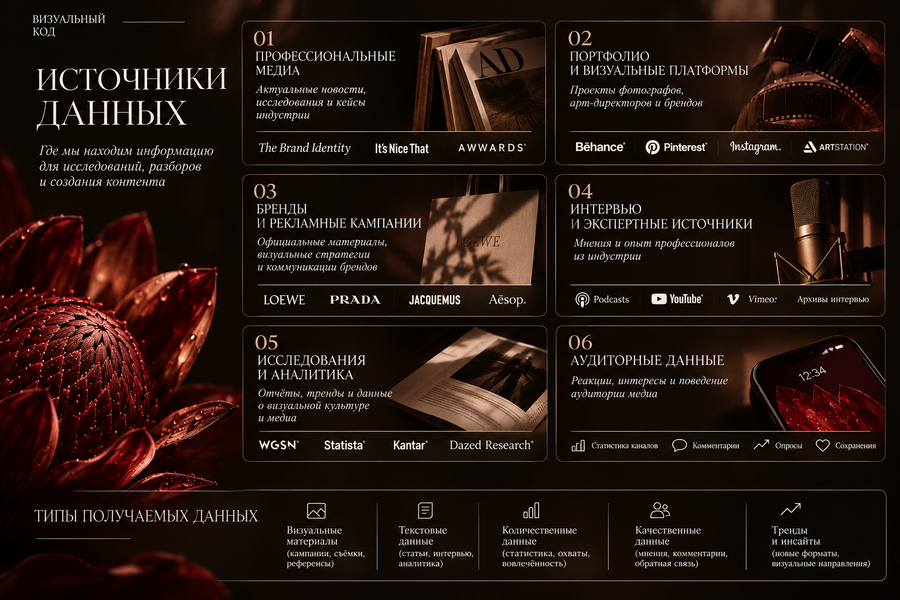
Examples of specific sources
Behance — portfolio and visual projects. Pinterest — references, mood boards, and visual directions. The Brand Identity — branding research and visual systems. It’s Nice That — projects by photographers, designers, and artists. Awwwards — visual and digital projects. Official brand and advertising agency websites — primary sources for campaigns and their concepts.
Important: Images, interviews, and quotes must have confirmed authorship and permission for use. A reference does not equate to publication rights.
03. Data Schema: Human vs. Machine Processing Separation
I propose dividing the editorial process into two streams: the machine stream—for gathering, sorting, and preparing information—and the human stream—for review, interpretation, and creation of editorial content.
COMPUTER-AIDED DESIGN
Automation -Publication Collection -Keyword Search -Material Sorting -Text Recognition -Statistics Collection -Draft Preparation
HUMAN INTERFACE
Editorial Staff -Source Verification -Visual Solution Analysis -Interviews -Reference Curation -Authorial Writing -Editorial Direction
Unified Editorial Database
Texts · Images · Authors · Links · Rights · Publication Statuses
A Practical Example: the system detects a new perfume brand advertising campaign, saves the link and image, and categorizes it as «Beauty / Advertising.» The editor studies the campaign, analyzes the lighting, color, composition, and meaning, and then prepares an original analysis for publication.
What Data Does the Editorial Database Store
Material ID: unique number Title: article or project name Category: campaign, interview, case study, reference Source: link to the original source Author: photographer, designer, editor Images: files and links Description: brief abstract Rights: usage terms Status: found / verified / in progress / published Date: date received and published
04. Guidelines for Automated Services
Automated services should help the editorial team save time, but they must not replace original work or visual analysis.
Toolkit

Feedly — Information Curation
Automation Aggregates publications from professional journals, blogs, and websites on specified topics: photography, advertising, art direction, branding. Process: the system collects links and headlines, and the editor reviews the material to determine its value. Feedly Website
Notion — Editorial Base
Automation + Editing Storing materials, authors, links, references, publication calendars, and work statuses. Rule: Every material is assigned a category, source, author, and review status. Notion Site
ChatGPT — Intelligent Assistant
Automation with Editor Review Transcription and structuring of interviews, drafting, identifying recurring themes, and question generation. Rule: Do not present generated quotes as the actual words of photographers, nor invent facts about advertising campaigns. ChatGPT