Research Concept
The banquet scene from the XVIII Dynasty Theban tomb belongs to the most reproduced themes in Egyptian art. It is known from several canonical vignettes: musicians from the tomb of Nakht, a group of musicians from Nebamun, and servants near the latrine of a noblewoman. These scenes are presented both as depictions of daily life and as evidence of the virtuosity of Egyptian artists. Both interpretations describe what is happening in the image, leaving aside how it is structured.
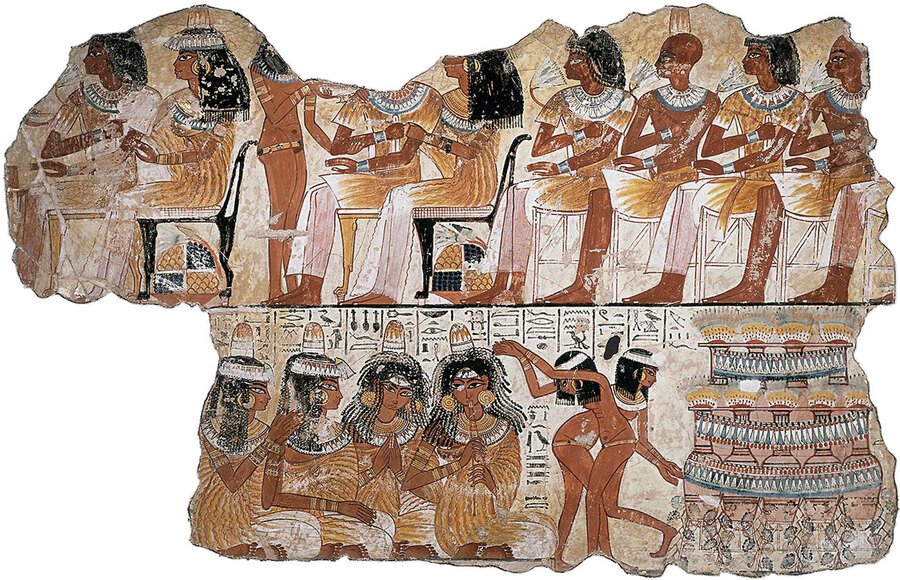
In one register of the Nebamun tomb fragment, women with faces composed of two projections stand alongside women whose faces are entirely rendered and turned toward the viewer. The canon of Egyptian representation is traditionally described as a static system that reproduced itself for three millennia. The juxtaposition of these two face types within a single scene contradicts this description—the artist made a choice, and that choice was subservient to meaning.
The feast allows one to observe the canon in action, which is why the theme of a gathering was chosen. Rules and deviations from the rules are contained within a single image, allowing them to be compared and establishing an argument through that comparison. In narratives structured as a series of activities—farming, craftsmanship, hunting—deviations do not form a system, and the discussion remains descriptive.
In a dinner scene, people with different social statuses participate, and each status has a visual form: head tilt, gaze direction, figure size, position in the register. Material of this nature is open to critique and allows for the articulation of a thesis that can be challenged.
The visual sequence includes frescoes from the Theban private tombs. The visual sequence is composed of plaster painting, relief, and ostraca with sketches. The comparison is based on the turn of the face within the scene, and a sequence cannot be established in three dimensions based on this criterion. The reliefs from Amarna and two later Walter reliefs meet this condition and serve as control points outside the Theban sphere.
Therefore, the primary sources are museum catalogs. These detail the attribution, date, material, inventory number, and provenance, and any statement about the painting technique can be verified on the collection’s page. Scholarly literature is brought in to explain a phenomenon or when it contradicts the museum label; in areas of contention, both explanations are retained.
This research examines how the composition of a drawing changes when it is transferred from a large wall to a small ostracon, while fundamental techniques for depicting the human form—such as profile heads and extended shoulders—remain consistent.Testing this hypothesis involves meticulously counting figures, comparing frames, and conducting a staged analysis, with each conclusion evaluated by its degree of certainty. This approach clearly demonstrates how reducing the format affects the density of element placement without disrupting traditional artistic conventions.
Navigation
Research Concept Section 1. Profile Guests: Nebamun, Nakht, Nebseni Section 2. Two Frontline Musicians: Nebamun Section 3. Musicians in Profile Research Conclusion
Section 1. Wall Ensemble
The first group combines wall murals from two Funan tombs—Nebamuna and Rehmira. Here, the figures are organized into groups or registers, and the instruments and gestures link them into an ensemble.
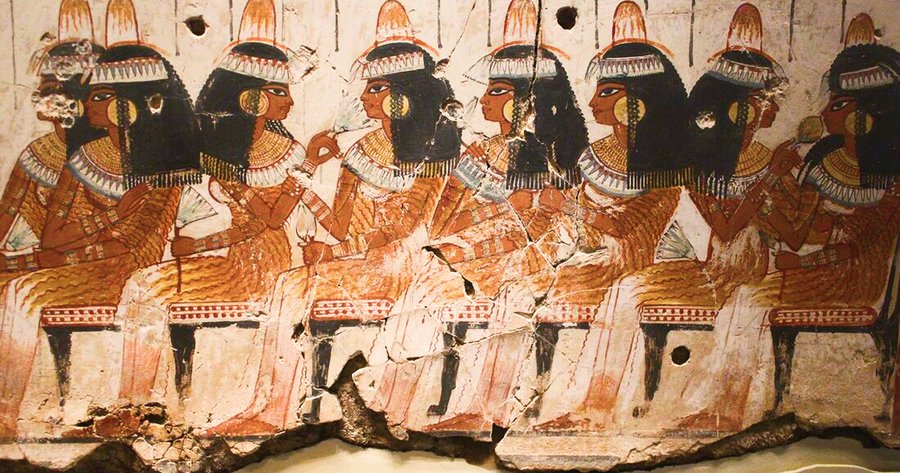
The fresco from the tomb of Nebamun depicts musicians seated in a row at a banquet. Harps, lutes, and handclaps held by the neighbors build a unified ensemble: the figures are turned toward one another, the instruments are aligned along the row, and the viewer perceives this as a cohesive action rather than a collection of individual portraits. The heads here are in profile, but the shoulders are turned toward the viewer—a convention that will be repeated both on the walls and on the roof tiles.
A detail from the same painting allows for a close examination of the technique: profile heads, eye lines, and figure contours. It is at this magnification that one can see how the artist holds the form—the shoulder girdle is turned toward the viewer in the profile head, and this combination functions both in the overall view and in the details.
Another fragment of the Nebamun painting reveals what is left out of the general view: adornments, clothing patterns, and traces of paint correction. These small details remind us that before us is not a perfect schematic, but a living work by an artist, where color and line were adjusted as the process unfolded.
The upper register of the same tomb depicts another side of the feast—the guests seated in a row. The musicians here are not isolated but are integrated into the scene as both its audience and performers: the banquet is composed of rows, and each row sets its own rhythm.
…four musicians (two shown in profile) sit on the ground while two dancers entertain the guests.
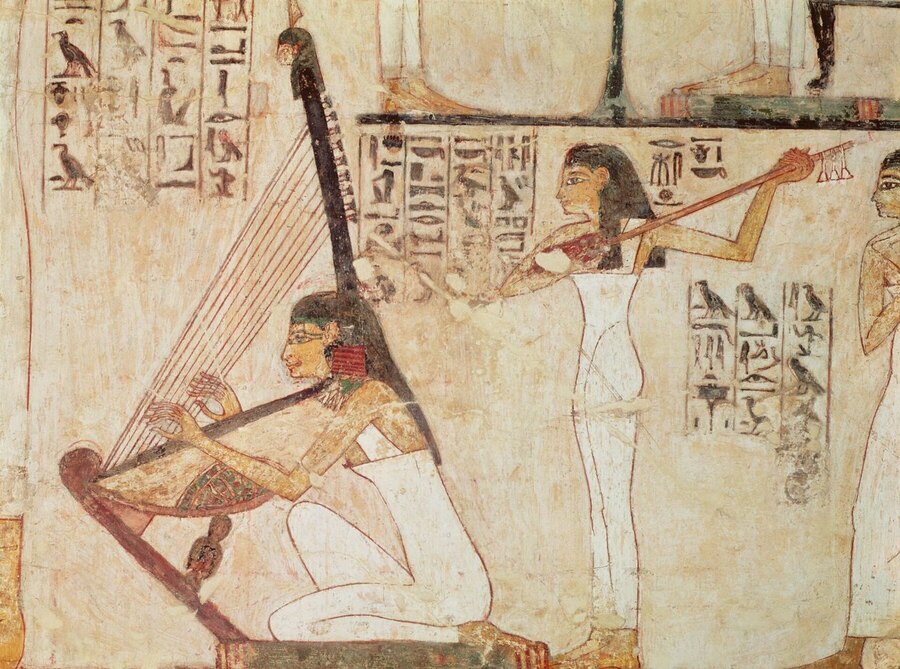
In the tomb of Rehmir (TT 100), the ensemble is assembled differently from that of Nebamun. The harpist and lutenist stand next to the clapping women, with the percussion instrument closing the group, and all figures are oriented toward one another. The result is not a line, but a circle of interaction: hands are directed toward the instruments, gazes toward their neighbors, and the scene reads as a moment of shared music-making.
The second frame from the Rehmir tomb depicts an harpist and a lutenist alongside a server. Here, the composition is linear: the figures and instruments are aligned along the register, and the direction of the instruments sets the rhythm for the entire scene. A comparison with Nebamun illustrates two ways of assembling an ensemble—as a group and as a line.