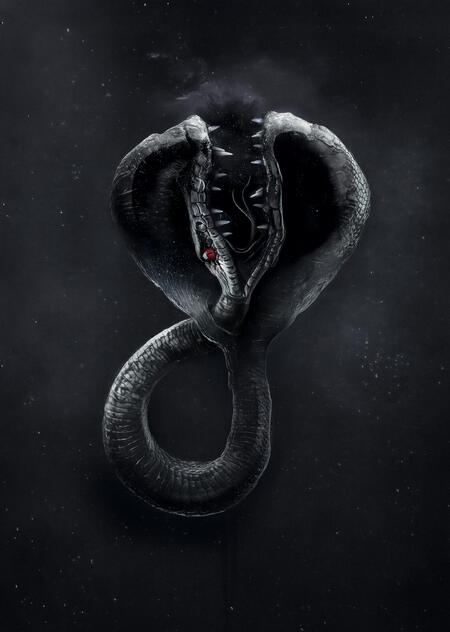
Little Python cries: He tangled himself up. He crawled over himself, And tied himself into a knot. Who can help him now: He cannot find himself Vladimir Orlov
Delegation
Perhaps it’s an off-topic tangent, but a story comes to mind about a labor agreement between humans and birds—one that appeared spontaneous but was actually initiated by non-human actors:
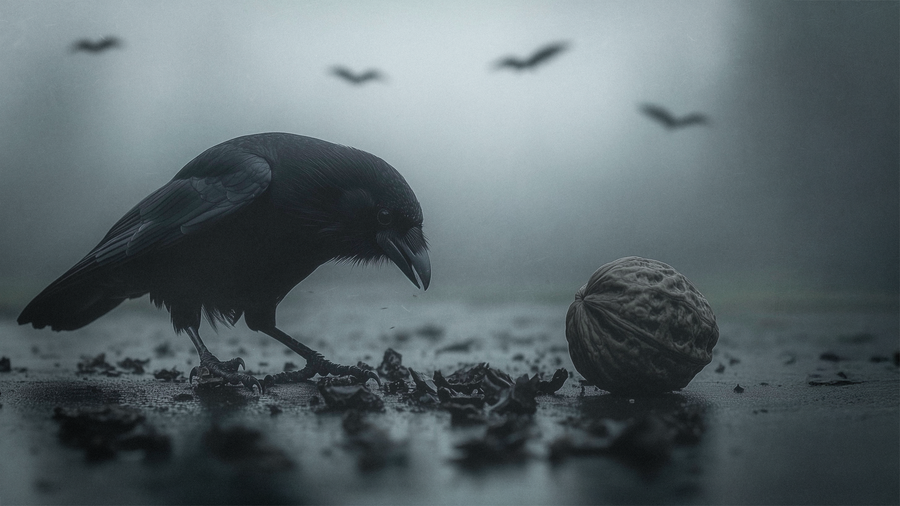
My brother told me. One day, a friend of his, who lived in a private house, went into the yard to crack walnuts. Crack, crack, and a raven flew down and dropped another walnut near him. Since it wasn’t difficult, he cracked it for her, the raven ate it, and flew away. After that, ravens from all around would bring him nuts. He cracked some for them and kept some for himself. Thus, the ravens hired a human to work for wages.
To summarize, we will utilize another concept that Ann-Marie Willis terms «ontological design» (a term that seems synonymous with «anthroposocial composition» or «black design, ” which we advocate). We are accustomed to viewing the designer as an architecht of elements, arranging them in their proper places, as if they were chess pieces on a board. This approach presupposes the object as something preordained and subservient to the subject’s will—a hierarchical relationship, meaning the second always governs the first. But the formula of reality is recursive: people design things, and things „design“ people.
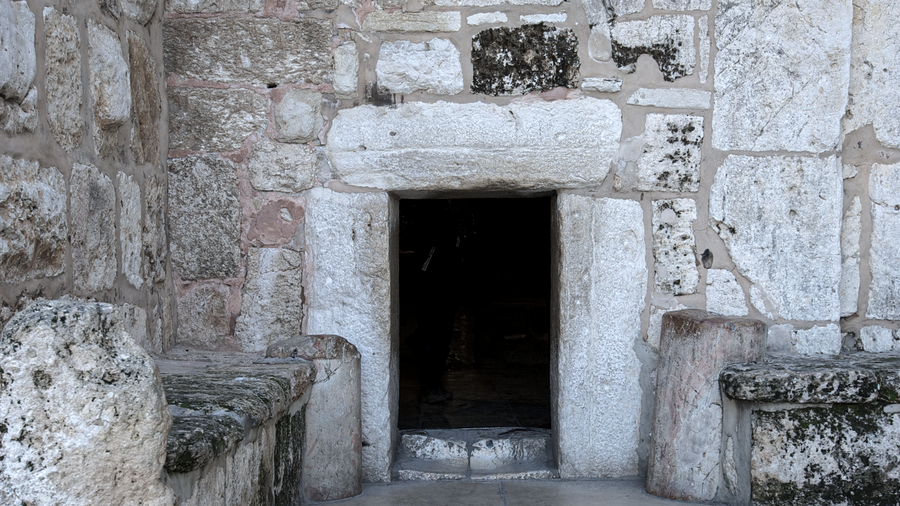
The western entrance to the Basilica of the Nativity in Bethlehem is a low doorway in the stone wall that forces everyone entering to stoop—effectively to bow—which is why it is called the «Gates of Humility.» Sociological action theorists, following Alain Touraine, view any social system—whether human, non-human, or hybrid—not as a collection of passive elements, but as a collective of agents who create the system itself. The «Gates of Humility» do not merely allow entry; they demand a specific action—a bow.
Sociologist Victor Vakhshtain (whose agency, by the way, the Ministry of Justice of the Russian Federation recognized as «foreign, ” whatever that may imply) writes:
Affordance refers to the set of actions an architectural object permits. Scenarios (inscriptions), on the other hand, are subsets of this action set—actions that are already embedded in the object, including what must be done with it or what the object prevents you from doing. In the «Gate of Humility, ” a specific usage scenario is already inscribed: you cannot enter the temple without bowing. The act of bowing itself is the result of a compulsion exerted by a specific architectural element.
For action theorists, the building no longer exists as a unified whole. It becomes a network of distributed agency across individual elements.
Sometimes this effect is called «reverse delegation»: we delegate some task to objects, and in return, the objects expect some action from us.
The person who observes the designed object or uses it is shaped by that gaze and that usage, becoming part of an ontological loop where neither authors nor recipients remain—only a single stream of mutual formation, where each element simultaneously becomes an agent and a patient, a subject and an object, designing and being designed.
Demolition of the Pruitt-Igoe housing complex 1972
A chain of influence is established: the designer creates an object that, in turn, influences user behavior. Furthermore, the designer is not necessarily required to use their own artifacts. For instance, an architect may not live in the building they designed: Minoru Yamasaki, the creator of the Pruitt-Igoe complex—one of the most notorious failures in social housing—never lived in it and never planned to (perhaps that is why the block was hastily demolished in 1972).
In the loops of design
Ann-Marie Willis, however, insists that designed objects influence not only their users but also the designers who create them. The designed designs the designer. Willis writes, «Ontological design is an interpretation of design related to the nature and agency of design, which understands design as a subject-decentered practice, acknowledging that things, just like people, design.»
You hold the pencil in your hand, preparing to draw the first line on the paper’s surface. It seems as if you are the source of action, and the pencil is merely a tool. But this is an illusion: your hand is already conforming to the pencil’s «pencil-ness,» which shapes your muscle patterns, body posture, and voluntary and involuntary microgestures. The very act of grasping and holding the pencil recursively shapes you—through ergonomics, through tactile sensations, through motor habits. Your tool becomes your equipment the moment you decide to use it—or even earlier, when the thought «I need something to draw with» emerges, and your tool is already designing you—even before you begin to design. You become zuhanden (the available instrument) for your tool—and for what you create with it. For the artifact you produce, you and your toolkit are the personnel hired for the job: «these are the guys who make me.»
In our nigredo approach, this requires radicalization in meaning—the designer is always pre-designed by what they are only about to design. The loop closes before the design process even begins, and the author-subject itself becomes merely a post-effect of the looping structure.
The future viewer or user programs the artifact, and through it—transitively—the designer or artist—even before the design begins—is shaped, not just by their expectations, but primarily by the very fact of their future existence—by their own virtuality, which desires to actualize and actualize the entire network of becoming as a whole, and specifically, each of its nodes—which are simultaneously creator, creation, and consumer.
Heidegger writes in the essay «Building, Dwelling, Thinking»: «When I approach the door of the lecture hall, I am already there, and I could not have reached the hall unless I was the one who was already there. I am never here as just a body in a capsule; rather, I am here, meaning I pervade the room, and only in this way can I pass through it.»
This is not simply a network of feedback loops; it is more akin to an ontological loop, where cause and effect converge into a taut knot: everything happens at that elusive moment when the yet-undesigned is already constructing the person who has not even begun to design it, but is merely about to. It is truly a chontological situation—the design is a phantom haunting the designer even before its appearance. By creating things, we discover their pre-existence: the virtual seeps into the actual, forming a loop where design becomes the archaeology of the future.
«Go to hell, Franklin.»
Nigredo design perceives these ontological loops not as an annoying inconvenience, but as the very essence of the object-making process. The designer is not a controlling authority, but a medium through which matter actualizes its autonomous will. When the typeface Helvetica asks you to use it in a specific way and, for instance, refuses to coexist with Franklin Gothic because it would be an incestuous juxtaposition—since neo-grotesques develop the formative principles of older grotesques (or, as type designer Hayane Baghdasaryan once put it, «to combine them is like serving boiled potatoes as a side dish to potato pancakes»)—that is where the ontological reality of design literally manifests. In this space, the human and the non-human, the designing and the designed, the realization and the project, the developer and the user intertwine into a dense chiasmus—precisely in line with the old joke, «In Soviet Russia, things design YOU!!» — though, of course, this happens not only in the Soviet Union but everywhere.
Design as Necessity
In traditional practice, the artist or designer functions like a Hobbesian sovereign managing the Leviathan of design: objects seemingly «agreed» to delegate their collective will to him (though who asked them?), and now, by looking at them—who is large, who is small? who is angular, who is rounded? who is dark, and who is light? —he assigns roles and establishes order. The sovereign-artist cannot be wrong and is unbound by anything concerning the medium or compositional elements.
Frontispiece to Thomas Hobbes’s Leviathan Engraving by Abraham Bosse London, 1651
In the black—anarcho-actor—composition, there is no sovereign, nor are there subjects: all its elements are independent actors that seem to have agreed to meet on the canvas and alongside it «without gods or masters.» They enter into multiple relationships with one another, and an image emerges from their spontaneous coordination. The composition becomes a distributed field of agency, where there is no distinction between subject and object, as the designer, material, form, and observer coexist within and around the work, dynamically and collaboratively shaping the space of coexistence. For an anarcho-actor composition to occur, the designer must abandon intrusive control and adopt a mode of «dwelling» (English: Dwelling; German: Wohnen). We borrow this term from Heidegger: «to build is already to dwell”—that is, to inhabit, to care for the emerging world, to „spare“ the world, to live within the process, to listen to the materials, and to allow the form to gradually discover itself:
True bliss is when something positive occurs—when we embed something into its own essence, when we liberate it and return it to the world in accordance with the true meaning of the word freien. To dwell, in other words, to be brought into a state of stillness, means to remain within the enclosure of the world; it means to be set free into a freedom that shelters and preserves everything, embedding each thing within its essence. The fundamental characteristic of dwelling is manifested in bliss.
The designer humbly weaves their loops into this entanglement—just as a monk enters a temple. The founder of the Kyoto School, Nishida Kitarō (西田 幾多郎, 1870–1945), believed that beauty, as an embodied truth, is grasped only in the state of muga (無我)—self-effacement that trembles toward self-oblivion. Sartre describes humanity as a project of constant transcendence beyond its own boundaries, and we, following Nishitani Keiji (西谷啓治, 1900–1990), a student of Nishida, allow ourselves to add that this ecstatic project—a collaboration involving things, the entire world, and the eternally pregnant Nothingness of Being. To allow oneself to be designed, to be designed—is not a capitulation to chaos, but rather an acceptance of its structural energy; it means relinquishing the illusion of sovereign control in favor of ontological humility, which does not exclude existential self-determination through the subject’s ecstasy, but instead provokes it.
Thus, design transforms into world-building and, consequently, worlding (English: Worlding, German: Welten), encompassing the entire world beyond the division between observer and observed, agent and patient, virtual and actual, space and time. Composition ceases to be merely the arrangement of forms on a plane—it becomes the process of generating an entire world. Embedded within every solution is more than just aesthetics or function: it alters the very way a person coexists with an object in the world, and how the world coexists with them within it.
Dragon Meat
This loop network is fractal—meaning it is infinitely self-similar: each of its elements contains the whole, much like how every fragment in a hologram holds information about the entire image. It is this fractal nature (which we discuss in more detail in the chapter «Degrees of Freedom») that makes genuine anarchy possible—the absence of an archē, a first cause. It resembles something like a snake eating its tail and infinitely replicating itself—an Ouroboros—which simultaneously possesses the topology of a Klein bottle, as it has no beginning, no end, no inside, no outside, no past, no future, no devouring, and no devoured—only continuous, flowing, emergent becoming.
Ultimately, Black Design offers us not methods or tools, but a transformation in the very understanding of what it means to be a designer—or, more precisely, to be-with-design: not merely designing things, but allowing things to design themselves—and the world through oneself. The author—along with the thing they create, the observer of that thing, and the user of that thing—transforms into a «threshold”—in other words, into what Heidegger called unconcealment (Lichtung)—a space where being itself clarifies itself.