Navigation
- Introduction 1.1 Hypothesis
- Iconography of Dreams in Medieval Art 2.1 Biblical Scenes Depicting Dreams 2.2 The Image of the Sleeping Person in Medieval Miniatures 2.3 Dreams as Part of Religious Narrative 2.4 Distinguishing Mundane Dreams, Prophetic Dreams, and Divine Revelations
- Symbolism and the Visual Language of Dreams How artists depicted the invisible through symbols and conventional imagery 3.1 Angels as Intermediaries Between the Earthly and Divine Worlds 3.2 Jacob’s Ladder as a Symbol of Connection Between Heaven and Earth 3.3 The Sun, Moon, Stars, and Other Signs in Dreams 3.4 Animals, Plants, and Objects as Elements of Prophetic Dreams 3.5 Halos, Clouds, and Gestures as Means of Signifying Divine Presence
- Artistic Techniques for Depicting Dreams What methods artists used to separate dreams from the real world 4.1 Compositional Separation of Dream and Reality 4.2 Vertical Organization of Space: Earth, Sky, and the Celestial Realm 4.3 Figure Scale and Conventional Perspective 4.4 Color, Background, and Architecture as Ways to Designate Different Spaces 4.5 Sequence of Events in Book Miniatures and Frescoes
- The Evolution of the Dream Image in Medieval Art How the ways of depicting dreams changed across different periods of the Middle Ages 5.1 Early Medieval Depictions of Dreams in Religious Manuscripts 5.2 Romanesque Art: Convention, Symbolism, and Expressiveness of Imagery 5.3 Gothic Book Miniatures: Increasing Complexity of Narrative and Space. 5.4 Depicting Dreams in Monumental Painting 5.5 The Transition from Primarily Religious Subject Matter to Allegorical and Literary Dreams
- Conclusion
- List of Textual Sources
- List of Image Sources
Introduction
In the Middle Ages, dreams were often perceived not merely as the workings of the imagination, but as a potential means of receiving a divine message or prophecy. I became curious about how artists conveyed this unseen experience through visual imagery.
In my research, I aim to examine medieval art from the Early Middle Ages through the end of the 14th century, with a particular focus on illuminated manuscripts and monumental painting. I am interested in how biblical and prophetic dreams were depicted, what symbols were employed, and how artists delineated the space between reality and the dream state.
Hypothesis
I surmise that in medieval art, dreams were depicted as a distinct space, separated from everyday reality yet connected to it. To achieve this effect, artists employed symbolic imagery, conventional composition, and the juxtaposition of earthly and celestial worlds. Through these techniques, the dream transcended being merely a depiction of a sleeping person; it became an independent component of the artistic narrative.
Iconography of Dreams in Medieval Art
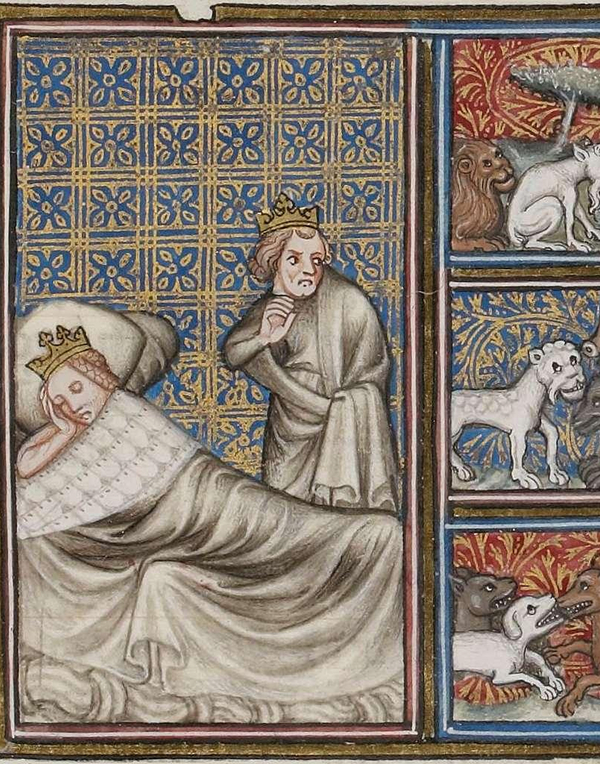
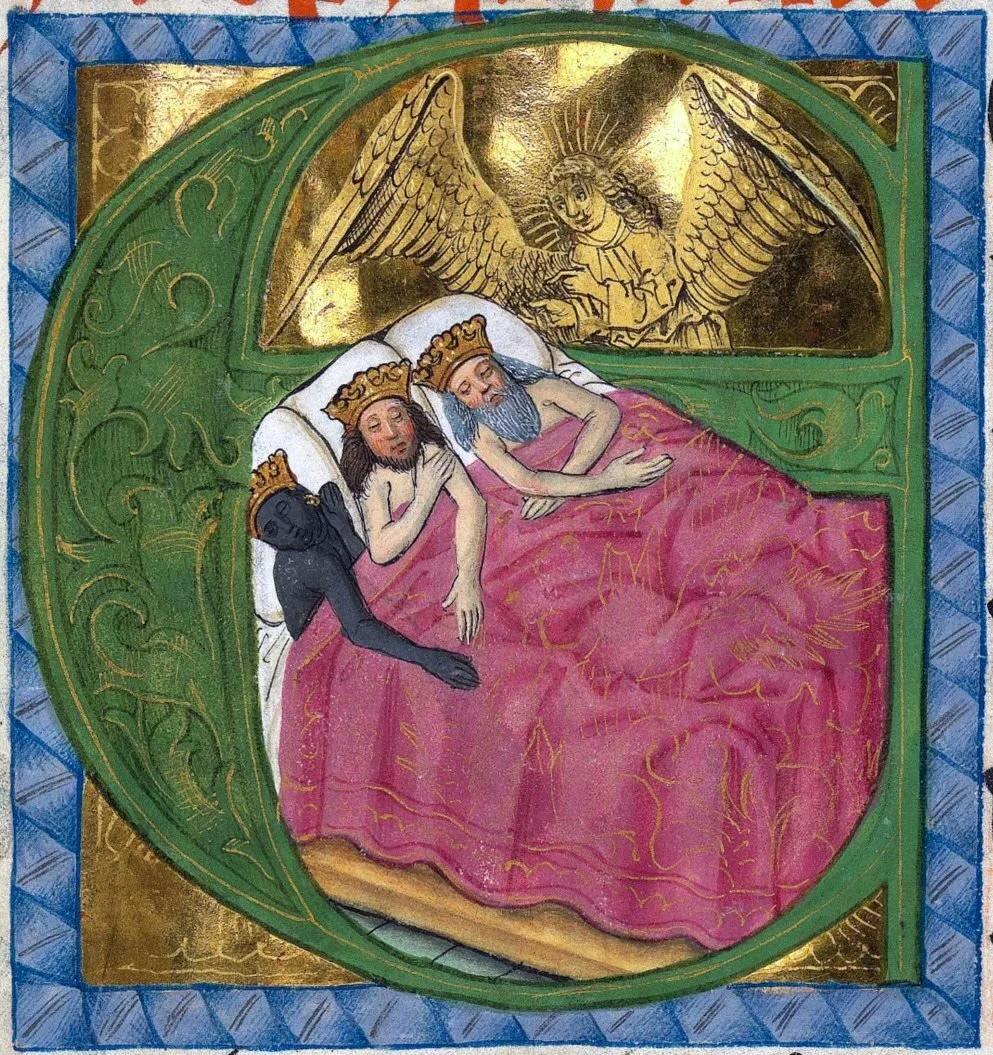
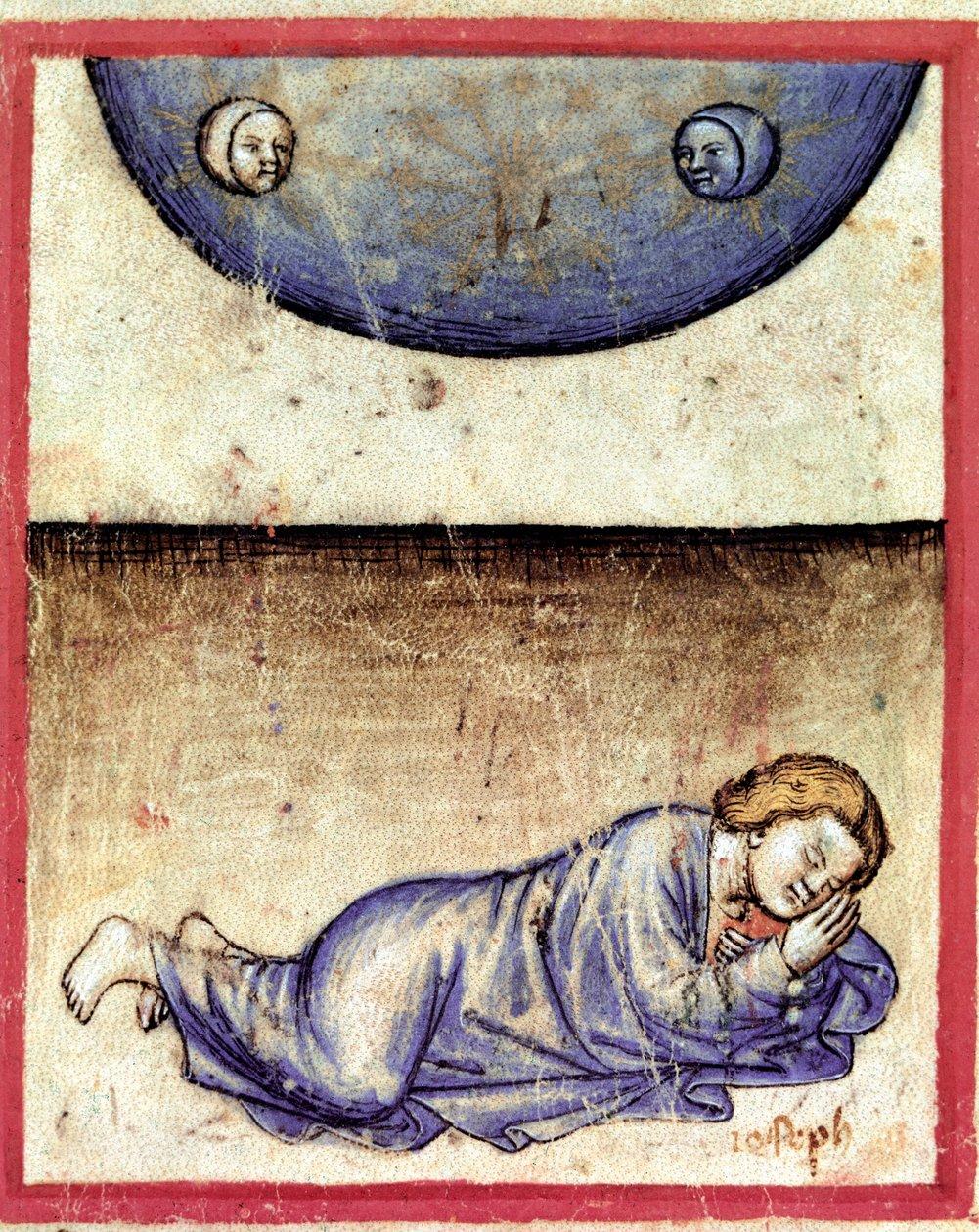
In medieval art, dreams most frequently appear in works depicting religious subjects. Scenes from the Old and New Testaments are particularly common, where the dream becomes a crucial part of the narrative. It can warn a hero of danger, predict the future, or convey a divine message. One of the most famous narratives is Jacob’s dream. According to the Bible, while sleeping, Jacob saw a ladder connecting earth and heaven, along which angels ascended and descended. This motif gained wide popularity in medieval painting and illuminated manuscripts. Artists depicted Jacob lying on the ground, with the ladder and angels above him. This compositional approach allowed the viewer to simultaneously observe the sleeping individual and the events transpiring within his dream.Another significant narrative is Joseph’s dreams. These feature symbolic images—sun, moon, stars, and wheat sheaves—that foretell events in his future life. Unlike Jacob’s dream, the focus here is not only on the figures of the characters but also on objects, whose meaning is revealed through biblical text.The dream of the Magi holds a special place. After worshipping the infant Christ, the Magi receive an angel’s warning in a dream not to return to King Herod. In depictions of this scene, one typically sees the Magi lying near each other, with an angel addressing them from above.
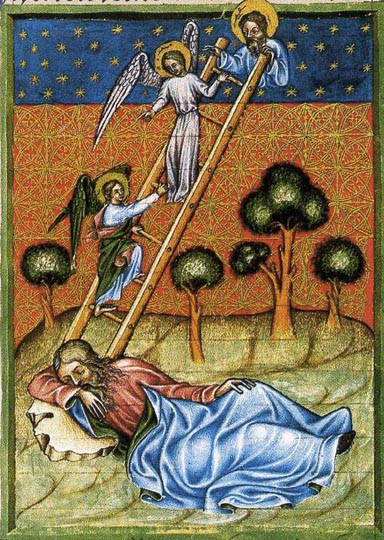
The Sleep of Jacob, 1244–1254
When comparing these narratives, it is noticeable that sleep in medieval art was rarely depicted as a casual or everyday event. More often, it was connected to a significant turning point in a character’s life. In this context, artists employed recurring visual elements: a reclining figure sleeping, an angel appearing above them, and symbolic imagery that illuminated the dream’s meaning.Thus, the iconography of dreams in medieval art was shaped around religious subjects, where the dream served as a means of conveying future knowledge or establishing a connection between a person and the divine world.
Research Concept (over 2500 characters)
Conclusion
List of Text Sources
Image Sources List
- https://natanaele.jimdofree.com/home/l-incontro/scala-giacobbe/?utm_source=chatgpt.com
- https://www.meisterdrucke.it/stampe-d-arte/Unknown-artist/961339/Giuseppe-sogn%C3%B2-che-il-sole%2C-la-luna-e-undici-stelle-si-prostravano-davanti-a-lui.-Miniatura-dal-codice-212-%28o-codice-padovano-o-Bibbia-di-Padova%29-1390-1400.-Rovigo%2C-Accademia-dei-Concordi.html?utm_source=chatgpt.com