Navigator 1. Concept 2. Establishing Cyclicity 3. Repetition as a Visual Motif 4. Changes Within the Cycle 5. Deconstruction of Cyclicity 6. Return to Cyclicity 7. Conclusion
Concept
Every day we perform countless repetitive actions, often without noticing them. The same route, familiar places, known faces, and everyday rituals shape our daily lives. This kind of cyclicality is often perceived as stagnation—a lack of development and forward momentum. However, in Jim Jarmusch’s film Paterson (2016), it is precisely the quotidian that becomes a space for creativity and a source of new meaning.
The film is centered on one week in the life of a bus driver who writes poetry in his spare time. Each of his days follows a specific pattern, and the repetition of habitual actions is reflected in the film’s compositions, angles, and shot sequences. Despite the outward constancy of the events, the narrative continues to evolve. I became curious about how the director manages to build a narrative within the context of almost unchanging daily life and what role the visual element plays in this process.
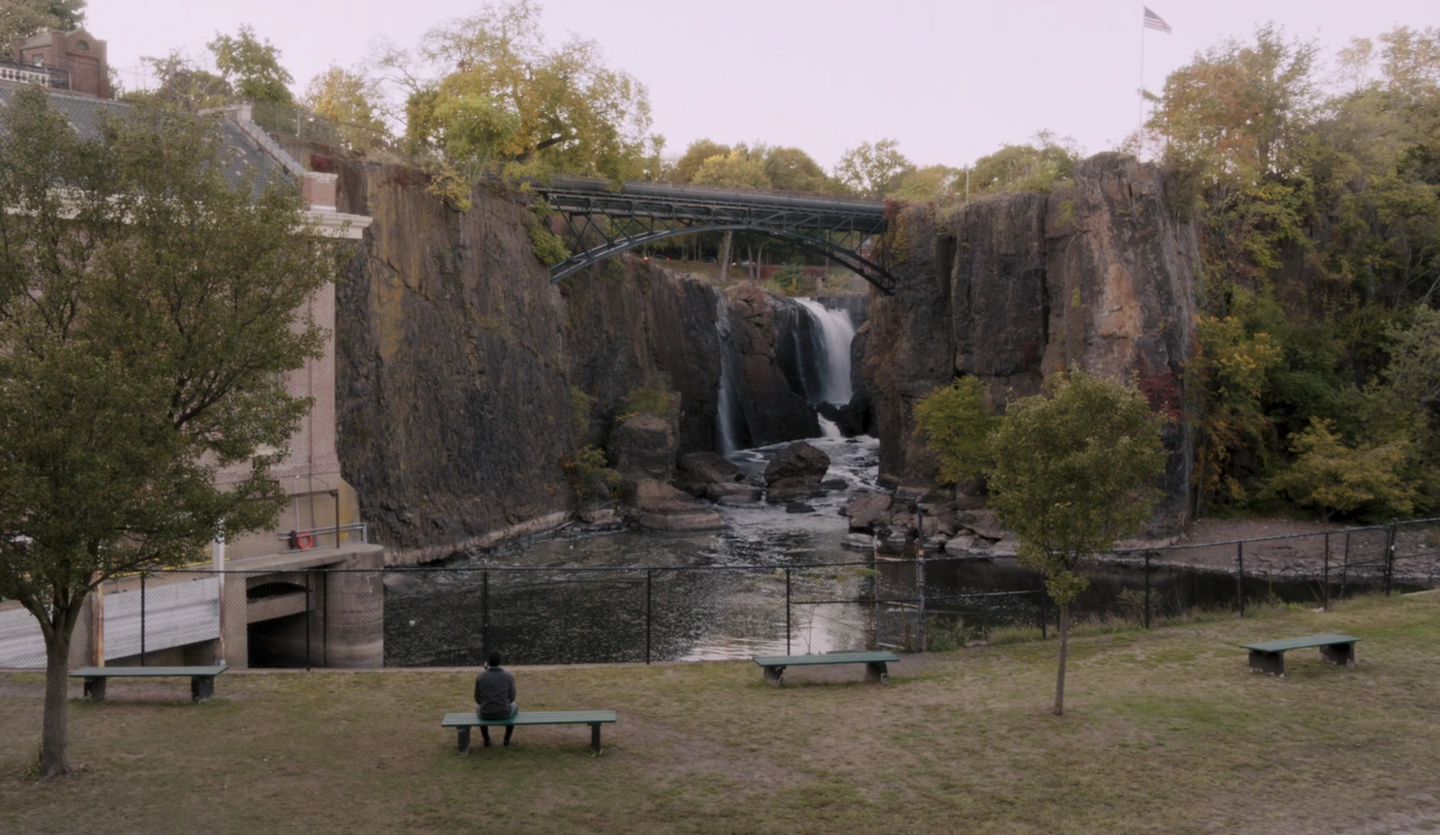
The focus centers on recurring actions, motifs, objects, and spaces, as well as the changes that occur within them throughout the film. The visual material is composed of shots selected based on principles of compositional and semantic similarity. Comparing these shots allows one to trace which elements remain constant, which gradually transform, and which disappear entirely from the established sequence.
The structure of the work follows the development of the film itself: from establishing cyclicity and identifying repeating visual motifs to the gradual disruption and subsequent reestablishment of the familiar order. Special attention is paid to how repetition shapes viewer expectations and why even minor changes can gain significant narrative weight. It is also interesting how familiar images acquire new meanings as the story progresses, despite remaining visually almost unchanged.
The principles governing the film’s construction are also reflected in the presentation of the work. The recurring imagery, compositional correspondences, and interruptions of the established sequence allow the viewer not only to see but also to independently feel the characteristics of Jarman’s visual storytelling.
Can repetition be a tool for development? Does change always imply a rejection of the familiar? Through the film’s visual language, this work suggests viewing cyclicity not as a lack of motion, but as a potential for discovering the new within what is already known.
Formation of Cyclicality
Patterson’s daily life consists of a sequence of habitual actions that structure his day. In the film’s opening episodes, the director introduces the audience to the main character’s routine. Later, this sequence forms the basis of the film’s visual and narrative structure. The narrative is tied to the characteristics of slow cinema, where everyday actions, repetition, and rhythm become vital tools for organizing screen time. Brian Jarvis [1] examines this approach to analyzing Jarman’s cinematography.
Awakening
Breakfast
road
work
Poetry writing
Returning Home
dog walk
Bar Visit
The cyclical nature of everyday life is underscored not only by the repetition of actions but also by how they are visually presented. Across episodes from different days, the director reproduces similar compositions, angles, close-ups, and the subject’s positioning in space. By comparing the shots, it becomes clear just how stable the film’s visual language is, despite the passage of time.
The viewer gradually memorizes the main character’s daily routine and begins to anticipate the subsequent sequence of events. Repetition forms a kind of visual norm against which any future deviations will be perceived. Thus, the director preemptively creates the conditions necessary for the film’s dramatic development.
Repetition as a Visual Motif
Repetition in the film is manifested not only in the sequence of the main character’s actions but also in specific visual images. One such image is the twins, who appear several times throughout the movie.Their physical resemblance, while retaining individual differences, echoes the structure of the narrative itself: each of Patterson’s new days resembles the previous one, but never reproduces it exactly. Thus, the principle of repetition and differentiation is reflected directly in the frame’s content.
Another manifestation of repetition is the black-and-white patterns that the protagonist’s wife, Laura, uses to decorate her clothing, household items, and home space. These patterns are based on the multiple reproduction of simple geometric elements. If repetition organizes time at the narrative level, then at the level of the pattern, it organizes space. The same principle forms the basis for both the film’s narrative and graphic composition.