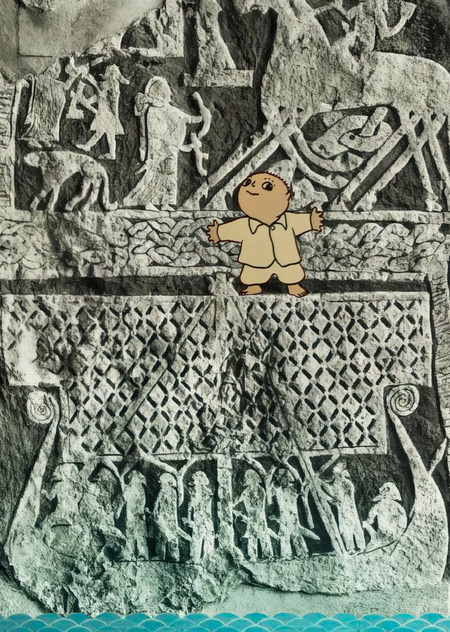
Scandinavian art is characterized by its individuality, expressive, and unique styles. Even today, some artists retain the distinctive traits of the past.
Due to Scandinavia’s unique trajectory, it is particularly fascinating to examine its path through the lens of art, comparing the Viking era (8th–11th centuries) with the contemporary period. It should be noted what is meant by «contemporary»: the starting point for this study is the end of the 19th and beginning of the 20th centuries, because Viking artifacts can be interestingly compared to design objects. This is largely because the word «design» emerged during this time, acquiring its modern meaning, and the «designer» became a distinct profession spreading globally. Furthermore, this topic is relevant because «Scandinavian design» is extremely popular and sought after today, as it combines «…elements of traditional crafts alongside minimalism and functionality» [1]. It is interesting to discover what inspired such a popular art form and how strongly it adheres to past traditions. One of the primary disseminators of «Scandinavian design» to the masses is the company IKEA. Through its interiors, furniture, and textiles, it vividly expresses its core principles: natural motifs and decorative quality.
Norwegian designers followed a distinct trajectory compared to other Scandinavians, showing particular reverence for tradition. Individual artists there—past and present—have drawn heavily from their heritage: for instance, Gustav Gaudernack, David Anderson, and Frida Hansen were inspired by Viking art and even emulated its styles.
Viking styles themselves are highly structured, largely because they are named after the sites where artifacts were discovered. These artifacts share common characteristics that the Vikings preserved for centuries: «animal style» and high levels of ornamentation. This comparative analysis will examine the Urnes, Borre, Mammen, Ringerike, and Oseberg styles. To gather visual material, we utilized various sources, including websites—such as the IKEA site—articles, and social media posts dedicated to different artists, as well as popular online resources focused on Viking Age Scandinavian art.
Based on all the above, the following principle of categorization will be used in this work: first, using examples from Osberger’s artifacts, «Ikea» wooden toys, and Kai Boisen, the «animal style» will be examined—the place of animals in Scandinavian art; then, vegetative motifs will be analyzed through the interiors and products of «Ikea,» alongside the Ringeiking and Urnes styles. Following this, the characteristics of the Viking styles will be described in greater detail, compared with the works of Norwegian designers. Finally, the less popular but significant motif for both periods—the human figure—will be examined, specifically how Scandinavians depicted and continue to depict people. To create the visual research, textual resources and literature matching the following criteria were studied: the articles are in demand within the academic community, have a high number of citations (verified using Google Scholar), the authors' expertise is confirmed, and the articles are timely.
Animal Style
Fragment of a sledge from Oseberg, Norway, 9th century, The Viking Ship Museum
Fragment of an Oseberg ship, Norway, 9th century, The Viking Ship Museum
Carved wooden animal head, Oseberg, Norway, 9th century, The Viking Ship Museum
Artifacts from the Oseberg burial represent the Oseberg style. Like in other Viking styles, it is characterized by high ornamentation and decorative detail. The patterns consist of wavy and intertwined lines that are part of a zoomorphic motif.
Wooden toys by Kai Boisen, Denmark, 20th Century
Kai Boisen’s toys feature strong geometric abstraction; the bodies appear «as if engineered» [4]—they are highly logical and entirely devoid of superfluous detail. Here, similarities and differences between the principles of various eras are visible. For example, much like the Vikings, Kai Boisen employs geometric abstraction and curved, spiral-like lines, yet his toys lack the characteristic Viking ornamentation.
Fragment of a sled from Oldsberg, Norway, 9th century, The Viking Ship Museum
Wooden horse figurines «STOLLE» by Katarina Breeditis for IKEA, early 2000s
Drawing from their background, these horses reference medieval horse figures, yet their incorporation of Viking artifacts shares something in common. Firstly, there is the soft quality of their lines, and secondly, the desire to experiment specifically with animal imagery. These horse figures varied greatly—they featured unique patterns, manes, and tails—which echoes the remarkable animals of the Viking animal style.
Botanical Motifs
Floral pattern on tulle, «Scandi party ready!» collection, «Ikea»
Vegetal pattern on a blanket, «Scandi party ready!» collection, IKEA
«Cosy in the Countryside» Collection, Ikea
Typical Scandinavian interior, «KALLAX» shelving unit, «Ikea»
«A defining characteristic of Scandinavian style, which references the centuries-old traditions of Northern peoples, is its color palette. Like everything else, it leans toward naturalness, lightness, and freshness» [2]. Contemporary Scandinavian interiors are highly minimalist; they are designed to be functional and therefore lack excess. Pastel colors predominate. This austerity is compensated for by plants, which infuse the surrounding environment with freshness and naturalness. Plants are an integral part of the modern Scandinavian style.
Mammen style axe, Denmark, 10th century // Ringerike style weather vane, Sweden, 11th century
Stone from Vanga, Norway, 11th century
Church portal, Urnes, Norway, 11th century
Despite the prevalence of botanical motifs today, they only appeared in Viking art during later styles, gradually beginning with Mammen. Often, plants simply complemented the composition, for example, the serpent tails resembling leaves in the Urnes style.
Motifs of the Past in Contemporary Design
Gustav Gaudernack — Norwegian designer from the late 19th to early 20th centuries.
Tableware, Gustav Gaudernack
Brosh, Gustav Gaudernack
Tea set, Gustav Gaudernack
«Surfaces were covered in dense, intricate ornamentation, which upon closer inspection often resolves into an almost abstract pattern of interwoven beasts—their twisted limbs and bodies coiling and interlocking to form a strict, rhythmic design» [3]—this is the principle the designer draws directly from their ancestors, as that is the core of their intent: to create objects that evoke that era. On their ceramics, they render extremely detailed patterns, with the utensils themselves taking the shape of Viking longships, often featuring an animal head at one end. In their brooches, the artist adheres to the principles of symmetry and ornamentation, positioning animal heads in profile, a characteristic also found in certain Viking styles, such as the Jelling style.