Table of Contents01. Concept 02. «The Black Pearl Curse» (2003). Brig and His Miniature 03. «Ship of Dead Men» (2006). The Ship in Motion 04. «At the Edge of the World» (2007). Three Ships in One Frame 05. «Strange Shores» (2011). The Second Form of One Hull 06. «The Dead Don’t Tell Tales» (2017). The Ship and the Digital Sea 07. What the Ship’s Size Conveys 08. ConclusionBibliography Image Sources
The Gear of a True Crew. Diary of a Ship, Disney, 00:16.
Chasing from the first «Pirates of the Caribbean, ” two ships are visible from above for a few seconds. A strip of water lies between them. Then, the camera descends to the deck, and the same adversary is barely visible behind a wave. From the first shot, it is easy to grasp who is chasing whom. From the second, it is easier to imagine oneself on board. However, neither of these angles alone indicates the actual size of the vessel on the set. What interested me was where the sensation comes from—the feeling that a large, heavy ship actually passed in front of the camera.
Key Question How did the five „Pirates of the Caribbean“ portray the size and heft of a sailing ship when a real ship, a miniature, or a digital model appeared on screen?
Hypothesis I hypothesize that the viewer perceives the ship’s size and weight through various cues. Size is easier to gauge when something familiar is visible nearby—a person on the deck, a row of gun ports, or another vessel in the distance. To sense the weight, motion is more critical. When the bow has turned and a wake from the previous course still trails behind the stern, you can sense how much water was displaced. I expect to see these cues on the real ship, the miniature, and the digital rendering. However, the filming crew’s work changes based on this—in one case, the hull itself generates the wave, while in another, the wave must be added and precisely matched to its movement.
The study encompassed all five films, from the first chase sequence of «Interceptor» in 2003 to the sea battle in the fifth installment in 2017. The second and third parts share a common production background but address different objectives. The second film is interesting for understanding why a working ship was built for «Black Pearl.» The third film allows for an examination of the specific plan and reveals the fate of each of the three ships onscreen. The fourth part ties these stories together: a familiar hull received new gun decks, equipment, and a new name. [3, 9, 10]
How I Deconstruct Shots For each segment, I selected a moment that allows me to answer one simple question: Where does the hull end and the water begin? Is the deck visible next to the person? What indicates the turn first: the bow’s position or the wake’s foam line? In wide shots, I analyze the distance between objects. In close-up segments, I track a single movement from beginning to end. In workshop photographs, I look for a familiar object near the model; it gives an idea of its actual scale.Framing and Cinematography When assessing a ship’s appearance in a film, I cross-reference it with set photographs, artist interviews, and studio analyses. For example, the appearance of the foam in the first chase sequence allows me to deduce the turn of the «Interceptor.» Determining which specific ship was filmed based on that foam is more difficult. For the third segment, I have the artist’s specific commentary on the chosen shot. For the fifth segment, the studio itself documented how the shot evolved during the production. Where such material exists, I correlate it with the finished scene. [1, 3, 4, 6, 7]
Figure 1. Five films and five tasks for a film crew. A diagram by Savely Domanich.
One story unfolds across several films. The «Black Pearl» is shown at the shipyard, retains its recognizable silhouette in the frame, and then the same filming ship falls into the hands of another captain.
Miniature «Black Pearl» in the workshop. Photo from the archive of model maker BATAAN.
Two «Interceptors» In «The Curse of the Black Pearl,» the role of the «Interceptor» was played by the working brig Lady Washington. It also had a reduced twin. ILM artist Hal Hickel recalled that models of three ships were built for the film. Therefore, the photos from the set are especially interesting: they show how differently the two «Interceptors» looked next to people. [1, 2, 6]
Figure 2. The brig Lady Washington at the pier. Diary of a Ship, materials for the first film, 00:24.
In the harbor, you can estimate the size of the crew by looking at the structures at the pier. This reference disappears out at sea. However, next to the sail, you can see a person. Based on the small portion of the canvas they occupy, the scale of the rigging becomes clear.
Figure 3. A person by the sail aboard the Lady Washington. Diary of a Ship, 02:32.
On the hoisted sail, both taut and slack sections of the fabric are visible. These reveal the direction from which the wind is blowing. The dark mast behind the fabric remains straight and helps to notice even a slight curve.
The Chase Verbinsky depicts the distance twice. First, we see both ships on the open water simultaneously. Then, we find ourselves behind the rigging on the deck of one of them.
Figure 4. «Black Pearl» and «Interceptor, ” top view. „The Curse of the Black Pearl, ” 2003. A segment of a chase, 01:45.
Light water flows over the dark hulls from above. Even the bows are discernible against its backdrop. There is still ample space between the ships for maneuvering.
Figure 5. Enemy in the smoke, view from the deck. «The Curse of the Black Pearl, ” 2003. Chase excerpt, 01:51.
From the deck, the same stretch looks different. Nearby rigging crosses the frame, and the distant hull is almost swallowed by smoke. Distance must now be estimated based on the waves between the camera and the target.
Model before and during filming The miniature of the «Interceptor» features masts, rigging, and canvas sails. While in the workshop, it easily resembles a real vessel if one only looks at the sky behind the masts. The model looks different in the water. In the image on the right, the spray rises higher than the gunwale. A green screen is visible behind the ship. [7, 13]
Figure 6. On the left, the «Interceptor» model next to a person; on the right, a close-up shot of a miniature on the water in front of a screen. Photo by BATAAN and an illustration from an interview with Lorne Peterson, fxguide.
In the image on the left, a person stands between the masts. Their head is almost level with the lower boom. The human figure is no longer visible on the right, but small splashes and splinters can be seen instead. If we mentally remove the green background, the eye begins to judge the model’s size based on entirely different details.
Figure 7. «Interceptor» changes course. «Curse of the Black Pearl, ” 2003. Motion fragment, 03:33–03:35.
During the turn, the bow shifts first. A white wake line remains behind the stern, and you can still see the path the brig took a second ago.
This maneuver has a duration and a length. When the port side passes the second ship, the turn is still ongoing. It is this delay that conveys the sense of the hull’s mass.
What was determined Both a full-scale rig and its miniature were used for the film. Based on the available materials, I was unable to determine which version was used in each of the chase sequence shots. The photograph shows the model’s setup, while the film clip allows for observation of the maneuver itself. [1, 6, 13]
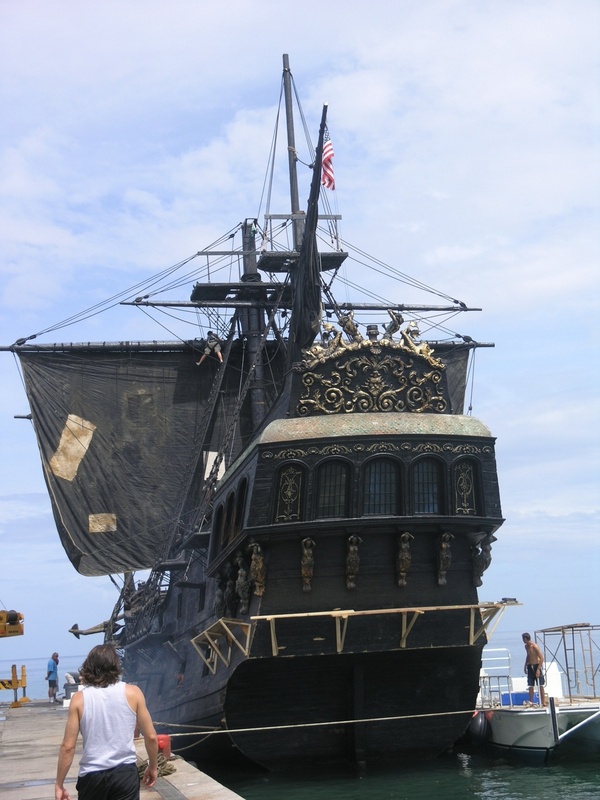
Rowan Byrne in «The Black Pearl.» Author’s archive, Dominica, 2005.
Why Did the «Black Pearl» Need an Engine? For the first film, a tugboat was used to pull the «Pearl» set. For the second film, Verbinsky wanted to shoot a scene where the bow of the ship would raise a wave on its own as it moved. The designers had to build the vessel entirely anew. Inside the familiar black hull, they concealed the steel supply ship Sunset, which featured two diesels. It was capable of sailing on its own power. [9]
Figure 8. Full-scale «Black Pearl» on the water near Dominica. Rowan Burn, filming for Parts Two and Three, 2005.
The photograph by Rowan Byrne shows almost the entire port side of the «Pearl.» The stern rises on the right, while the bowsprit extends far to the left. The sails are stowed, and the open sky is visible beyond the masts. From this shot, it is impossible to tell if there is an engine inside. But it is clear what silhouette the artists retained from the first film. [9, 14]
Figure 9. Kraken smashing the merchant ship «Edinburgh.» The name is still visible on the stern. «Dead Man’s Chest, ” 2006. Walt Disney Pictures Gallery.