Christianity and Islam are religions quite distinct in terms of aesthetics and traditions. However, they share common roots and were quite similar in their early stages. It is particularly interesting to examine their relationship through the lens of architecture.
Islam, as the youngest of the Abrahamic religions, boasts a strikingly rich and diverse architectural heritage that rivals the scale and significance of monuments from other faiths. Studying Islamic architecture allows one to trace the evolution of urban planning principles, construction technologies, and decorative traditions. Architectural forms within the dynamic history of Islam shifted according to the historical period, the type of structure, geographical location, and socio-political conditions. Of particular interest is the interaction between Islamic architecture and other cultures—for example, the Christian world, particularly Byzantium, whose architectural traditions were vividly reflected in the formation of the already unique Islamic architectural style.
This study is relevant because it allows us to trace the historical contacts and cultural exchange between the societies of the two most prevalent religions today: «the actual volume of Muslim culture is significantly greater than generally assumed, and <…> early Christian culture is its early stage» [8]. Analyzing the similarities and differences in architectural styles, technologies, and symbolism reveals both common traits—such as the use of domes, arcades, and symmetry, and the striving for the sublime—and unique features tied to cultural traditions. Furthermore, this comparative analysis will enrich the understanding of both religions and their cultural influence.
This study will trace the evolution of sacred space in Islam, beginning with the earliest constructions and progressing to medieval variations that diverge according to region. Key features of Desert Palaces and Mosques will be analyzed, alongside the placement of anthropomorphic imagery and the primary distinctions between Christian and Islamic architecture. Accordingly, the work will employ the following organizational principle: it will first examine early Muslim architectural structures—the so-called Desert Palaces; then, it will analyze a crucial period in Islamic history—the Fatimid Caliphate; after that, the focus will shift to medieval architecture, specifically examining various mosque types in sequence: Arabic, Iranian, and Turkish; finally, the last section will directly compare medieval mosques and Christian sanctuaries from the perspective of spiritual and spatial coordinates.
The visual research incorporated materials from open sources: photographs of Islamic and Christian architecture, as well as drawings and building plans. Various textual resources and literature were also examined. The sample was selected considering article citation (verification was performed using Google Scholar), the authors' expertise, and the relevance of the articles.
Early Period Architecture: Desert Palaces
Qasr Harana, 8th Century // Qusair-Amra, Early 8th Century // Qasr al-Azraq, 8th Century
Desert Palaces—unique Muslim structures built during the Umayyad Caliphate (661–750)—date back to ancient times when Islam, as both a religion and a body of philosophical teachings, was just beginning to develop and spread globally. Regarding the purpose of constructing these Palaces, researchers offer three theories.
Kharana Castle, 8th Century
Firstly, the desert palaces may have served as staging points, and they frequently did function as caravanserais. Secondly, there is a theory that some palaces were used as defensive structures. However, in the case of Al-Harana Castle, for example, there is ongoing debate: some researchers suggest that the narrow vertical slits could have served as arrow slits, but «art historians disagree with this hypothesis, believing the slits in the walls are too high and narrow for arrow slits and suitable only for admitting light and… natural ventilation» [2]. Thirdly, some of the desert palaces may have been not only places of leisure and entertainment but also venues for Umayyad negotiations with desert Bedouins.
Kharana Mosque, 8th Century
Qasr Harana, 8th Century // Upper Floor Plan of Qasr Harana, 2003
Plug with a motif of a tree or alternating leaves from Kasr Harana, early 8th century
Among the architectural and decorative features of Al-Khara, notable elements include the abundance of arches, the frequent use of semicupolas, and the ornamentation of walls with intricate patterns and carved tiles. Furthermore, the overall spatial composition is intriguing—a perfect square framed by semicircular protrusions and rounded towers. It is believed that Iranian and Mesopotamian traditions form the basis of this architectural structure.
Kusair-Amra, early 8th century
Kusayr-Amra, Calderium Dome, early 8th century // Church of St. Irene, 4th century
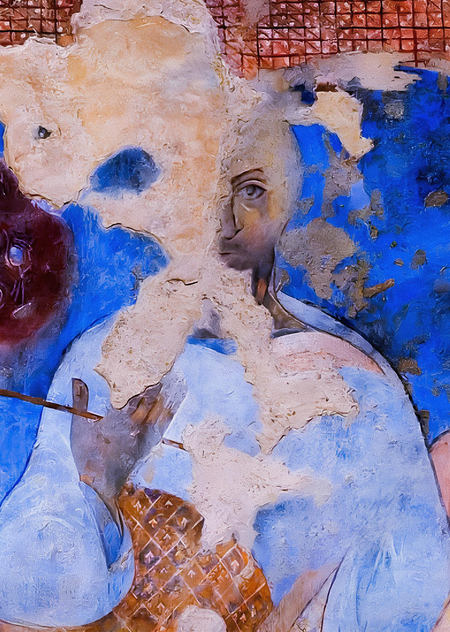
The most interesting and unique palace is the Kuseyr-Amra Palace («The Princess’s Castle»). It was originally «a combination of an entertainment palace, a fortress, and a bathhouse» [2]. The bathhouses descend from Roman and ancient models, while the rest of the architecture and decoration shows influence from Persia and Byzantium: it features a dome with a drum according to its canons, and—a remarkable feature for Islamic art—vivid murals.
Kusair-Amra, Fresco, 8th Century
Kusair-Amra, Fresco «The Six Kings, ” 8th Century
Kusair-Amra, Fresco with a hunting scene, 8th century
Kusair-Amra, Fresco of Caliph Al-Walid II, 8th Century
Kusair-Amra, Fresco of a Bathing Woman, 8th Century
Kusair-Amra, Fresco, 8th Century
Muslims have always held a highly ambivalent view of anthropomorphic imagery. On one hand, there was no direct prohibition against it, but on the other, they were most often criticized because the Hadith states: «Gabriel appeared to me and said, ‘We angels will not enter a house that has a dog, a depiction of a body (statues and pictures), or a house where there is a urinal’» (Biharul Anwar, Vol. 73, p. 159).
«Gay and Sea Centaurs, ” Floor Mural, Kasr al-Khair al-Gharbi, 727 // „Musicians and the Rider, ” Floor Mural, Kasr al-Khair al-Gharbi, 727
Anthropomorphic figures were not unusual in the Palaces of the Deserts. In fact, these works even feature sculpture.
Sculptural Relief, Kasr al-Khair al-Gharbi, 8th Century
Alhisham Palace, Male figure with a sword standing in a niche above the bathhouse entrance, 8th century // Semi-nude female figure, 8th century // Example of carved stucco, 8th century
When constructing the Desert Palaces, the rigid frameworks found in mosque construction were absent. They were created to please the eye, lacking any sacred meaning.
Although the Desert Palaces existed only during the reign of the Umayyad dynasty, anthropomorphic themes accompanying the architecture were present not only at that time.