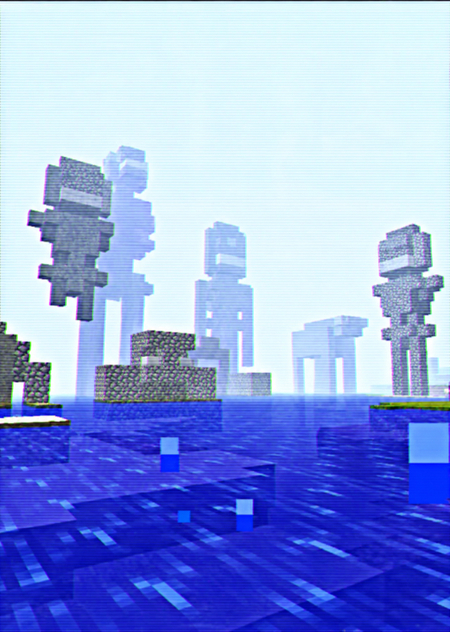
Minecraft has long evolved beyond just a game to become a space for crafting terrifying narratives. Over the years of the game’s existence, the ways fear is depicted have noticeably shifted: where horror stories once centered on enigmatic characters and urban legends, today the creation of anxiety can stem from a strange structure, an inexplicable change in the landscape, or the feeling of being watched by an unseen presence.
The familiar gaming world has gradually transformed into a space where conventional rules cease to apply, and the source of threat becomes increasingly difficult to pinpoint.
Early Minecraft horror games largely relied on creepypastas and urban legends where fear was tied to the appearance of a specific creature. In modern ARGs (Alternate Reality Games), the threat is increasingly becoming abstract. Unknown entities can warp space, disrupt game mechanics, and affect the world itself while remaining invisible to the viewer.
Fear arises not so much from the monster’s appearance, but from the inability to grasp the nature of what is happening.
However, contemporary Minecraft ARGs are interesting for more than just a change in the visual depiction of the threat. Behind the supernatural events and intricate puzzles often lie profoundly human experiences: loneliness, depression, loss, the disappearance of a loved one, and the fear of the unknown. Through these in-game spaces and inexplicable phenomena, such stories can engage with deeper questions about life, death, memory, and the human condition.
How have visual methods for generating fear in Minecraft horror games evolved, and how has the familiar gaming environment become a tool for depicting not only supernatural but also personal, psychological, and existential fears?
At the core of this research are Minecraft horror games on YouTube—from early creepypastas about mysterious creatures to modern ARGs (Alternate Reality Games) with intricate plots and hidden puzzles. Comparing these forms helps us understand how the methods of frightening the viewer have evolved over time. Special attention is paid to how the game itself aids in generating fear.
Dark caverns, empty spaces, strange structures, unexplained events, and creatures that cannot be discerned transform the familiar world into something frightening.
Mysteries and hidden messages are examined separately, including their parallels to the internet phenomenon Cicada 3301. Narratives that conceal human fears—loneliness, loss, helplessness, and the unknown—behind supernatural events are also explored. Clips from various videos are used for comparison to analyze how the ordinary world of Minecraft transforms into a horror experience through lighting, color, composition, and the design of the game space.
In the first chapter, «The First Fear in Minecraft,» we explore early internet legends, the emergence of initial terrifying characters, and the nuances of their visual representation. Next, the chapter «Evolution and Creativity» shifts focus to contemporary Minecraft horror, where familiar monster imagery is replaced by unknown entities, visual anomalies, and violations of game rules. The third chapter, «Cicada and Minecraft ARG,» is dedicated to the evolution of internet puzzles and their application in modern horror narratives. Using Cicada 3301 as an example, the chapter examines methods of encrypting information and involving the viewer in an independent investigation. In the concluding chapter, «Existentialism and Human Fears,» we investigate how themes of loneliness, loss, depression, and the fear of the unknown lie beneath supernatural events, with in-game imagery becoming a medium for contemplating human existence.
The research utilizes textual sources dedicated to the history of Minecraft horror, internet folklore, creepypastas, ARGs, and visual methods of generating fear. Particular attention is given to materials concerning the origins of early in-game legends, the evolution of internet mysteries, and the changing depiction of threat in the digital environment. Furthermore, studies on psychological and existential horror are examined to explain how uncertainty, the disruption of established patterns, and a sense of helplessness provoke anxiety. Special focus is placed on the connection between supernatural imagery and human experiences, such as loneliness, depression, and loss. When selecting sources, their credibility, relevance, and thematic alignment are considered. Textual materials are used to grasp the historical and cultural context, as well as to interpret the visual techniques presented in the works under review.
How have the visual methods of generating fear in Minecraft horror games evolved, and how has the very concept of what can frighten a player or an audience member changed?
If Minecraft horror games used to rely primarily on specific monsters and enigmatic characters to instill fear, modern ARGs are increasingly generating dread through the unknown, the violation of game rules, and the palpable sense of something incomprehensible being present. Beneath these supernatural events, however, may lie entirely human anxieties: loneliness, loss, depression, and the fear of the unknown.
I. The First Fear in Minecraft
Minecraft is difficult to categorize as a horror game, yet scary stories have become part of its culture almost from the beginning. The vast, virtually endless world, the empty spaces, the dark caves, and the absence of other players created a sense of isolation. This was especially true in early game versions, where the limited rendering distance shrouded the surrounding world in a dense fog. Even without monsters appearing, the familiar environment sometimes felt unsettling, as if someone else were present. One of the most famous internet legends is Herobrine, who appeared in 2010. According to the creepypasta, he was the deceased brother of Notch, the creator of Minecraft, whose ghost inhabited the game. He looked like an evil doppelgänger of Steve with completely white eyes, appearing in single-player worlds, observing players from afar, and leaving behind strange structures. Naturally, the story was fictional, but it was presented as a real event.
Fear was built on the simple violation of established rules: in a solitary world, there should be no other person.
In the initial screenshots, Herobrine was barely distinguishable among the trees and fog, as if he had stumbled into the frame accidentally. It was this inconspicuousness that made the image convincing and compelled viewers to examine the ordinary in-game landscape closely.
Later, other legends emerged. Null was a completely black humanoid figure, which in different versions of the story was linked to glitches and corrupted versions of Minecraft. His appearance was accompanied by strange messages, disappearing objects, and game malfunctions. Unlike Herobrine, Null was frightening not so much because of his human likeness, but because of the lack of recognizable features—he looked like a void or an error that had taken human form.
Entity 303 was another well-known creepypasta character, dubbed the new Herobrine. Legend has it that a former Mojang employee lurked behind him, seeking revenge against the developers and players. He would infiltrate other worlds, destroy structures, and corrupt game files. His appearance—a white hood, a hidden face, and red eyes—lent him the look of a traditional villain.
All these stories spread by word of mouth—through forums, player anecdotes, screenshots, and staged videos. Each new tale added to the legend, and the images served as a kind of evidence for the characters' existence. Moreover, the creatures didn’t necessarily have to attack the player. It was enough to see an unfamiliar figure or discover traces of someone else’s activity.
However, it wasn’t just the characters that were frightening. The fog, the darkness, the empty spaces, and the strange sounds already created an unsettling atmosphere in Minecraft. Internet legends only added a sense of an alien presence to it. Ordinary caves or forests began to be perceived differently because the player accepted that something unknown might be lurking just out of sight.
Thus, early Minecraft horror games were built not on complex visual effects, but on the appearance of alien creatures, subtle changes to a familiar world, and a pervasive doubt about its safety. This very principle later evolved in modern ARG (Alternate Reality Games), where the source of fear is not just a mysterious character, but the game world itself.
II. Evolution and Creativity
Over time, Minecraft horror narratives have moved beyond stories involving enigmatic characters. The game world itself has become the source of fear—it features impossible spaces, violates conventional rules, and unknown forces can interfere with events. This is particularly evident in contemporary Minecraft ARGs.
Here, the viewer doesn’t simply observe the collision between the player and the monster; they gradually unravel the mystery through video logs, hidden details, and unusual occurrences.