Navigation
1. Visual Research Concept
2. Introduction
3. Chapter 1. Sample: State Apotheosis
4. Chapter 2. The Chariot Between Worlds
5. Chapter 3. Myth as a Mirror of Fate
6. Chapter 4. Gryphon, Garland, and the Language of Sides
7. Chapter 5. Victory and Valor
8. Chapter 6. From Myth to Scripture
9. Conclusion
Visual Research Concept
Basis for Topic Selection
The choice is motivated by my interest in the afterlife. Initially, I intended to take a broader topic, comparing the decoration of sarcophagi in Ancient Rome and Egypt. However, while studying the material, I discovered the term «apotheosis» (from Greek ἀποθέωσις), meaning «deification.» It was this word that prompted me to narrow the topic to Roman sarcophagi from the 3rd century CE. The research examines the Roman sarcophagus not as a container for a body, but as a monumental image that communicates with the tomb visitor. The visual analysis focuses on how the posthumous image of an individual, equated with gods and heroes, is constructed through the marble relief. The methodology is based on analyzing compositional diagonals, figure scale, the semantics of attributes, and the texture of the marble.
Basis for Region Selection (Ancient Rome)
Roman funerary culture left behind the largest collection of commissioned sculptural images: sarcophagi for inhumation were widely used in the Empire starting in the 2nd century, and Roman workshops were active around 110–120 AD. Most Western Roman sarcophagi were placed in mausoleums against a wall or in a niche, so the carving appeared on the front face and on two ends. Relatives and tomb visitors could see them, and thus the sarcophagus functioned as a means of social communication: the Roman mentality, obsessed with memoria (memory) and dignitas (dignity), demanded that a person’s status not be forgotten even after death.
Rationale for choosing the chronology (3rd Century AD)
The 3rd century was an era of political and economic crisis marked by the «soldier emperors.» The genre of sarcophagi predates this crisis, which I view instead as the backdrop against which the themes of conquering death and personal dignity resonate. Furthermore, the 3rd century is a period where mythological narratives, intricate reliefs, scenes of valor, and decorative garlands coexist, and by the end of the century, a transition toward Christian repertoire begins. The overarching scholarly framework involves the debate over the depth of meaning embedded in these mythological images: whether they functioned as symbols of afterlife hope, indicators of status, or mere conventional motifs.
Material Selection Principle
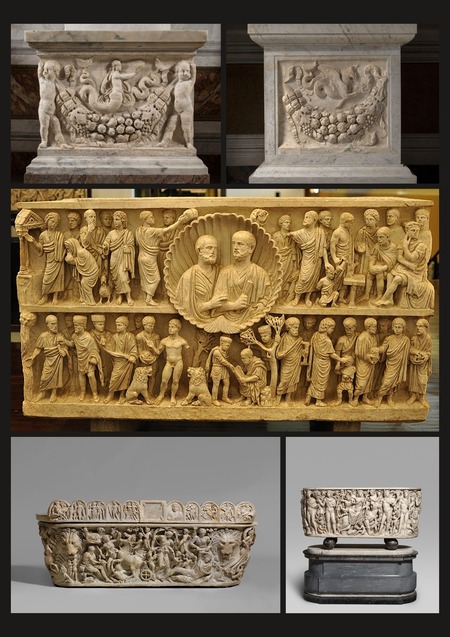
The primary material consists of 3rd-century sarcophagi with confirmed dating in museum catalogs. These pieces feature good preservation of the relief, allowing for analysis of figure plasticity, drapery, and gestures, and are accompanied by high-quality photographs. For contextual reference, three benchmark objects outside this century have been included: a state example of apotheosis (161 AD), the Borghese garland sarcophagus (130–150 AD) as a starting point, and the «Two Brothers» sarcophagus (circa 325–350 AD) as the endpoint of the evolution.
Principle of Selecting and Analyzing Textual Sources
The core of this list comprises museum catalogs and encyclopedic articles from major museums, an open monograph on the myth of Roman sarcophagi, a popular science journal on imperial apotheosis, and the primary source («Iliad»). Wikipedia was used solely to describe the Aachen sarcophagus and the Ludovisi sarcophagus as a supplementary source, with verification against museum records.
Hypothesis
Private sarcophagi from the 3rd century do not overtly display state apotheosis. Instead, they translate its language—chariots, eagles, Nike, the celestial cycle—into mythological analogy: the deceased’s fate is likened to that of a god or hero, in the spirit of the Courtboyan approach. This is just one way to address death; alongside it are demonstrations of valor and decorative motifs. By the 4th century, the same format begins to incorporate Christian narratives.
Key Question
How do compositional and plastic solutions translate the social status of the deceased into a language of the divine and heroic, and how does this visual formula change by the 4th century?
Introduction
In Roman culture, the word «apotheosis» describes two distinct phenomena. The first is a state act: after death, an emperor and his family members were deified (consecrated), and society witnessed this transition in rituals, on coins, and monuments. The second is a private practice without legal basis: the deceased’s family commissioned a sarcophagus whose imagery compared their fate to that of a god or hero. In the 3rd century, this second practice is particularly rich because Rome’s marble workshops had been operating for over a hundred years, accumulating a repertoire of subject matter.
It is crucial not to exaggerate what can be proven. In the material under review, the deceased is not depicted rising in a chariot; chariots are driven by gods, and the portrait of the deceased is located on the lid, in a medallion, or set apart from the myth. The connection between them is established by analogy, and it is this mechanism that transforms the sarcophagus from a mere container into an image addressed to the tomb visitor. The crisis of the «Age of Soldier Emperors» serves as a backdrop—it explains why the theme of victory over death sounds louder, but it does not explain the origin of the genre itself.
Chapter 1. Sample: State Apotheosis
To understand what the private sarcophagi depict, it is useful to see the official formula. Based on the column of Antoninus Pius (161 AD, Vatican Museums), the apotheosis scene shows the emperor and Faustina, who are carried to the sky between two eagles by a winged genius often called Aeon. The emperor holds a scepter with an eagle, and below sit personifications of the fields of Mars and Rome. Two other sides of the base are dedicated to the ritual circuit of mounted warriors (decursio), and the fourth bears an honorary inscription.
Fig. 1. Base of the Column of Antoninus Pius, apse side. 161 AD. Marble. Vatican Museums.
The visual elements of this scene are easy to list: the verticality of the rising figures, the diagonal of flight, a clear hierarchical scale (the gods and geniuses are larger than the earthly personifications), and the collection of attributes (eagle, scepter, wings). This is not a sarcophagus or a private commission, but a monument to heirs. Therefore, it does not prove direct borrowing, but it does reveal the language the state used to discuss apotheosis and the language by which private images of the 3rd century are being compared.
Chapter 2. The Chariot Between Worlds
On private sarcophagi, the chariot becomes a symbol of boundary. On the sarcophagus depicting the abduction of Persephone from Acheron (Rome, early 3rd century BCE, Carrara marble), Hades escorts the goddess into the underworld on a quadriga driven by Hermes. Cerberus, the giant Enceladus, the nymph Kyane, and Demeter are depicted nearby on a chariot harnessed to dragons. The composition is structured on diagonals and a dense filling of the relief: the figures are crowded, and deep undercutting creates a contrast of light and shadow. Here, the quadriga carries not the deceased, but a tragedy that, within the funerary context, transforms into the language of death as a transition.
Fig. 2. Sarcophagus depicting the abduction of Persephone («Sarcophagus of Proserpina»). Rome, first quarter of the 3rd century CE. Marble. Aachen Cathedral Treasury.
The Sarcophagus of Ariadne (Metropolitan Museum of Art, early 3rd century, Inv. 47.100.4a, b) constructs a different narrative. On the front panel, Selene descends from her chariot toward Endymion, who is granted eternal youth and eternal sleep. The ends depict Helios ascending in his chariot and Selene descending in hers. Ariadne’s portrait is carved onto the lid just to the right of the inscription, and her daughter commissioned the sarcophagus. Thus, the deceased does not participate visually in the myth but is connected to it thematically: the celestial cycle speaks to the constancy of nature, and Endymion achieves «realization through eternal sleep.»
Fig. 3. Sarcophagus of Ariadne with the myth of Selene and Endymion. Early 3rd century CE. Marble. The Metropolitan Museum of Art, Inv. 47.100.4a, b.