Кадр в кадре
Генезис архитектурной рамы и границ образа в искусстве до XIV века
Categorization
I. Prologue
II. Before Entering the Frame
III. The Line of Order
IV. The Absent Window
V. The Threshold
VI. The Rule of the Frame
VII. Epilogue
I. Prologue
The word «frame» suggests a wooden molding around a canvas painting, and such objects were almost nonexistent in art before the 14th century. However, the boundary of an image has always existed—the line of earth beneath the figures, a frieze, an arch above their heads, the edge of a stele, or the profile of an archivolt. This work poses the question differently: not «what frames the image?» but «who has the right to cross its boundary, and what do they have the right to cross?»
Zwimmel described the frame in 1902 as an act of separation1: the artwork becomes a self-contained world. Shapiro demonstrated that the field and boundary of an image are not given, but a historical decision that each culture makes in its own way2. The three cases we will examine offer three different answers. In the Mesopotamian register, the boundary establishes a hierarchy. In the Pompeian fresco, it masquerades as architecture, creating an illusion of depth. In the Romanesque portal, it aligns with the actual threshold: beneath the tympanum, a person literally passes from one world into the sanctuary.
But every border has its own history of transgressions. It is the glitches—not the rules—that show what was intolerable or unacceptable for that era to contain within.
II. Before Entering the Frame
What Constrains
Register— the horizontal band in which figures are arranged. Ground line— the horizontal upon which they stand; in Egypt and Mesopotamia, it is simultaneously the floor and a sign of order. Frieze— a band of scenes or ornament that repeats along the wall. Field and support— a pair by Meyer Shapiro (1969): the support is the material surface, and the field is what culture has chosen to consider the space for the image2; they do not always coincide. Parergon— Derrida’s (1978) term for what is neither inside nor outside the work: a frame, a signature, a column3.Containment and Projection
Nais — a small building with columns and a pediment, which houses a statue or depicts the deceased. Clipeus — a round shield, or an *imago clipeata* in Roman art—a portrait in a circle. Nimbus — a circle of light around the head. Mandorla — an oval of light surrounding the entire figure; in Christian art, it signifies a divine manifestation. Tympanum — the semicircular area above a doorway. Archivolt — the arched framing of a tympanum. Trompe — the central column of a portal. Arcade — a series of arches resting on columns, which in manuscripts and sarcophagi evolved into compartments for scenes.God descends into the scene. The King emerges from the register. The text cuts through the bodies. The spectator reaches out to the painted curtain. The figure moves from the wall onto the column. There is always a direction at the boundary—top to bottom, inside to outside, outside to inside. Distinguishing these directions is more important than noting the breach itself.
Five Types of Failure
This catalog will be a working tool throughout your entire process. Out of field: part of the figure extends beyond the boundary. Overlap: a foot, wing, or leaf rests on top of the frame. Scale breach: the figure is so large that it ignores the register. Medium breach: text or another material cuts through the image. Frame within a frame: a second element, constructed architecturally, appears inside the image. Counterbalance to the list: Henri Focillon and Jürgys Baltušaitis described the «law of the frame, ” where the figure compresses and bends to fit within the boundary4, 5. Sometimes the frame is not violated, but rather shapes the figure.What Constitutes Evidence
It is easy to succumb to the aesthetically pleasing narrative here. A wing might have broken off the edge because the cutter lacked material. Lost paint could have «completed» the boundary. Therefore, every case has an assessment of intent.
High: there is a system, repetition, or period texts. Medium: the technique is repeated, but no sources are available. Low: it is a singular occurrence; a simple calculation may be possible.
III. Lineage of Order: Mesopotamia and Egypt
Horizon
The first boundary in the history of the image was not a frame, but a horizontal line. Figures stand upon it, and it keeps them in order. Mesopotamia and Egypt developed two variations on this single idea. In the Fertile Crescent, the line divides the stele into registers, and the order is read upward, like floors. In Egypt, the earth is below, the sky is above, and the image exists between them as part of the cosmic order. There is no frame because there is no need to separate the image from the world—the image itself is the world in miniature.Standard from Ur. Circa 2600–2400 BCE. Wood, shell, lapis lazuli, red limestone, bitumen. British Museum. Source: Wikimedia Commons.
On the «martial» side of the standard, there are three registers from Ura. At the bottom, a chariot treads upon enemies; in the middle, infantry escorts captives; and at the top, the Tsar stands surrounded by servants, his head rising above all others to the very top edge. The conventional way to read it is from bottom to top—from chaos to order: thus, victory is structured vertically. But one must specify. The proper way to interpret the standard is still debated, and the reconstruction of the object, from which only inlays remain, is questionable.
Boundary: register.
Who crosses: no one, the king’s head touches the top.
Intent: moderate, fixed as a rank scale.
It’s tempting to call the register a montage device, as if the stripes were film frames. This metaphor is useful, but misleading. Registers are not required to be sequential in time: the lower register might depict something that happened simultaneously with the upper, or even later. Iren Winter, a researcher of ancient Near Eastern imagery, suggested reading them immediately as a logic of rank and space10. For us, the register is primarily a means of indicating who is superior.
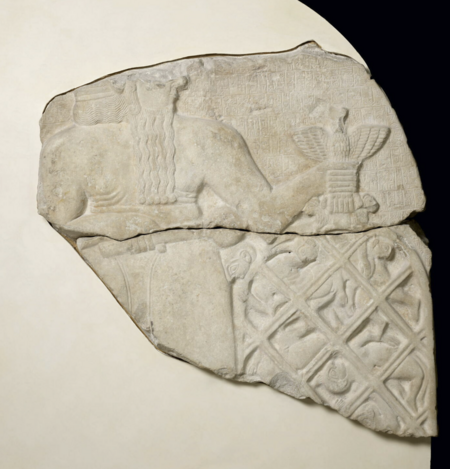
On the Steller Plate (c. 2450 BCE, Louvre), King Annatum fights the neighboring city, and the god Ningirsu secures victory on one side. He is immense, dominating the entire field, while tiny captives squirm within the net held in his hand. There are no registers here; the god’s scale has negated them. This is the first response to the work’s question. The deity crosses the boundary not with a foot, but with sheer scale, and everyone else finds themselves within his gesture.— Image: Korshunov Stele. c. 2450 BCE. Limestone. Louvre, Paris. Source: collections.louvre.fr.
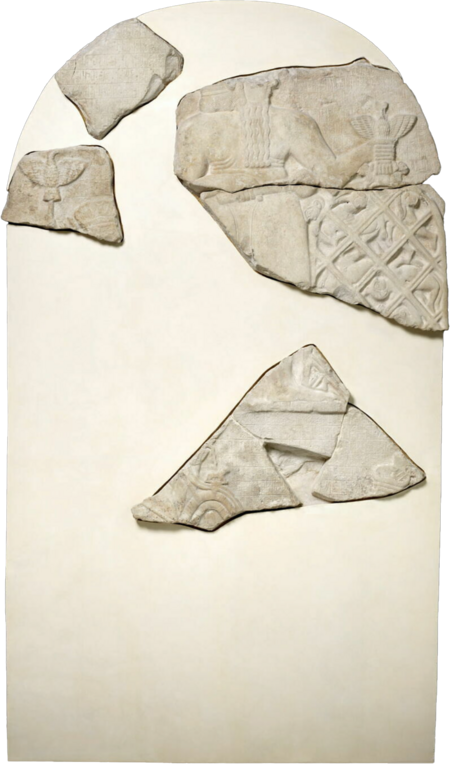
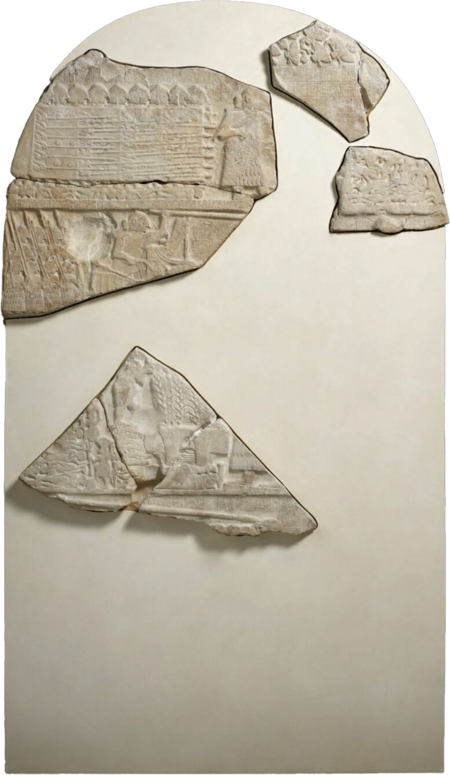
Stela Korshunov. c. 2450 BCE. Limestone. Louvre, Paris. Source: collections.louvre.fr.
Boundary: case.
Intersects: form, scale.
Intent: high.
On the Code of Hammurabi stela (Louvre, circa 1792–1750 BCE), an image (or perhaps a depiction?) occupies the upper portion, functioning like a title letter for the law. The King stands before Shamash, the god of justice, and there is no register or barrier between them—both are on the same ground, face to face. The rest of the space is dedicated to the text. The image here is not the main focus; it serves to authenticate—it shows who the following words originate from. The boundary of the image aligns with the division between the testimony and the document.
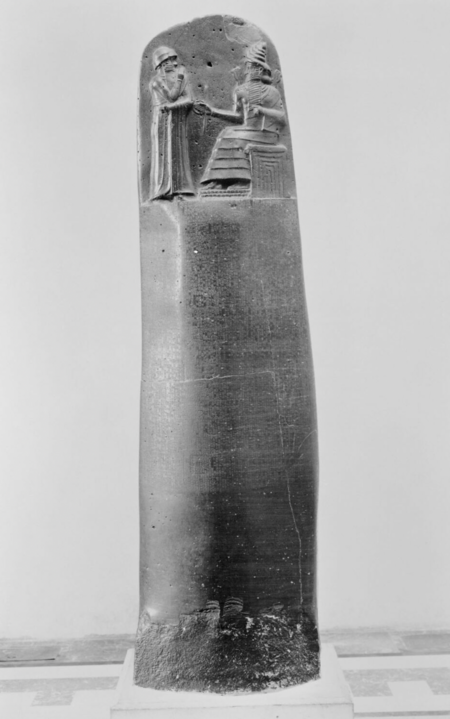
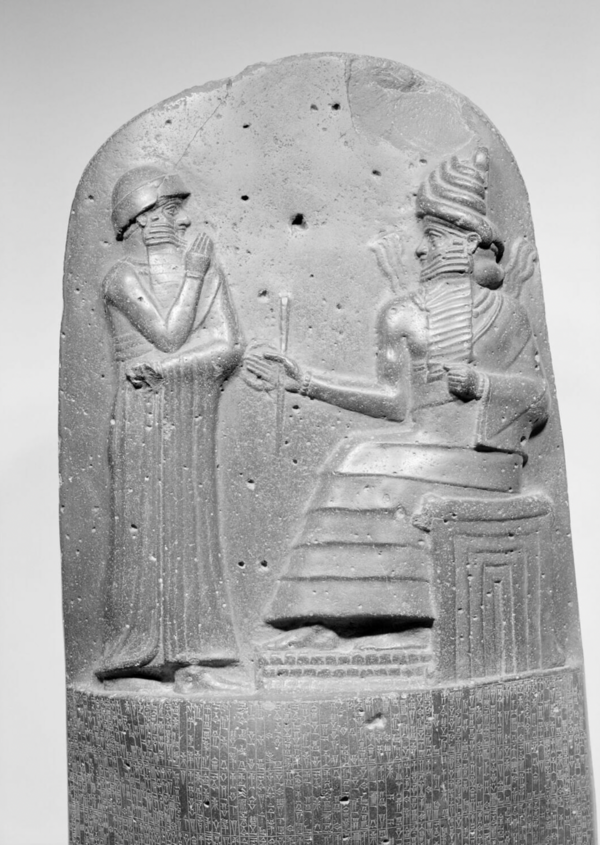
Stele of Hammurabi, upper section: the king before Shamash. Babylon, c. 1792–1750 BCE. Louvre, Paris. Source: collections.louvre.fr.
Around 2250 BCE, the Akkadian king Naram-Sin commissioned a stele celebrating his victory over the Lullubi mountain tribe, and the artisan rejected what was considered conventional. There are no registers. The army climbs the slope diagonally, the enemies fall beneath their feet, and at the very top of the field stands the king. Above his head are two stars—the sky enters the frame as a participant. The diagonal achieves what the horizontal could not: it depicts the path to the gods as motion rather than as a position in a line.
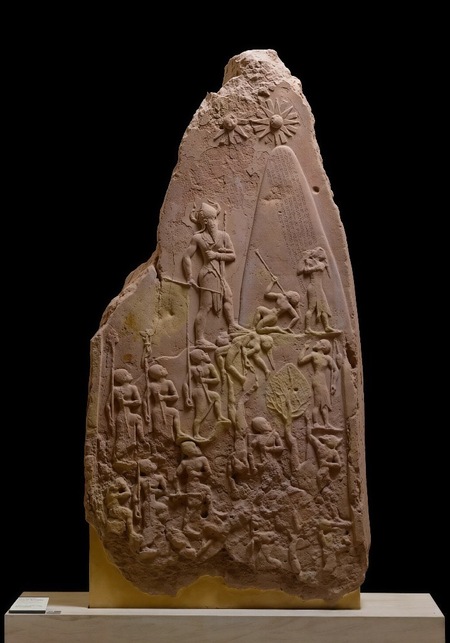
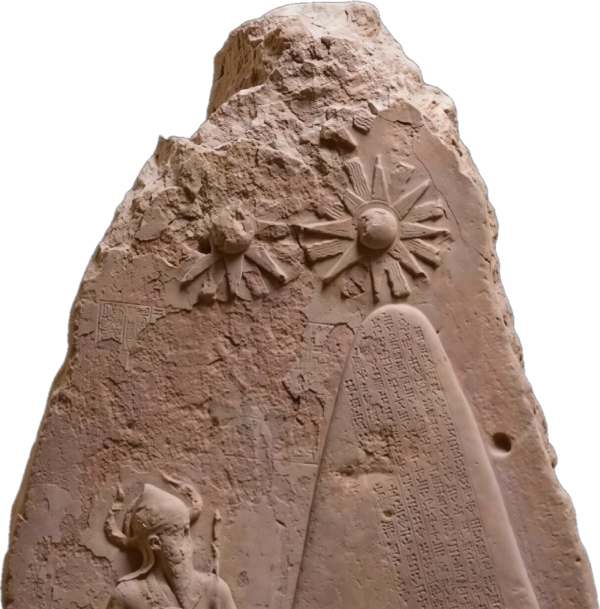
Victory Stela of Naram-Sin. Susa (found), Akkad, c. 2250 BCE. Pink sandstone. Louvre, Paris. Source: collections.louvre.fr
Boundary: field of a stela instead of registers.
Crossing: a king ascending toward the sky.
Intent: elevated, with a systemic rejection of registers.
On the Narām-Sîn stele, the king wears a horned helmet, a symbol of divinity. According to sources, he was the first Mesopotamian king to be deified during his lifetime. The correspondence of form and content here is almost literal: the human transforms into a god, and the register that maintained everyone in their place ceases to be necessary. Centuries later, in the 12th century BCE, the Elamite king Shutruk-Nahunte carried the stele to Susa as a trophy and added his own inscription to it. Thus, on the field of victory, a new hand appeared: an alien text became the final boundary the image endured.
Narām-Suen in a horned helmet and a late Elamite inscription on the same field. Detail of a victory stela. The Louvre, Paris.