Navigation Menu
[1] Concept [2] Biographical and Historical Context [3] Illustrative Sequence [3.1] «Smiling People» [3.1.1] «Average People» [3.2] «Believing People» [3.3] People Armed with Rifles [4] Conclusion [4.1] Prospects for Further Research [5] Bibliography [6] Image Sources
Concept
«A photograph becomes a document when it captures not only the external appearance but also the spirit of the times.»[1]. — John Berger

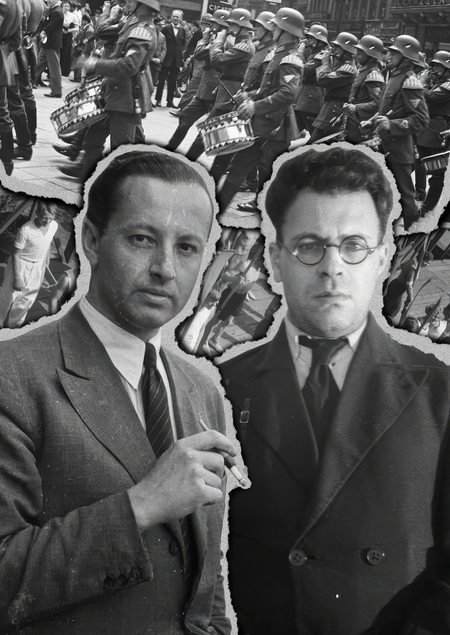
Evgeny (1896–1938) and Yakov (1903–1941) Henkin are the names of photographer brothers who have only recently entered history as «the Henkin Brothers.» During their lifetimes, they hardly sought fame through their photographs and may not even have considered themselves professional photographers. Their work, accidentally discovered more than half a century later, unveiled to the world a unique perspective on the 1920s and 1930s—the everyday life of Leningrad and Berlin, the faces of ordinary people, and street and domestic scenes.
The Henkin Brothers earned recognition not for their technical skill, but for venturing beyond the ordinary. Their photographs—amateur shots, which means they are sincere and devoid of staging—reflect a deep sensitivity to the human soul. The brothers' creativity is an art expressed through the emotions with which they approached their subjects and landscapes. In an era dominated by propaganda and bombastic imagery, their work stands out for its intimacy and truth, offering a rare glimpse into the essence of society during its transformation.
Yakov and Evgeny Henkin
Henkin—a symbol of creative unity; while different, yet simultaneously alike, they create something greater than the sum of their efforts. Their work embodies a dialogue between the past and the future, between two nations, two uncompromising regimes, where visual imagery serves as a bridge connecting epochs. Through their lens, they captured not only reality but also the harbingers of change that society has not yet recognized—perhaps even the brothers themselves did not realize these changes. Philosophically, their creation is an attempt to capture the elusive: that moment when history teeters on the threshold of something new, and the brothers preserve this moment for us, allowing us to view the world through their everyday prism.
The aim of this study is to analyze how Henkiny’s photographs reflect the social changes leading up to the war. His images can be viewed not merely as works of art, but as a unique historical source—a valuable document that reveals «visual anchors"—signs of an impending conflict manifest in daily life.
Photographs and films, as Tarkovsky stated, are «canned time.» These very artifacts allow us to trace the chronology of events and capture the emotional and social tension—the pressure of propaganda, the transformation of the social environment. This research seeks to demonstrate, through visual imagery, how society, gradually and often unconsciously, prepared for the looming threat.
I emphasize the role of photographic art as a tool for documenting history, offering a new perspective on the pre-war period through the lens of the Henkin brothers. These photographs are valuable not only to creative minds but also to historians, sociologists, and cultural studies experts, providing an inside look at the era through the eyes of the people who lived through it.
Biographical and Historical Context
Photography, despite the illusion of neutrality, is always embedded within the social context of its time—as a historical document, it demands interpretation.
Below is an example of photographs by Alfred Eisenstaedt, in which the photographer captured Joseph Goebbels in two contrasting images. In the first photograph, taken in 1933 at a League of Nations meeting in Geneva, the Nazi propaganda minister is smiling and in a cheerful mood. However, upon learning that Eisenstaedt was Jewish, Goebbels changed his expression. In the resulting shot, he is depicted as hostile, with «eyes full of hatred.»
A. Eisenstadt. Joseph Goebbels at the League of Nations conference, Geneva. 1933.
It is the historical context that allows us to fully appreciate the value of these photographs: «With just one click of the camera shutter, Alfred Eisenstaedt captured the profound meaning of the frozen moment with great accuracy, without distortion or exaggeration.» [2]
Henki’s photographs cannot be interpreted without referencing their biography and the events of the pre-war period. The «meaning of the frozen moment» only becomes clear after studying who the «Henki brothers» truly were.
A. Ya. Henkin. Evgeniy (in gymnasium uniform), Sofya, and Yakov Henkin (in sailor suits). 1910–1911.
Evgeny and Yakov Henkin (1900–1938 and 1903–1941) were born in Rostov-on-Don to Alexander Yakovlevich Henkin, the owner of a successful factory. After finishing gymnasium, their life paths diverged: in 1926, Evgeny moved to Germany, where he began his studies at the Berlin Higher Technical School (now Berlin Technical University), while Yakov, along with his wife Frida Semyonovna Fein and daughter Galina, settled in Leningrad, moving to Herzen Street.
Ya. Henkin. Self-Portrait / Self-Portrait with Apollo. 1920–1930.
Before the war, Yakov worked as an accountant and industrial economist at the «Svetoch» factory, the Evgeny Sokolov Printing House, and the «Soyuz» plant. With the start of the Great Patriotic War, he voluntarily joined the ranks of the Red Army and participated in battles on the Leningrad Front. In November 1941, Yakov died from his wounds in the field hospital.
Yevgeny Henkin in Berlin / «Original Theremin Trio, ” music from the ether (E. Henkin on the left). 1920–1930.
After being dismissed from the Berlin Polytechnic in 1930, Evgeny began a career as a stage performer, touring Germany with the theremin. However, the rise of antisemitic sentiment in Berlin forced him to return to the USSR in 1936. This decision proved fateful: on November 18, 1937, Evgeny was arrested in Leningrad (where he lived with his sister Sofya Henkin) and sentenced to the most severe penalty. He was posthumously rehabilitated in 1989.
During the pre-war years of the USSR and Germany, both nations lived through an era of totalitarian regimes where art and private life were subjected to harsh censorship. Photography, particularly amateur photography, became a dangerous form of testimony: photos that did not align with state propaganda—criticism of authority or «uncomfortable» faces—were destroyed. The technology was scarce, and the fear of informants compelled people to avoid documenting daily life. Pre-war amateur photography is rare due to censorship, war, and fear.
E. & Ya. Henkin. Archive films. 2000–2010.
«The films left by his brothers will be kept by Yakob’s widow, Frida Semenovna Henkina. They will await their audience, stored in a box, in one of the rooms of an old communal apartment on Nevsky Prospect.»[3].
These frames, hidden in the box, survived purges, the blockade, and oblivion. It is a medium connecting the past with the future. Behind every photograph—unobtrusive moments of life.
«Smiling People»