Concept
The choice of research topic stems from the significant role of visual art in shaping the visual archetype of the witch. Theologians and judges of the 15th–17th centuries described sorcerers with words, whereas engravings and paintings solidified the stable visual image—an old woman or a nude young woman carrying a broom, goat, and cauldron. The concept of the witch as a participant in a satanic cult, flying to nocturnal gatherings, was fully formed in the 15th century [6], and the first illustrative depictions emerged almost concurrently.
Nevertheless, this image is built upon older material: Circe and Medea in vase painting, the tripartite Hecate in sculpture, and the Graces in Roman wall paintings provided contemporary artists with ready-made visual solutions. They borrowed, inverted, parodied, and centuries later returned these elements almost unchanged, a phenomenon A. Warburg terms the «formula of pathos.»
The goal of this visual study is to identify comparable iconographic solutions in the depiction of witches across different eras and to determine how the meaning of visual images and artistic techniques shifts when transferred into a new context.
The main hypothesis of this research is that the image of the witch is constructed from a limited set of formulas—attributes, the motif of flight, group composition—a significant portion of which originates in antiquity. Artists of various eras reproduce these schemas while altering their significance.
The visual material for this study includes painting, engraving, miniature, vase painting, sculpture, and illustration spanning from the 6th century BCE to 1917. The decisive selection criterion is the presence of a recognizable formula—a witch featuring attributes, flight, a group of figures, or a sabbath scene. Preference is given to works where the borrowing can be documented or is evident through comparison. Russian lubok and book graphics allow for the examination of these same techniques within a different artistic tradition. The visual research is structured into four thematic chapters, which sequentially examine the principal iconographic motifs of the witch figure in art. The first chapter is dedicated to the attributes of the sorceress and the transformation of the meanings of objects associated with witchcraft; the second examines the formation of the iconography of flight. The third chapter explores the ancient compositional prototypes of group depictions of witches and the mechanisms by which classical visual compositional techniques are reinterpreted. The fourth chapter addresses the art of the 1860s–1910s, highlighting the specific ways the witch figure is represented across various national art schools. The conclusions are based primarily on the comparative analysis of images, as well as on texts cited to establish facts and context: these include primary sources (Homer [2], Ovid [4]), the works of A. Warburg [1], studies on the history of witchcraft (J. B. Russell [6], R. Müschemberg [3], C. Zica [10]), research on folklore and Modernism (V. Ya. Propp [5], D. V. Sarabyanov [7]), and museum catalogs [8; 9].
Chapter 1. Witch Attributes
The first chapter examines the core attributes of the witch and their iconographic origins. Using the examples of the ancient sorceresses Circe and Medea—who serve as archetypes of the witch—as depicted in Homer’s Odyssey [2] and the works of Ovid [4], the chapter traces the migration of subject motifs into Renaissance, demonic, and Victorian traditions, alongside the transformation of their symbolic meanings and functions.
Frederick Sandys, «Morgan le Fay, ” 1864
On a late Archaic kylix from the mid-6th century BCE, Circe, centered in the frieze, extends a cup to Odysseus’s companion who has been turned into a boar; his comrades stand nearby, also transformed into animals, and on the left, the hero approaches with a sword. The motif of «the sorceress surrounded by enchanted men» is preserved in Dosso Dossi (circa 1525), where a deer, dogs, and birds serve as the sorceress’s familiar companions.
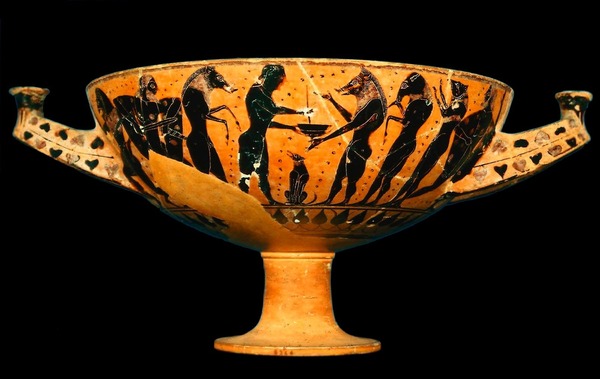
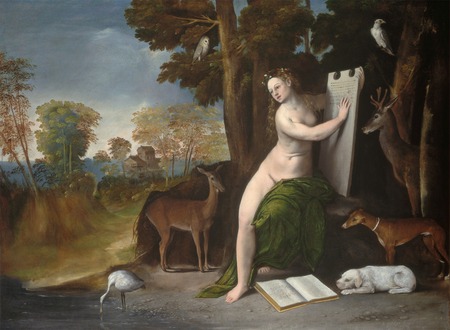
Vase painter of Boston Polyphemus, kylix with the scene «Circe and the Companions of Odysseus, ” circa 560–550 BCE. Dosso Dossi, „Circe and Her Lovers in a Landscape, ” circa 1525.
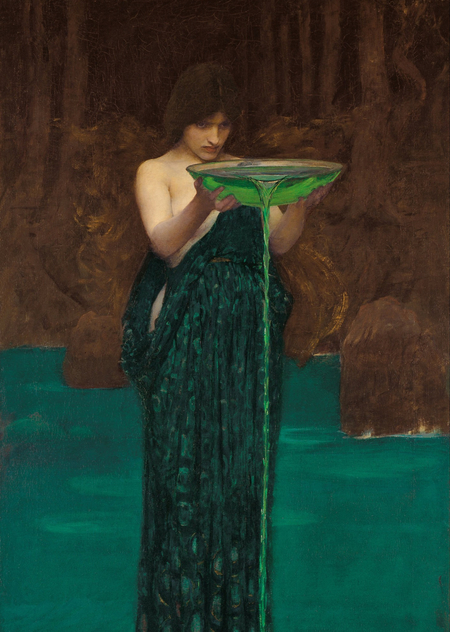
The image of witches with a chalice appears again later. For instance, John William Waterhouse depicted Circe with this attribute in the 19th century: in the painting «Circe Offering the Cup to Odysseus, ” the sorceress holds a chalice in her hand containing a magical potion intended to transform Odysseus into an animal, and in „Jealous Circe“ (1892), the same vessel is used for poisoning—the sorceress pours the potion into the water where her rival Scylla is bathing.
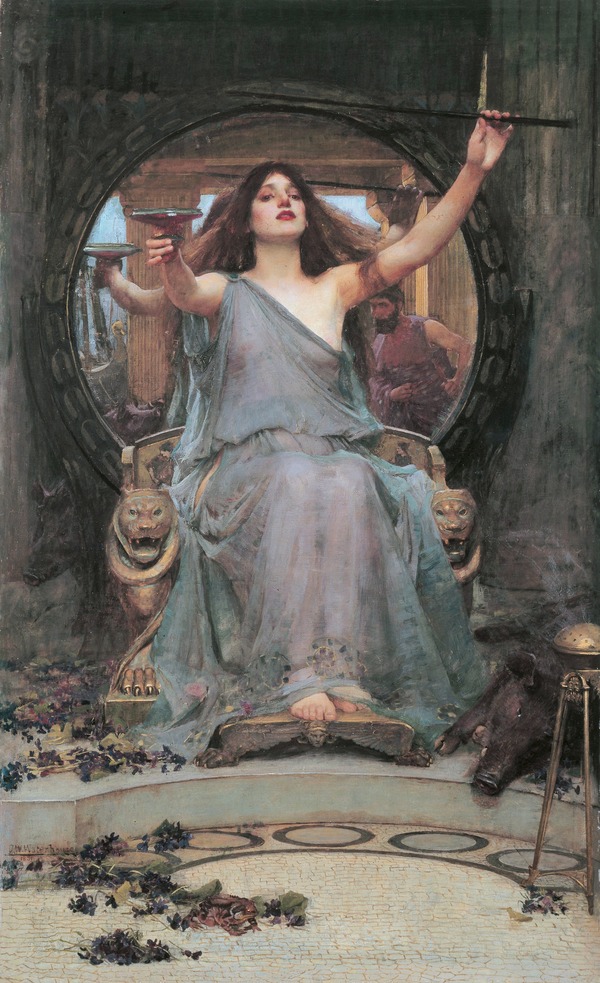
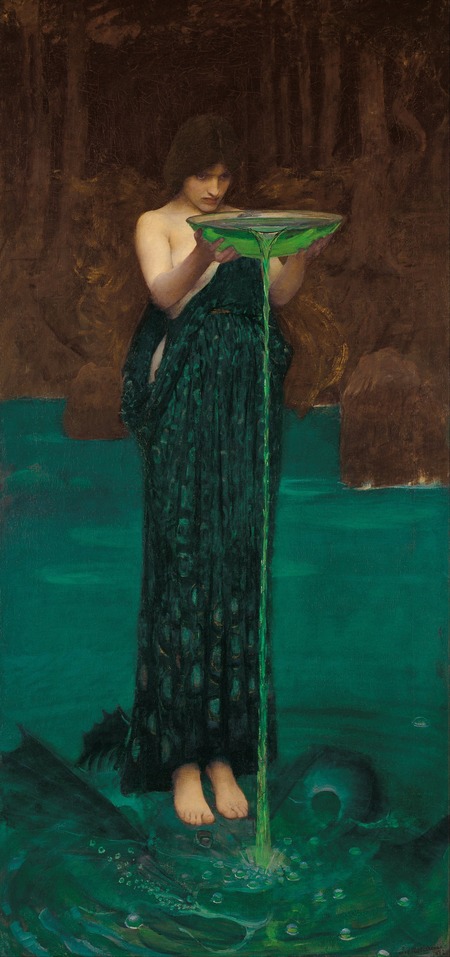
John William Waterhouse, «Circe Offering a Cup to Odysseus, ” 1891 John William Waterhouse, „Envious Circe, ” 1892
At the center of the decoration on a Munich vase from 480–470 BCE, an idealized ram rises from a cauldron on a tripod, flanked by Medea and witnesses of the miracle. Nearly two millennia later, the same motif—two figures flanking the vessel—is repeated in a woodcut illustrating Ulrich Molitor’s treatise: witches cast a serpent and a rooster into a pot, and hail falls from the sky. The transformation remains central to the action, but now it is directed toward harm.
Vase painter from Copenhagen, vase with the scene «Medea and the rejuvenated ram, ” circa 480–470 BCE. Illustration from Ulrich Molitor’s treatise „On Witches and Seers, ” circa 1489.
Victorian artists reimagine Medea’s vessel by reducing its scale: Frederick Sandys depicts the sorceress pouring an elixir into a brazier beside frogs and a red thread, Evelyn de Morgan portrays her carrying a vial, and Waterhouse illustrates her filling the chalice before Jason.
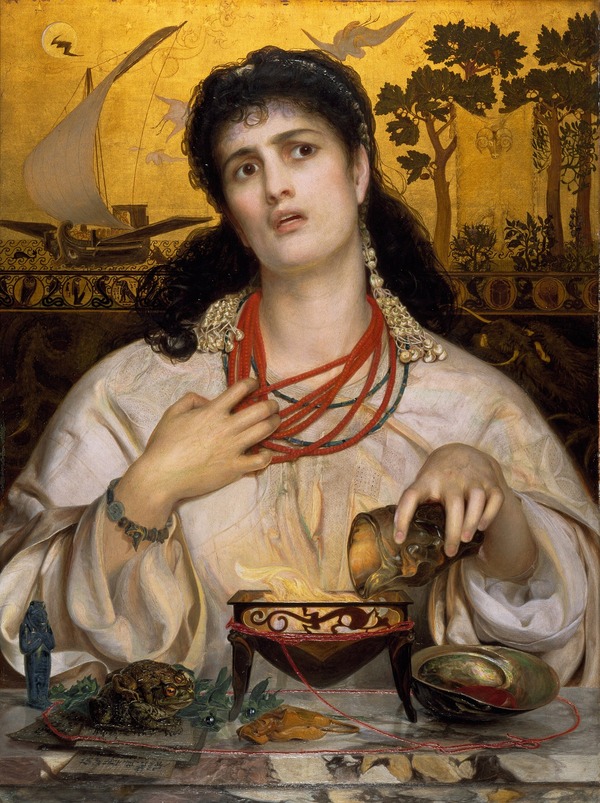
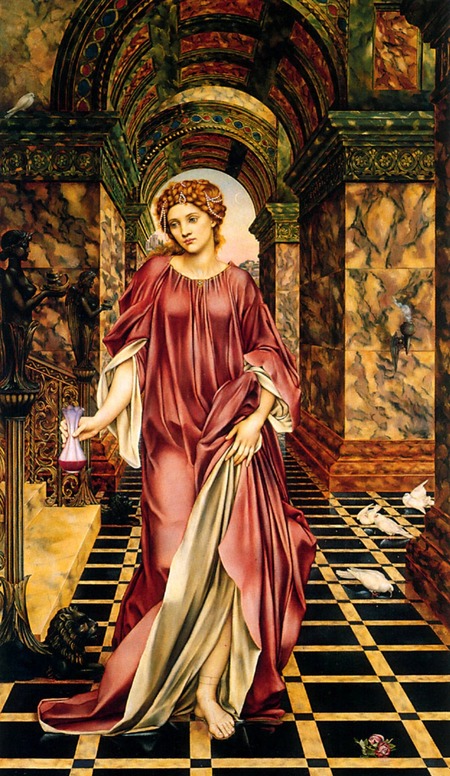
Frederick Sandys, «Medea, ” 1866–1868 Evelyn de Morgan, „Medea, ” 1889
John William Waterhouse, «Jason and Medea, ” 1907
In Dossy’s work, dating to around 1518, a circle drawn on the ground occupies the center of the composition. A sorceress, referred to as Circe or Melissae from Aeschylus’s poem, sits within it holding a tablet of signs and lowering a staff into the fire; armor lies beside her, and tiny human figures hang from the branches. Waterhouse’s «Magic Circle» (1886) replicates this schema: the woman traces a line around a smoking cauldron with the tip of her staff, while crows and a frog remain outside its perimeter. Because the painting lacks a specific literary basis upon which its narrative is built, «Magic Circle» can be interpreted as a paraphrase of Dossy’s composition, maintaining the solitary figure, the circle, the fire, and the animals situated outside the protected space.
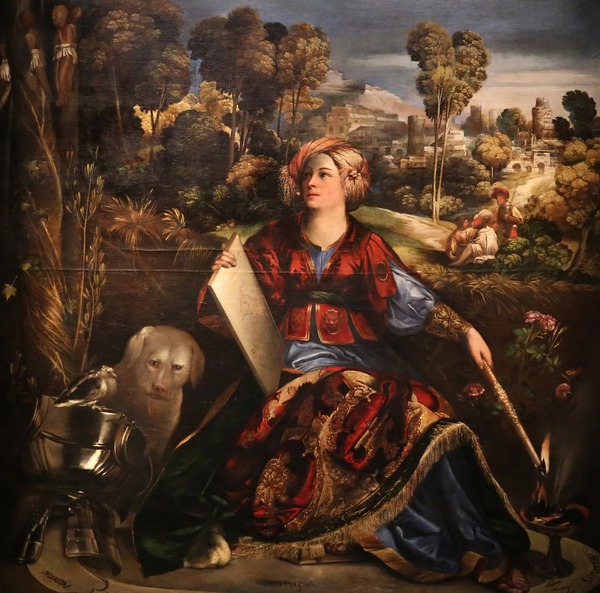
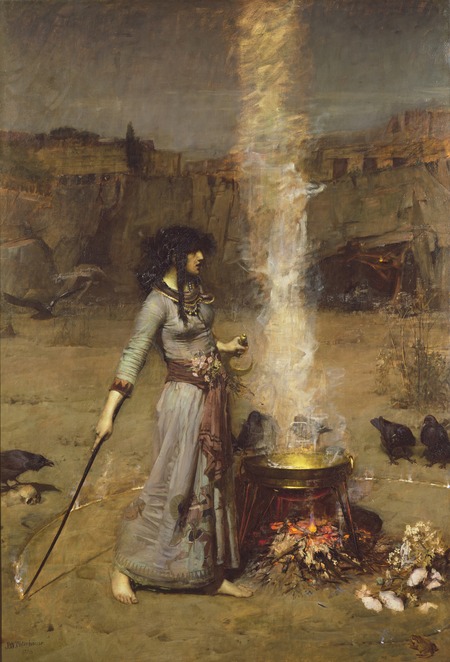
Dasso Dossi, «Melissa, ” circa 1518 John William Waterhouse, „The Magic Circle, ” 1886
Chapter 2. The Motif of the Witch’s Flight
Ancient art depicts Medea flying in a chariot harnessed to dragons; however, the flight of a sorceress riding a stick or an animal only appears in the mid-15th century and becomes a constant characteristic of the witch in printmaking within a few decades [10]. The mode of transport changes—broom, pitchfork, goat, pig, or shoe—while the structure of the motif remains the same: the rider, flowing hair, and the night sky. The inverted posture is particularly persistent: the character sits backward or flies headfirst, which demonologists attribute to sorcerers as a disruption of the world order, a concept explored in the second chapter.
William Mortensen, «The Witch,» c. 1928
One of the earliest known depictions of witches flying is a miniature on the margins of Martin Le Flanc’s manuscript of the poem «Defender of Ladies» (1451). Two women in ordinary clothes are depicted flying on a broomstick and a pole; the inscription labels them «Waldensians, ” linking sorcery with heresy. In a woodcut from Molitor’s treatise, flight is connected with transformation: three figures with animal heads are seated on a forked pole.
Miniature from Martin Le Frano’s manuscript of the poem «Defender of Ladies,» 1451 Illustration from Ulrich Molitor’s treatise «On Witches and Soothsayers,» circa 1489
Around 1500, Albrecht Dürer created an image that artists would return to for another three centuries: a naked old woman with a spinning wheel sits upside down on a flying goat while hail falls above her. Notably, the inversion extends even to the signature—the letter D in the monogram is mirrored.
Albrecht Dürer, «Witch Riding Backwards on a Goat,» c. 1500
In the 16th century, flight becomes incorporated into multi-figure compositions. In the painting by Jacob Cornelis van Ostensanen (1526), the biblical episode with the Aender witch occupies the left side; the sorceress sits within a drawn circle, much like those of Bosch, while on the right in the sky, witches fly on goats, on an animal skull, and on a stick.
Jacob Cornelis van Oostsanen, «Saul of the Wizard of Aender, ” 1526
Jacob Cornelius van Oostsanen, «Saul of the Aendor Witch» (excerpt), 1526
Lucas Cranach the Elder’s (1532) witch procession on goats and a hog, located in the upper left corner, is enveloped in a dark cloud. This alludes to Renaissance beliefs connecting melancholy and despondency with the influence of demonic forces. Thus, Cranach visualizes the demonic nature of melancholy, presenting the witches as embodiments of hidden spiritual threats.
Lucas Cranach the Elder, «Melancholy, ” 1532
Lucas Cranach the Elder, «Melancholy» (excerpt), 1532