Ornament in Motion: How the Geometric Fabric Designs of Popova and Stepanova Interact with Garment Form, 1923–1924
Research Concept
In a flat sketch of a geometric pattern, it is easy to observe how the lines and borders of the motifs repeat. On clothing, this same pattern falls across sleeves, bodices, and skirts: some elements are hidden within folds, while others change their visible direction or terminate at the edge. For a fashion designer, this transition is crucial—it demonstrates how a pattern is perceived on a three-dimensional garment.This study focuses on the fabric designs by Lyubov Popova and Varvara Stepanova from 1923–1924 and how those designs were utilized in clothing. During those years, the artists collaborated with the First Moscow Sateen Dyeing Factory [1]. We are interested in their geometric motifs, the rhythm of repetition, and the distribution of the pattern across the figure.The central question is: how do the directions and placement of the pattern relate to the visible form of the bodice, sleeves, and skirt, in both the sketches and in archival photographs of the clothing made from Popova and Stepanova’s fabrics? We proceed from the assumption that the same ornament can maintain a recognizable rhythm while simultaneously altering its visible direction and partially obscuring itself on different areas of the costume. To test this, it is necessary to compare areas of the same garment. If no differences are discernible in a sufficiently clear image, the hypothesis is not confirmed for that case. If a section of the photograph is illegible, the conclusion regarding it remains open.
For our work, we collect sketches of fabrics and dresses, textile samples, and photographs with verifiable authorship, dating, and source publication. A flat sketch illustrates the pattern logic, the dress sketch shows its intended layout, and the photograph displays the garment in a specific pose. To establish a direct link between «drawing and garment, ” we require a match in motif structure and confirmed textile attribution. Mere stylistic similarity or general authorship is insufficient to link a specific sketch to the depicted item.We analyze the work of both artists using a unified scheme. On the bodice, sleeves, and skirt, we note the direction of the pattern, where graphic accents are placed, the continuity of the rows, and whether the motif is fully legible. A fold or a seam is considered a pattern break only if it is visibly present in the photo. We assess the scale relative to the garment’s details, without translating photographic proportions into centimeters. On black-and-white photographs, discernible tonal contrasts can be compared, but the fabric’s color cannot be determined from such an image.The research logic follows a progression from the flat design to the garment: first, the structure and repetition of the motif itself, then the pattern distribution on the dress sketch, its appearance in photographs, and finally, the integrated comparison. The word „movement“ in the title refers to the visual direction of lines and the variation of the pattern on a three-dimensional form. Tracing the physical movement of the fabric would require a sequence of frames. Images are grouped according to observed interaction techniques between the pattern and the form.Textual sources are selected based on the specific objects and research questions. Museum catalogs provide support for attribution, while scholarly publications help align our visual observations with existing interpretations. Yulia Tulovskaya’s article on the textile sketches of Popova and Stepanova examines the rhythm and perception of the ornament on the fabric [2]. Her findings are compared with observations of the selected garments. The result will be a map of the interaction between pattern and form, in which observations confirmed by visual material are separated from assumptions.
Drawing Composition
Lyubov Popova. Fabric Sketch. 1923–1924
Varvara Stepanova. Textile Design. 1924
In Popova’s sketch, the pattern is composed of angular elements arranged in horizontal rows. The diagonals of the turquoise shapes change direction, and the joints between them are emphasized by black and white squares. The shapes fit closely against each other: the edge of one color serves as the border for the next.
In Stepanova’s work, large circles are clearly visible, although their outline is not drawn. Each circle is formed by vertical light-green stripes of varying lengths. Red horizontals fill the spaces between the circles, and solid red bands separate the rows. Within the motif, the vertical dominates, while the horizontal frames it.
These two sketches delineate the boundaries of their motifs in different ways. In Popova’s design, adjacent geometric figures connect via shared edges. In Stepanova’s, the circle is distinguished by the change in color and the direction of the stripes.
Sketch of the dress design
Lyubov Popova. Dress sketch. 1923–1924. Paper, ink, watercolor. 25,3×14.2 cm. Tsaristino Museum-Reserve. Inventory Gr-122, KP-4504.
In Popova’s dress sketch, she uses a different pattern: circles through which blue stripes pass. On the bodice, the stripes run almost vertically, while on the sleeves, they are shown at an angle. This difference is especially noticeable on the right sleeve. Additionally, light areas are left around the shoulders, and the colored pattern is positioned closer to the lower edges of the sleeves.
A wide sash with a bow interrupts the ornamentation between the bodice and the skirt. On the skirt, the circles are grouped into two horizontal bands. Unfilled paper remains between these bands and along the bottom. Thus, one motif is presented in different placements: nearly solid filling on the bodice, distinct sections on the sleeves, and bands on the skirt. Since it is unclear how the light spaces were intended to be executed in the fabric, this sheet cannot provide that information.
Lyubov Popova. Dress sketch. 1923–1924. Paper, ink, watercolor. 21,9×9.6 cm. Tsaristino Museum-Reserve. Inv. Gr-127, KP-4509.
In this sketch, green and black diamonds fill the bodice and skirt down to the hemline. The elongated motifs are arranged into vertical chains. The skirt lacks the wide light sections that separated the pattern in the previous sketch.
The largest light area is the wide collar. A narrow black belt crosses the dress, and its long ends hang down along the skirt. In the first sketch, the wide belt with a bow emphasized the boundary between the bodice and the skirt. Here, the belt occupies less space across the silhouette, but its hanging ends run in the same direction as the diamond chains.
From fabric drawing to finished product
Varvara Stepanova. Drawing for Fabric. 1924. Paper, gouache. 31,5×37 cm. Private Collection.
Alexander Rodchenko. Varvara Stepanova. 1924; printing 1997. Silver-gelatin print. Howard Schikeler Collection.
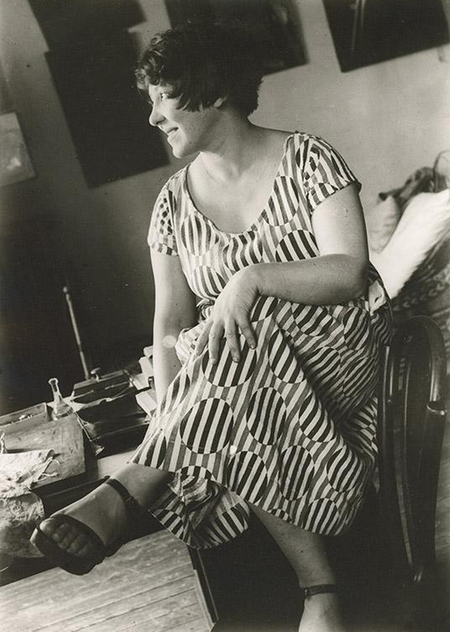
In the sketch, the red and yellow stripes run vertically. The color changes at the boundaries of the circles, but the white gaps continue throughout the drawing. The circles are repeated with an offset: adjacent columns do not align in height.In the photograph, Rodchenko Stepanova is wearing a dress that she designed and sewed herself from fabric featuring her own pattern [3]. The striped circles and their shifted arrangement are recognizable in both images.Below the arms, on the front of the skirt, several circles are visible almost entirely. On the right, the stripes change angle and converge in the folds. The motif appears in fragments on the chest and short sleeves. In this pose, the design retains its recognizability, although a complete circle cannot be traced across every section of the dress.It is impossible to determine the fabric color from the black-and-white photograph. The structural resemblance of the pattern also does not prove that this specific preserved piece of paper was used for production.
Alexander Rodchenko. Varvara Stepanova in a dress made from fabric patterned by her. 1924. Photographic fragments. Cropping for visual analysis.
In these fragments, the motif is not fully visible for various reasons. At the edge of the sleeve, the outline of the clothing restricts it; under the hand, it is obscured from view; and within the folds, the visible outlines of the stripes change. Therefore, the incomplete circle in the photograph does not, by itself, prove a change in the pattern’s form.
Alexander Rodchenko. Varvara Stepanova at a desk, wearing a dress made from fabric patterned by Lyubov Popova. 1924.
In the photograph, Rodchenko Stepanova is seated at a table wearing a dress made of fabric patterned after Popova’s design [1]. On the sleeve visible on the left, the dark and light stripes form nested angles. Here, the vertices and both sides of several repeating motifs can be discerned. On the upper part of the right shoulder, the stripes run closer to the horizontal axis of the frame, but on this light area, their boundaries are less distinct.
At the edge of the cutout, the corner motifs are not visible in their entirety. Next to the cutout on the fabric, the stripes curve, and individual sections are obscured by the folds near the chest. The lower part of the dress is covered by the table, so the pattern’s placement on the skirt cannot be determined from this photograph.
Motivation Recognition
Alexander Rodchenko. Varvara Stepanova in clothing made from fabrics designed by Lyubov Popova (left) and Varvara Stepanova (right). 1924. Photographic fragments juxtaposed for visual analysis.
On the left sleeve, several overlapped angles are visible. The pattern of Popova is recognizable by their vertices, even where the continuation of the stripes is hidden in the folds. On the right, Stepanova’s circles can be traced along the arcs between the light and dark sections of the stripes. Near the neckline, the circle is not visible in its entirety, but its rounded boundary remains discernible.
In these examples, recognizing the motif requires only a characteristic fragment of it. It will not be possible to determine which pattern changes less on a three-dimensional form with this pair: Stepanova is posed in different ways, the photos were taken from different viewpoints, and the lower part of the dress on the left photograph is covered by a table.