Phantom Pains in Art and Cinema
The Ache of Absence
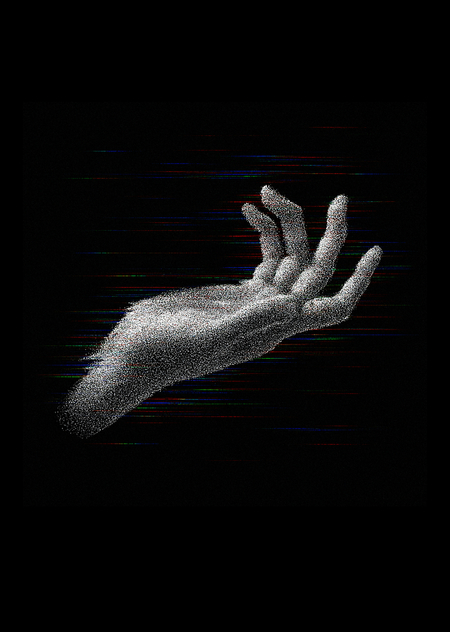
The phenomenon of phantom pain the persistent sensation in an amputated limb, that is, pain felt by the brain in a limb that no longer exists has transcended its clinical origins to become a dominant metaphor for our contemporary condition. We live in an era of aftermath, where there is no clear path or direction, only a prolonged, often painful, lingering from a past that has been severed.
This is a pain that exists precisely because of absence, when the phantom of a lost integrity haunts the collective body in the present. This essay examines the concept of the term, exploring how phantom pain continues to exert its influence.
Boris Orlov: The «Phantom Pains» of a Shattered Empire
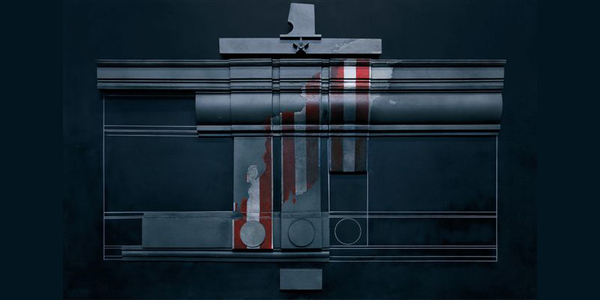
The traces of a collapsed great power constantly make themselves felt, representing a vast layer of phantom pain for the entire people and era. Boris Orlov’s project for the Tretyakov Gallery serves as a magnificent example of this phantom pain. His sculptural and pictorial objects historical «fragments» held together and connected by rusty metal clamps and wire in an attempt to maintain integrity constitute a visual form of the phantom pain from the amputation of an entire empire and the death of its utopian faith.
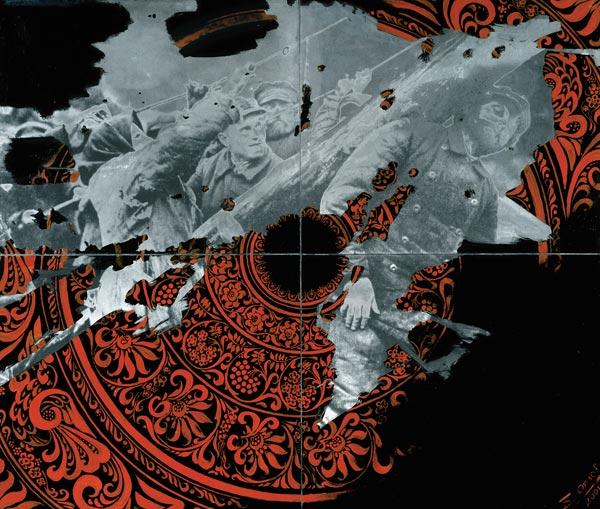
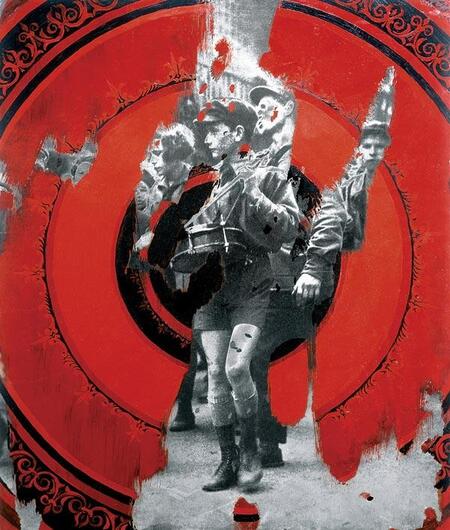
Boris Orlov Farmer. 2000-2012/ Boris Orlov Pioneer. 2000-2012
If the first part of the exhibition acknowledges the amputation and the futility of attempts to preserve the old ideals, then the second part undertakes the painful, almost surgical assembly of an entirely new meaning from the remaining fragments. Orlov demonstrates that the pain stems not only from the loss of the USSR, but also from the realization that the former space, once occupied by a sacred ideal, has been replaced by absolute emptiness.
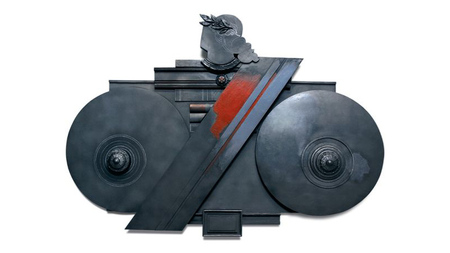
Boris Orlov Triumphant bust with ribbons. 1988-2012
Doris Salcedo: Atrabiliarios — The Quiet Archive of Personal Grief as a Political Body
Doris Salcedo, in her series «Atrabiliarios» (1992-2004), focuses on local microhistory and the inexpressible pain of individual loss. Her installation, where women’s shoes belonging to «disappeared» victims of political violence in Colombia are imprinted and stitched with thread into wall niches, and then sealed with a semi-transparent animal membrane. The shoes act as an imprint of the body. The membrane is like skin over an unhealed wound of collective memory, simultaneously concealing and exposing it. This is a political statement where personal trauma, merely archived and put on display for society, becomes an object of collective mourning and a new phantom pain.
Doris Salcedo «Atrabiliarios» 1992 — 2004
Andrei Tarkovsky: Stalker — Space as Embodied Trauma
In Andrei Tarkovsky’s film Stalker (1979), phantom pain is transposed from the realm of objects into spatial and metaphysical dimensions. The Zone is, in essence, a territory altered by an ineffable catastrophe a place where the familiar laws of physics and logic cease to function and break down. The Zone is materialized phantom pain, severed from the real world a landscape that has become the embodiment of collective trauma, too profound to be named or articulated in words. The very topography of the Zone reflects the nature of phantom pain: it is unpredictable, oppressive, irrational, and exists in the tense space between memory and oblivion.
Андрей Тарковский, Сталкер 1979
Stanley Kubrick: The Shining — Phantom Pain as Psychosis and Violence
In Stanley Kubrick’s The Shining (1980), the film demonstrates what happens when unacknowledged phantom pain manifests as pure psychosis. The Overlook Hotel becomes the embodiment of this pain isolated from the world and saturated with past horrors and nightmares that no longer exist, yet are preserved there. Jack’s reaction is a manic attempt to impose a new, monstrous order upon reality. The Shining serves as a grim warning that forgotten collective and personal trauma does not fade away, but can endure for years, remaining entrenched in its original space.
Стэнли Кубрик, Сияние 1980
The Wachowskis: The Matrix — Reconstructing the Self in a World of Fundamental Absence
In The Matrix (1999), the question of phantom pain is elevated to the highest existential level. Here, reality itself and the perception of it are completely severed. Neo feels a primal pain. He senses that something is wrong with the world, that something is missing, and this absence causes him anguish. Morpheus offers him a choice: to forget this pain and construct a new reality, or to remain oblivious and continue living with the phantom pain. Neo’s reconstruction is a deconstruction of the past world and the building of a new one upon its foundation. In essence, he does not merely endure the phantom pain. He overrides it completely, giving his mind the very missing part it craves in order to become whole again.
Братья Вачовски, Матрица 1999
Conclusion
The trajectory outlined by these five works reveals phantom pain as a multi-layered phenomenon, progressing from the tangible «rusty wreckage» of imperial utopia and the intimate traces of disappearance, through a traumatized landscape, to the point of personal catastrophe where the phantom erupts into a psychotic violence against reality. However, the final note sounded in The Matrix directs us not into a dead end, but rather forward. Together, these works demonstrate that engaging with historical and existential trauma should not involve its denial or suppression; no, not at all. Art and cinema take on the role of a kind of «mirror therapy» for the whole of society, helping to recognize the contours of the phantom, to touch it, and, ultimately, to begin the very painful but necessary process of constructing a new wholeness, one’s own new reality upon the foundation of the past.
Сальседо, Д. (1992–2004). Atrabiliarios [Инсталляция: обувь, животная плёнка, шкафные ниши]
Вачовски, Л., & Вачовски, Л. (Режиссёры). (1999). Матрица [Фильм]. Warner Bros.
Кубрик, С. (Режиссёр). (1980). Сияние [Фильм]. Warner Bros.
арковский, А. (Режиссёр). (1979). Сталкер [Фильм]. Мосфильм.
Государственная Третьяковская галерея. (2013). Борис Орлов: «Фантомные боли» [Выставка, Москва, Крымский Вал, зал спецпроектов № 38, 1 марта — 23 июня 2013]. ArtInvestment.RU.