Navigator
I. Profession instead of name—urban and peasant «types» (1860s–1870s) II. The populace as specimens—imperial ethnographic catalogs (1868–1875) III. Name in small print—the name appears but is subordinate to the type (1871–1907) IV. Color without a label—color photography and old typologies (1904–1913) V. Portrait with a name—who gains the right to a name (1903–1911) Conclusions: What the caption tells us
Concept
Rationale for Topic Selection
When we look at old ethnographic photographs, we almost never know the name of the person in the frame. Below the picture, it might say «Tochilshchik, ” „Kirgizka, ” „Sartyanka, ” or „Types of Dagestan”—but not a name. The caption seems like a secondary technical detail; yet, it is precisely what defines who the person in the photo is: an individual or a type. In the second half of the 19th century, photography in the Russian Empire became one of the main tools for describing a vast multinational country, and with it emerged the genre of „types”—images where the person represented a profession, social class, or ethnicity. I felt it was important to examine this genre not by what is depicted, but by how the depiction is named, and to trace when and why a person in the frame gains their own name.
Main Hypothesis
The key question is: how did the perception of the person in the frame change in ethnographic photography from the second half of the 19th to the early 20th century—from a „type“ to an individual—and what does the caption beneath the image tell us about this shift? The hypothesis is that Russian „types“ photography developed not in isolation, but within a broader international sphere that simultaneously encompassed the colonial catalog, the social document, and the romantic portrait. Within this sphere, the caption gradually shifted from occupation and ethnic designation toward a personal name, but this journey was not linear: color, close-ups, and personal names appeared before the typological mindset disappeared, and in some early 20th-century projects, the type resurfaced in a new, aestheticized form.
I. Profession Instead of Name
1860s–1870s
In the 1860s, series of «Russian Types» cards began appearing in St. Petersburg and Moscow—featuring porters, cab drivers, sharpeners, and peasants. Travelers and collectors purchased these as a visual catalog of the country. The individuals in these photographs were identified by their occupation—the caption named the trade, not the person. Almost simultaneously, in London, John Thomson photographed street vendors and cab drivers, but alongside his images, stories of specific individuals were published.
Fig. 1. William Carrick. Tuchilshchik. From the series «Russian Types.» 1860s. Albumin print
Karrik is photographing a street whetstone vendor in the studio—with the grinding machine, against a neutral background. This person is a carrier of a craft: the card was bought as a representation of «Russian life,» not as a portrait of a specific Petersburg resident. There is no name, and none is intended.
Fig. 2. William Carrick. Basket Bearer. St. Petersburg, 1860–1870s. Albumen print. The Metropolitan Museum of Art, New York
Cargo and clothing reveal more about a profession than a face does. The studio staging transforms a street vendor into an exhibit that can be placed in an album alongside other «types.» It is telling that the photograph is simply titled «Studio Portrait» in the museum catalog—and the caption still determines how we perceive a person today.
Fig. 3. John Thomson. London Hackney Carriages. From «Street Life in London» (text by Adolph Smith). London, 1877. Woodburytype
The cab driver is one of the most popular «types» in both St. Petersburg and London. A comparison with Caricature cards illustrates how international the language of professional types was—the same pose, the same occupational attribute. However, in Thomson’s book, next to the photograph, there is an essay on the life and earnings of the cab drivers—the type is accompanied by a narrative.
Fig. 4. John Thomson. London Nomads. From the book «Street Life in London.» London, 1877. Woodburytype
A group of street vendors gathered around a van. In Smith’s text, the owner of the van is named William Hampton. The British book is gradually transitioning the «types» into neighbors who have names and stories; this step is not yet present in the Russian cards.
Interim Output
In the urban «type, ” a person is defined by their craft: their signature, suit, and tools completely replace biography. Comparing this to Thomson shows that the scheme itself was common across Europe, but the British book already accompanied the type with a narrative of fate, while the Russian card remains silent.
II. The People as Exhibits
1868–1875Following the annexation of Central Asia, Governor-General K.P. von Kaufmann commissioned «The Turkestan Album”—a multi-volume description of the new territory, the ethnographic section of which was compiled by A.L. Kun. In the same years, the eight-volume edition of „The People of India“ was published in British India. Both projects were commissioned by the administration and described the empire’s subjects as a system of peoples and castes. In such albums, the individual becomes an archetype of their group.
Fig. 5. Alexander Kun (compiler). Clothing of a Kyrgyz woman. Everyday headscarf. «Turkestan Album,» ethnographic section. 1871–1872. Library of Congress, USA
The caption contains neither a name nor even the word «woman» as the main subject: the photo describes a scarf. The person becomes a mannequin for displaying the costume. This is the ultimate point of the typological logic of the imperial catalog.
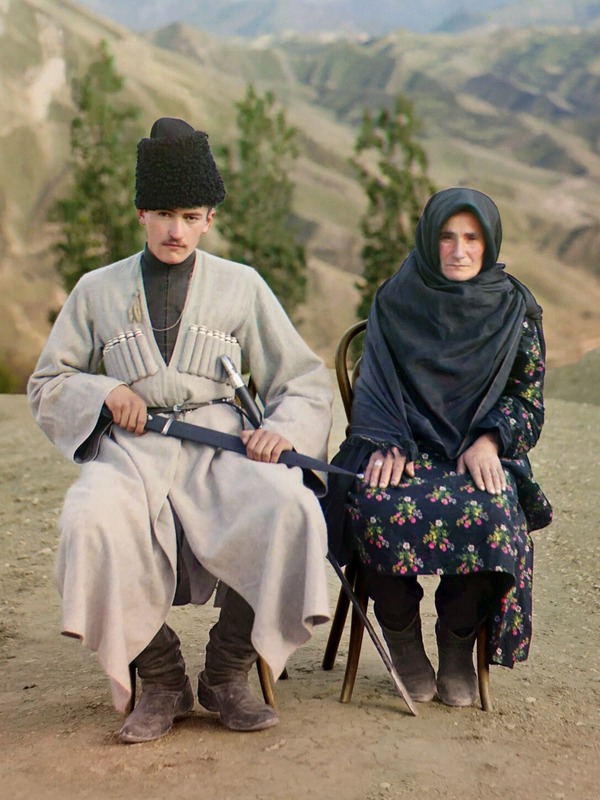
Fig. 6. William Carrick. Caucasian man in a Cherkeska and Papakha. St. Petersburg, 1860s. Calling card
Karrik photographs not only Russian artisans but also individuals from the empire’s peripheries. The costume—a Cherkeska with gazyry and a papakha—becomes the central «text» of the image. A card featuring such a subject functioned as a small ethnographic illustration.
Fig. 7. Unknown photographer. Portrait of a man. Plate from the publication «The People of India, ” vol. 5. London, 1868–1875. Digital copy from the Robarts Library, University of Toronto
The British parallel to the «Turkestan Album»: an eight-volume edition commissioned by the colonial administration described the population of India as a system of castes and tribes. In the digitized copy, this photograph is separated from its printed caption—and today, we can no longer say who is depicted. Without the caption, the «type» loses even its category: this is the best evidence that the meaning of such photographs relied on the text beneath them.
Fig. 8. Unknown Photographer. Budhiki (Shahjahanpur). «The People of India.» 1868
Four peasants are lined up in a row, similar to an anthropological plate. This frontal composition is also seen in the «Turkestan Album"—both empires utilized photography as a tool for census taking.
Interim Summary
In the imperial catalog, the caption no longer names a profession, but rather a populace, a caste, or a specific costume detail. The photograph serves an administrative function—it helps to «identify» the subjects and categorize them. The Russian and British projects here are almost mirror images.
III. Name in small print
1871–1907
Within the same «Turkestan Album, ” there are photographs signed differently: after the ethnic designation comes a personal name—such as „Jewish woman. Mazal“ or „Khivan people. Haji-bay.“ The name appears, but remains on a second line, clarifying the type. A similar situation recurs thirty years later on Ellis Island in America, where Lewis Hine photographs immigrants: they are still identified by nationality, even though the photographer’s gaze is now directed toward a specific individual.