Concept
«Goose» is one of the most enduring game structures in the history of European tabletop culture: it originated in the 16th century and continues to be reproduced in new forms to this day. However, research into «Goose» games has been uneven. It is well-documented as a historical and cultural and literary phenomenon (the works of M. Kostyukhina, D. Parlett, and A. Seville), but it is hardly examined as an object of visual culture—as a sequence of images, compositional choices, and graphic techniques that have evolved from one era to the next. The novelty of this work is that «Goose» is examined not as a «text with pictures, ” but as a visual system where the design of the game board is directly linked to the rules, the social context, and the artistic style of its time. The theoretical significance of this research lies in filling this gap: it demonstrates that a board game can be analyzed as a complete visual artifact. The practical significance lies in developing an approach applicable to other card games and to contemporary board game design.
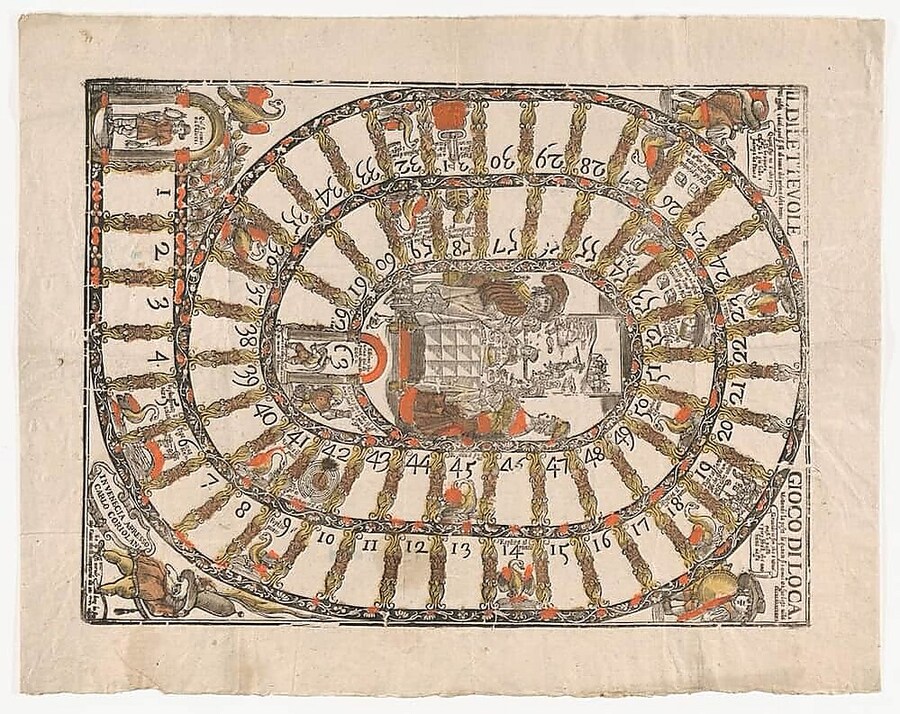
«Gusyok,» 17th Century
The key research question is framed as follows: how has the visual design of «Gusya» evolved under the influence of game rules, historical eras, and the cultural traditions of various nations? The hypothesis posits that the visual transformation of «Gusya» was not random; while the basic game mechanics remained consistent (spiral or serpentine route, trap and bonus cells, a central finish line), the representational elements changed, reflecting cultural exchange, shifts in artistic styles, and social customs.
The specific visual objects and their creators become the subjects of this study. These are early European «Gusyok» from the 16th–17th centuries—Italian, Dutch, and German engravings and woodcuts where basic iconography was established. These are Russian «Gusyok» from the 19th century—such as «Konyok-Gorbunok, ” „The Journey Where They Command, ” and „Whoever Deceives Time Will Receive a Reward, ” where the European schema was filled with national literary and everyday material [1]. This is the Soviet „Gusyok”—the game „From Morning to Evening, ” conceived in 1944 by Rina Zelyonaya and Natalia Konchalovskaya and initially illustrated by Natalia Ushakova, and later by Willy Trubkovich, with a 1975 variant where the didactic game about Pioneer Day combined poetry, illustrations, and rules [5]. These are modern remakes—Ilya Tikhomirov’s „From Morning to Evening in Petersburg, ” which reinterprets the old schema in a contemporary design [5]. Finally, there are functional variants of „Gusyok“ from the late 19th to the mid-20th century—advertising and educational games where the schema was used for product promotion and teaching [4].
The foundation of the research lies in a contradiction: the rules of «Gusyk» are extremely simple and have barely changed over centuries, yet the visual landscape of the game was recreated each time—tailored to a specific era, country, and audience. The objective of this work is to trace how this happened.
Categories
- Concept
- The Origin of the Goose and its Ancient Analogues
- The Visual Language of the Goose Across Different Cultures
- The Goose in the Social Space: Literature, Propaganda, and Advertising
- The Image of Play in Soviet and Contemporary Design
- Conclusion
- Bibliography
- Image Sources
Genesis
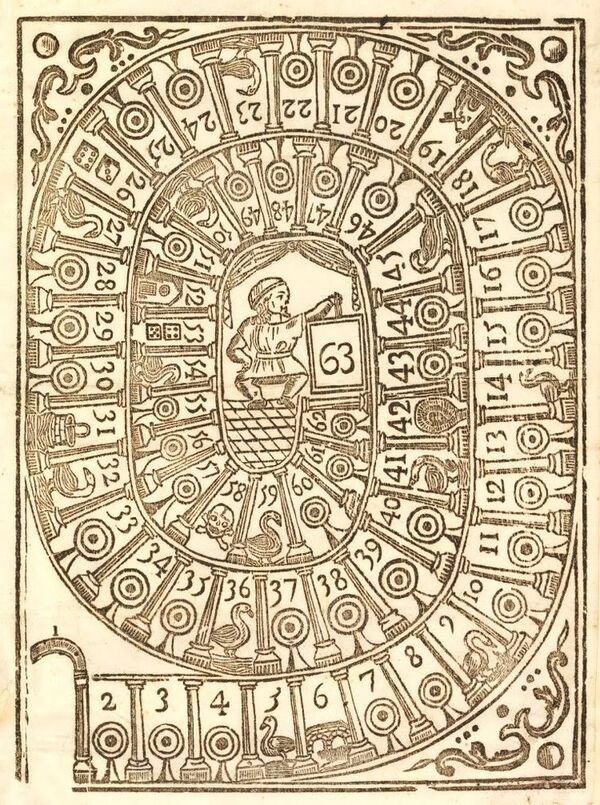
«Goose» appeared in the 16th century and, according to legend, was a gift from Francesco Medici to the Spanish King Philip II—the game was perceived from the outset not merely as amusement, but as something symbolic, relating to fate and chance. Its Florentine origin indirectly supports the fact that young Louis XIII played it in the early 17th century, and his mother, Catherine de' Medici, was from Florence. The game spread very quickly: German and English versions appeared by the late 16th century, followed shortly by French versions.In its mechanics, «Goose» is similar to simple betting games like «Owls, ” where everything was determined by combinations of dice. However, its distinction lies in the board, which is an unrolled spiral of 63 squares, and each square has its own meaning: a bridge, an inn, a well, a maze, a prison, death. These traps and bonuses, combined with the symbolism of the numbers, transform the game into a unique visual narrative of a person’s life journey.
possibly the earliest surviving example of a game board for Goose (according to THEMET)
However, «Gusyok» belongs to a broader category of games that researchers call race games: players take turns rolling dice and moving their tokens along a route from start to finish, with the first to reach the goal winning. This category also includes much older games—for example, the ancient Egyptian Senet, where tokens also traveled a path across a marked board, and the outcome was largely determined by chance. It is against the backdrop of this tradition that it is easiest to examine the predecessors of «Gusyok.»
Researchers trace the ancient analogs of «Gusyok» back to the Egyptian game «Mehen”—a spiral board with a serpent’s head at the center, the oldest examples of which date back to around 3000 BCE. No direct link between the games has been proven, but formally, they are very similar: a spiral route, movement toward the center, and division into segments. Even closer is the Arab game „Hyena”—a square spiral with dots representing „days of travel, ” where the token moves to the center and back, after which a pursuer appears.
It turns out that „Gusyok“ evolved at the intersection of two traditions: ancient spiral travel games and 16th-century European gambit games. Its novelty does not lie in the spiral mechanism itself, but in the fact that the spiral becomes the carrier of an elaborate visual program for the first time—each cell features an image and a rule, transforming the game into an allegory of the human life path. It is this combination of simple mechanics and a rich visual array that made „Gusyok“ a universal template upon which later versions were created.
Mehen
The Game of «Goose» Across Different Cultures
Researchers—notably Adrian Sevil—note that geese from different countries developed in relative isolation for a long time, which resulted in noticeable differences in visual language. While the classic scheme of 63 cells and a strict set of traps remained nearly unchanged in France and Italy for centuries, in Germany, for example, masters quickly departed from the canon: they altered path lengths, introduced new cell types, and used different symbols of luck (such as monkeys instead of geese).
A French game themed around sea voyages
The Dutch tradition provides one of the most telling examples of national adaptation with the game «Goose» — Reis door Friesland («Journey through Friesland»), created by Pibe Credit in 1880. The underlying structure remained recognizable: a spiral of 63 squares, movement toward the center, and trap squares. However, instead of geese, Credit placed empty squares (which also granted an extra move), and filled the entire board with the actual topography of Friesland—53 images of cities, villages, and landmarks. The game came with a chronological list of historical dates (from 800 to 1813) and portraits of famous Frisians. The game was reissued three times—in 1880, 1889, and 1906—and each edition featured distinct design elements: the 1889 edition included new illustrations and removed the chronological list, while the 1906 edition reversed the game’s direction and replaced nearly half of the images. Thus, the «Goose» transformed into a vivid textbook of local history and geography.
«Journey through Fresland» original part
«Journey through Friesland» 1889
«Journey to Friesland» 1906
Italian «Goose» games from the 16th–18th centuries often maintained a strict, almost architectural aesthetic. Early engravings (such as those by Lucino Gargano, 1598) feature a vertical format and a distinct spiral. The visual language here leans toward allegory: the squares may depict not just geese, but scenes of hunting, everyday vignettes, or even philosophical narratives. For instance, in Valerio Spada’s game (circa 1650), the central panel is adorned with a scene from the «Goose» game, and the pathway itself is accompanied by a riddle sonnet where the players resemble travelers journeying toward a goal.
Italian version of the game
German goose games (and their close relatives, monkey games—"Affenspiele») are the most visually diverse. They were among the first to move away from the mandatory 63 squares and classic traps. The visual language here could range from crudely satirical (scenes in taverns, drunken gatherings) to didactic (picture alphabets for children). Furthermore, the German tradition gave rise to numerous «journey» games (Post- und Reisespiele), where the visual content depicted a real journey (coaches, stations, signs) rather than a life allegory.
German version of the 1830 game
The English tradition of «The Goose» developed early: John Wolfe registered the game in 1597 in Stationers' Hall, and the earliest surviving English copy (around 1690, published by John Overton) closely mirrors Italian iconography but adds portrait medallions in the corners—these changed from edition to edition and reflected topical events, ranging from political allusions to portraits of notorious criminals. By the end of the 18th century, the classic «Goose» was nearly obsolete in England, yielding to thematic variations; however, its structure lives on in moral and educational games («New Game of Human Life,» 1790; «Abode of Happiness,» 1800), where the visuals serve moral instruction rather than gambling. In the early 20th century, the tradition unexpectedly returns to politics in the game Pank-a-Squith (1909), where the track illustrates the suffragettes' path to Parliament.
The popular English game «The Golden Goose»
English Game of Goose — John Overton
British Monarchs from Egbert to George III
«Gusyok» in Social Space: Literature, Propaganda, and Advertising
«Gusyok» was never just a game from the start. Beginning in the late 16th century, it was played for money and as a narrative about a person’s life, where everything depended on fate. By the 19th and 20th centuries, these two aspects diverged: in some places, «Gusyok» became a literary game; in others, it was an instrument of propaganda; and in yet others, it was advertising. The spiral remained recognizable, but the cells ceased to be mere «lucky squares"—they now carried meaning: literary, political, or commercial.