OFF TO SLEEP
— this is the time when a person goes to bed and prepares to sleep.
Dreams are an elusive phenomenon that is difficult to describe. After waking, people rarely manage to recall the plot of their dream. In many myths and legends, sleep possesses a sacred power; it is associated with healing, oblivion, and death.
Initially, for any creative individual, the theme of sleep served as a means to convey additional details and meanings that they could not write directly. Thus, the author could add layers to the prism through which the viewer perceives the narrative and the themes being raised.
For example, in ancient Greek mythology, the god of sleep Hypnos and the god of death Thanatos are brothers.
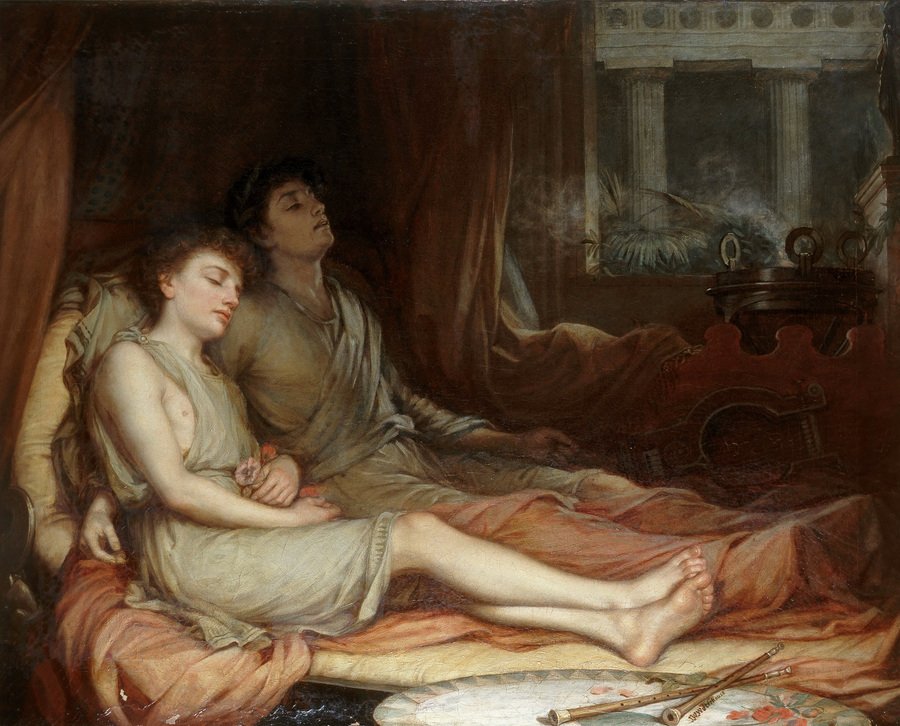
«Sleep and its Brother Death» John William Waterhouse 1874
It was this magical feeling of dreaming that gave the animation pioneers the freedom to incorporate this theme into their work. The lack of professional technology did not prevent the creation of scenes that violated the laws of physics or featured distortions. The characters' unconventional movements only helped to mask the imperfections of the graphics.
In this visual study, I aim to examine how directors have used the theme of dreams—how this narrative thread has helped unveil the creators' intentions, what techniques they employed, and how these ideas have survived and continued into our contemporary era. Specifically, I want to trace how animation has utilized metamorphoses, changes in scale and proportion, spatial distortion, the animation of inanimate objects, and the violation of conventional laws of physics to construct images reminiscent of human dreams.
How did animation of the first half of the 20th century utilize the dream theme to expand its own visual and expressive capacities?
The hypothesis of this research is that sleep became not only a convenient narrative device for early animation—one that allowed for the explanation of fantastical events—but also a distinct space for artistic experimentation. Dream logic provided directors with the ability to liberate imagery from conventional physical and spatial constraints, experiment with movement, form, and composition, and convey the subjective experiences of the characters. It is posited that as animation developed, techniques initially employed to create comedic and fantastic situations evolved into autonomous means of visualizing the inner world of humanity.
I decided to frame the visual research as a complete sleep cycle, from preparing for sleep to waking up. I added a brief definition to each section to deepen the immersion into the research topic. Furthermore, the color of the headings changes depending on the depth of sleep—from light to dark and back again. In each section, I analyzed animations, focusing on the segment that was most relevant to the chapter title.
SLEEP
— this is a transitional physiological process from wakefulness to sleep, during which the body gradually decreases its activity: muscles relax, breathing and heart rate slow down, and consciousness shuts off.
«Mickey’s Nightmare» Walt Disney’s Judge 1932
«Mickey’s Nightmare» 1932. The moment of drifting into sleep, a parallel with reality
In Mickey’s Nightmare, a parallel between the real world and a dream is presented. The protagonist moves into a world of dreams using a visual cloud. This technique of depicting thoughts is still used today. As the character falls asleep, the clouds remain framed, emphasizing the difference between the worlds.
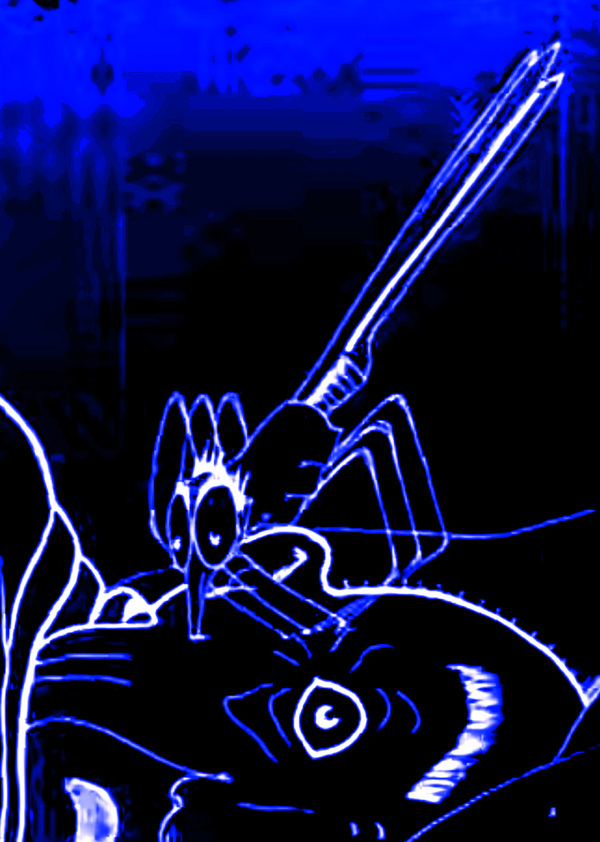
«How the Mosquito Operates» Windsor Mackay 1912
In this animation, the director taps into a universally irritating sensation: trying to fall asleep and relax while a persistent mosquito buzzes around. The conflict is depicted through the contrast between the characters: the sleeper is nearly motionless and static, occasionally turning in annoyance, while the mosquito is agile, itching, and flying around the sleeper. The repetitive shots, likely used for economical pacing, heighten the feeling of the insect’s intrusion. At the end of the animation, the mosquito dies, and symbolically, this is the moment the man finally begins to sleep soundly.
Thus, in this animation, sleep becomes the point of conflict between the two characters. By employing the theme of sleep, the director draws the viewer’s attention to a state familiar to everyone.
WORLD OF IDEAS
«Somewhere in the Land of Dreams» Max Fleischer 1936
The dream space in Fleischer’s animation becomes another dimension, unlike the real world. It is beautiful, marvelous, and in contrast to the unpleasant reality, it serves as an ideal for the children. The heroes travel through space and clouds into another land—the land of dreams.
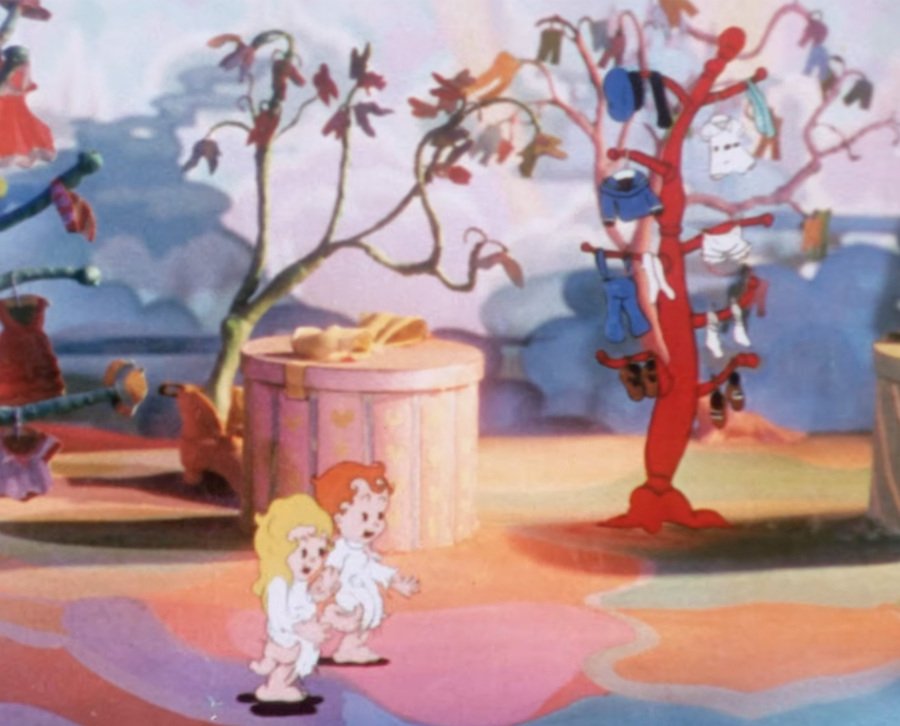
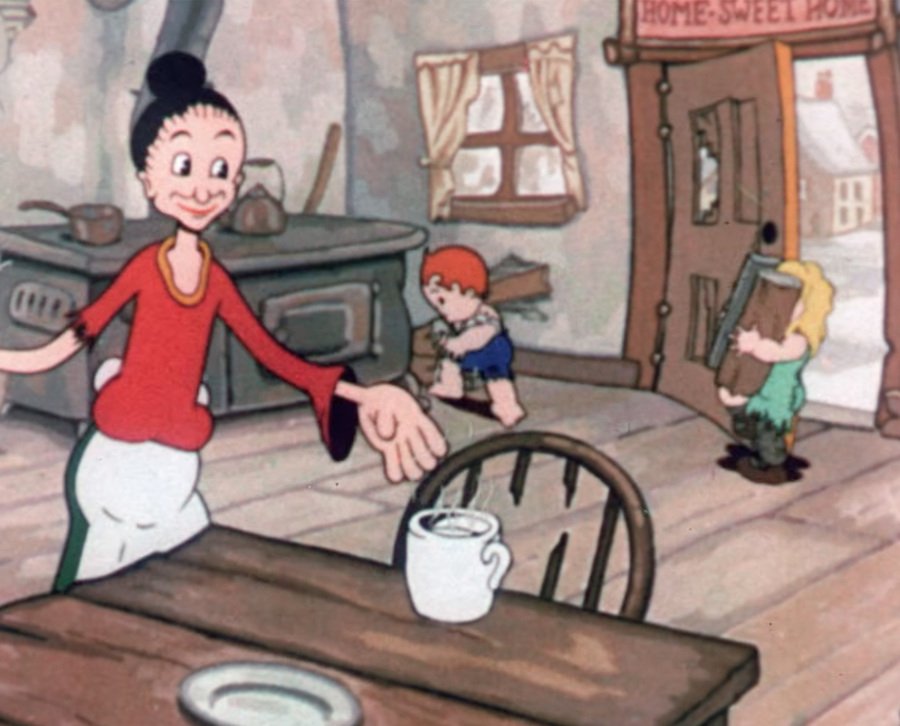
«Somewhere in the Country of Dreams» by Max Fleischer, 1936. The contrast between the colors of two worlds.
The land of dreams becomes a place where all of the characters' wishes come true. It is important to note that technical specifications play a major role in creating this beautiful world. First, there is the ability to make the cartoon in color. Simultaneously, soft and vibrant colors reflect the childlike carelessness that children often lack. For contrast, the family’s real house is rendered in muted beige tones. Second, the space of the dream becomes three-dimensional. In the animation, drawn characters blend with puppet scenery.
«Somewhere in the Land of Dreams» by Max Fleischer, 1936. Example frame using 3D set design.
The marvelous laws of sleep persist in animation: ice cream can be gathered from a flower, and clothing can be plucked from a tree. Pastries grow in the fields, and the river flows with syrup instead of water.
«Somewhere in the Country of Dreams» Max Fleischer 1936
Sleep becomes the harbinger of a celebration organized for the family by the city residents. The kids receive everything they dreamed of in their sleep.
NIGHTMARE
— these are frightening, vivid dreams that evoke intense feelings of fear, anxiety, or horror and often lead to sudden awakening.