Introduction
Hayao Miyazaki’s creativity is a global cultural phenomenon, often viewed within the context of Japanese aesthetics (Shintoism, nature, tradition). However, the director himself has repeatedly acknowledged that his development as an animator began with the Soviet cartoon «The Snow Queen» (1957, directed by Lev Atamanov).
At the Ghibli Museum, there is a poster hanging that features stills from this film with the caption: «My fate and my favorite film.»
The relevance of this research lies in its demolition of the stereotype of Soviet animation’s «closed-off» nature, demonstrating how its visual codes—soft drawing styles, pastel backdrops, and narrative rhythm—permeated global culture through the work of one of the most renowned directors of our time. The novelty of this work is examining Miyazaki not merely as a «Japanese» artist, but as a descendant of the Soviet animation school.
The material is composed of a frame from the Soviet animation «The Snow Queen» by Lev Atamanov and key works by Hayao Miyazaki, including «Howl’s Moving Castle, ” „Spirited Away, ” and „Princess Mononoke.“
Selection criteria include visual and compositional similarity in background construction, character design, and camera movement. It is important to select based on visual techniques—such as the depiction of snowy landscapes, line fluidity, and the structure of «traveling through fantastic spaces"—rather than narrative parallels.
The research is divided into three sections, each demonstrating a specific type of «Soviet trace»:Section 1. Landscape and Atmosphere. A comparison of snowy and winter landscapes in «The Snow Queen» and in the works of Miyazaki (for example, scenes from «Howl’s Moving Castle» and «Spirited Away»). An analysis of the pastel palette, the softness of the lines, and the sense of «silence» within the frame.Section 2. Architecture and Fantastic Spaces. A comparison between the Snow Queen’s palace and Howl’s «Moving Castle.» Both structures are more than mere backdrops; they are living, mobile entities that reflect the characters' inner worlds.Section 3. Character Design and Movement. A comparison of the movements of Gerda and the Little Bandit (in the Soviet animation) with Miyazaki’s heroines. The focus is on how emotion is conveyed through the minimalism of lines and pauses characteristic of the Soviet school.
The theoretical foundation draws from interviews and autobiographical writings by Hayao Miyazaki, where he discusses the influence of Soviet animation. Works on the history of Soyuzmultfilm and Japanese studies articles concerning Ghibli’s visual culture are also utilized. The analysis is structured around the comparison of specific frames and the identification of formal characteristics (composition, color, rhythm), rather than general discussions about influence.
Key Question: What visual techniques from Soviet animation (using Lev Atamanov’s «The Snow Queen» as an example) were adopted and reinterpreted by Hayao Miyazaki, and how does this «Soviet trace» manifest in the visual language of his key works?
Hypothesis: I hypothesize that the Soviet animation school (specifically, «The Snow Queen») influenced Miyazaki not in terms of plot, but in the visual structure of the frame: the soft color palette, the fluidity of the lines, the construction of fantastic spaces, and the narrative rhythm. This visual code became one of the foundations of Ghibli’s aesthetic, although it remains unnoticed by the general audience.
Section 1. Landscape and Atmosphere
In animation, a landscape is never merely a weather phenomenon or a decorative backdrop. It functions as an active environment that shapes the viewer’s emotional state. In Lev Atamanov’s «The Snow Queen,» nature and space create a sense of oppressive cold and boundless emptiness, within which the human figure becomes lost. Decades later, Hayao Miyazaki employs a similar logic but imbues it with new meanings: his landscapes can be indifferent to the characters, or they can be unsettling and mutable.
Still from the cartoon «The Snow Queen» (1957), directed by Lev Atamanov, Soyuzmultfilm
For Atamanova, snow is not merely a background; it is an environment that «presses» upon the character—minimal shadows, a great deal of air, and soft, almost pastel lines. Gerda appears minuscule within this white space, and it is precisely this that conveys her despair and vulnerability.
A still from the anime «Howl’s Moving Castle» (2004), directed by Hayao Miyazaki, Studio Ghibli.
In Miyazaki’s «Howl’s Moving Castle, ” he employs the same logic. Sophie, trekking across the snowy landscape, also appears small and vulnerable. The setting does not strive to be „beautiful“; it is vast and indifferent to human life.
Analyzing how both directors construct space and atmosphere around the character, we see how the Soviet school shaped Miyazaki’s approach to visualizing loneliness and vulnerability.
Still from the animated film «The Snow Queen» (1957), directed by Lev Atamanov, Soyuzmultfilm
The Atamanov Palace of the Snow Queen is virtually dissolved in emptiness. The background here is a solid, cold fog (emerald and turquoise hues) that lacks any horizon, sky, or ground. This space «consumes» the object, creating a sensation of absolute cold and isolation.
A scene from the anime «Howl’s Moving Castle» (2004), directed by Hayao Miyazaki, Studio Ghibli
Miyazaki in «Howl’s Moving Castle» also depicts a castle against a vast sky, but the atmosphere here is different. His sky is unsettling—heavy, dark clouds contrasting with a pale sunset. The castle isn’t dissolving into emptiness, but it appears solitary and vulnerable against this somber, mutable landscape.
These shots clearly reveal the similarity in the visual approaches of the two directors. Both Atamanov and Miyazaki utilize the same compositional technique: a vast, dominant object (a palace or a castle) is contrasted against an equally massive, yet empty, space. Both structures rise above the ground, and both are encircled by a dramatic, shifting sky—an emerald haze in Atamanov’s work and heavy storm clouds in Miyazaki’s. In both cases, the architecture appears solitary and isolated from the rest of the world.
Thus, we see that «The Snow Queen» provided Miyazaki not with specific imagery, but with a methodology for working with space. Both Atamanov and Miyazaki utilize the landscape as an emotional environment, rather than mere decoration: for the Soviet director, this is expressed through a heavy, static emptiness, while for the Japanese director—through an anxious, mutable sky. In both cases, the atmosphere becomes a visual equivalent of the hero’s solitude.
Section 2. Architecture and Fantastical Spaces
In animation, architecture is rarely just scenery. For both Atamanov and Miyazaki, space becomes a visual reflection of the character’s state of mind.
Frame from the cartoon «The Snow Queen» (1957), directed by Lev Atamanov, Soyuzmultfilm
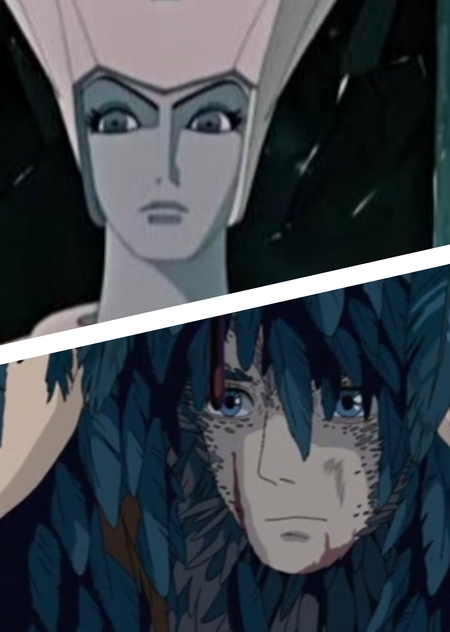
At Atamanova’s Ice Hall, the architecture is one of absolute cold. Notice the perfect symmetry and the strict, almost mathematical lines of the crystals. There is nothing «human» in this space—no objects, no furniture, no traces of everyday life. It is a perfect, yet dead, structure that reflects the essence of the Snow Queen: because she cannot feel, her home is ice.
Frame from the anime «Howl’s Moving Castle» (2004), directed by Hayao Miyazaki, Studio Ghibli
Miyazaki’s Walking Castle interior is its complete antithesis. There is no symmetry here, but rather an accumulation of objects: vials, books, herbs, and mechanisms. This space seems cluttered, yet it is within this chaos that life is felt.
Both directors utilize the same visual principle. Their interiors function as a projection of the character’s inner state. Atamanov’s icy, geometric vaults and voids convey the coldness and emotional vacancy of the Snow Queen. Miyazaki’s chaos of vials, books, and herbs mirrors the turmoil and complex inner world of Howl. The similarity in their approach proves that Miyazaki internalized a lesson from the Soviet school: space must «speak» about the character without words. The difference lies only in method—Atamanov works through emptiness and symmetry, while Miyazaki works through an accumulation of detail.