Duration is a physical parameter that defines the length of all things and processes. Most compositions inevitably come to an end; time dictates these rules. There are exceptions, such as the work of John Cage, a composer who expanded not only the boundaries of music but also the dimension of duration—Organ²/ASLSP (As Slow as Possible)—a piece that is the subject of the longest musical concert in human history. The performance of the organ version of «ASLSP» began in St. Burchard’s Church in the German town of Halberstadt in 2001 and is scheduled to continue for 639 years. According to the concept, the performance will conclude in the year 2640.
Scattering ash in the wind feels to me like a necessary simplification. I translate this feeling into an endeavor to reveal the concept of decay—the division of a whole, of something clear (like firm ground beneath one’s feet) into a multitude of small parts. This involves sublimating the grand scale in the sense of a physical parameter and in the sense of meaning, into something provocatively small. Translated into contemporary discourse, this refers to deconstruction.
The influence of the sound environment is becoming increasingly important in the cultural process. The core of the topic under consideration is the search for interpretations of decay as an existential experience—the grief of loss—and the need to study the form of sound as a tool for managing a person’s state of being.
The theoretical framework of this paper relies on the concepts of acoustic estrangement and defamiliarization. Although literary criticism traditionally associates this technique with Viktor Shklovsky, this idea was formulated long before the 20th century; its philosophical roots are found much earlier—in the teachings of Thomas Aquinas on universals.
According to Aquinas, universals (general concepts of things) exist in three ways: «prior to things”—as eternal ideal prototypes in the mind of God; „in things”—as their concrete essence; and „after things”—as abstractions in human thought.
When we name something, we inevitably detach it from the original divine plan (the primary archetype in a theological sense, independent of faith) („prior to things“) and place it within the realm of human perception. Thus, the act of naming is inherently an act of alienation and estrangement. The idea of „ostranenie“ (estrangement), which Viktor Shklovsky named in 1917—a technique that makes the familiar strange in order to renew perception—is key here.
The central thesis of this research posits that acoustic estrangement, achieved through various strategies of deconstruction and loss of the sound source, induces a psychoacoustic collapse in the subject’s perception, during which the sound is reduced and sublimated into „something small.“ Despite its minimality and abstraction, this „small“ sound carries a significant existential impact, intensifying the experience of decay, loss, and metaphysical death.
Research Question: How do processes of acoustic alienation (the detachment of sound from its source) transform the psychoacoustic perception of space and the subject’s identity, facilitating its sublimation into a «smaller» entity, and how will the discovered events reflect the process of decay, and what techniques are used to construct the narrative?
Carrion
And the sun scorched this rot from the firmament, To burn the remains to dust, So that Great Nature, which was united, Might accept the divided. […] Hurrying to the banquet, a buzzing cloud of flies Twirled above the vile mound, And worms crept and churned within the belly, Like thick, black slime. […] All this moved, ascended, and shone, As if suddenly brought to life, The monstrous body grew and multiplied, Full of hazy breaths.
And this world streamed with mysterious sounds, Like the wind, like a running wave, As if a sower, raising his arms smoothly, Scattered seeds over the field.
It was a wavering chaos, devoid of forms and lines, Like a first sketch, like a stain, Where the artist’s gaze foresees the figure of a goddess, Ready to lie on the canvas. […] Tell the worms, when they begin to kiss, To devour you in the damp darkness, That I shall preserve forever Both the fleeting beauty and the immortal structure.
CONTENTS
/Shepard Tone /Camouflage Effect /Subject Entropy /Inside the Subject /Loss of the Original Source /Conclusion
TON SHEPARD
Деградация основы с точной системой
Pitch is a spatial, subjective factor (nature has frequency, but not the concept of pitch). There is only speed and the number of oscillations per second. More oscillations equate to high pitch; fewer oscillations equate to low pitch. A thick double bass string and a thin guitar string create different pitches by striking the air—compressing it—which in turn strains the eardrum in our ears.
The concept of pitch was understood as far back as Ancient Egypt. Hieroglyphics—a conventional system of gestures that originated over 4,500 years ago. One could argue that time becomes space.
Stereogram for the composition «Shepard’s Descending Minor Third»
We should begin by examining a loss of foundation, considering Shepard’s tone. For illustrative purposes, the auditory image must be translated into a stereogram to demonstrate movement and relative position to the sound. Shepard’s illusion builds an acoustic expectation by introducing a question of duration. The illusion is constructed such that the sine waves are designed to mask the preceding and succeeding ends of the waves, creating the effect of continuous ascent or, conversely, descent of the tone.
Decoding the sound image: the expectation of resolution, coupled with the isolation from the habit of visualizing what is heard, creates a feeling of instability.
As seen on the spectrogram, these are primarily waves that gradually descend from dark blue (low amplitude) to bright yellow (high amplitude). However, Shepard’s tone may not only be descending but also ascending. The example below utilizes both directions simultaneously, causing the waves to merge in transition. The sensation of endlessly descending or rising tone is an illusion—the sinusoidal signals are arranged so that when one wave concludes, another begins, and the difference between their switches is almost imperceptible.
Stereogram for the composition «Disconnected.»
DEATH SLEEP
Музыка / Жан-Клод Риссет — Компьютерная сюита для «Маленького мальчика» (1968)
Speaking of psychoacoustics, it is impossible not to touch upon music, as these concepts share a common terminology—pitch, dynamics, timbre, rhythm, and the density of sonic events. In this context, the focus will be on the influence—specifically, what effect the examples I provide have on the listener.
The suite is part of the musical accompaniment to Pierre Alle’s play, «The Little Boy.»
The play’s theme is the bombing of Hiroshima, experienced through the lens of pilot Ezzerly’s fantasies. While some details in the play are highly realistic, other staging or musical elements suggest that what is happening is merely a dream. For instance, the music references airplanes and sirens, but their simulation using sound synthesis gives them an unreal quality, allowing them to harmonize seamlessly with the musical structures presented in the instrumental and vocal parts.[1]
Spectrogram Computer Suite From Little Boy |Flight And Countdown (4:27)
The suite is structured as a three-part composition. The first movement, «Flight and Countdown, ” pairs a dream of flying to Hiroshima with dynamic sounds that transition into two episodes (jazz, gong), followed by a metronomic countdown to the atomic bomb drop.[1]
Spectrogram Computer Suite from Little Boy | Fall (2:50)
In the second episode, «The Descent, ” sound sweeps past various missiles as they trace large circles in an infinite fall: the pilot identifies with the bomb, codenamed Little Boy, and the descent becomes an imagined journey into the boundless psychological space. [1]
Spectrogram Computer Suite from Little Boy | Contra-Apotheosis (5:18)
In the third part, «Anti-Apotheosis, ” previous elements reappear only to disintegrate: the jazz band morphs into a burst of machine-gun fire, and the flute and gong become rising and receding sirens, eventually leaving behind only a memory.[1]
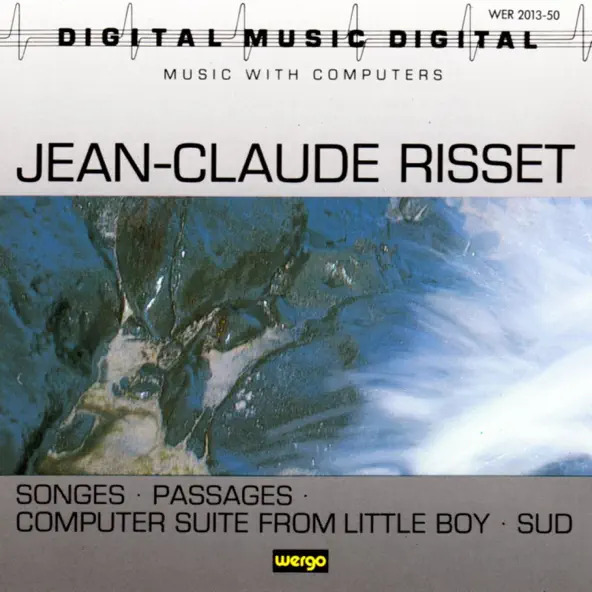
Suite Cover:
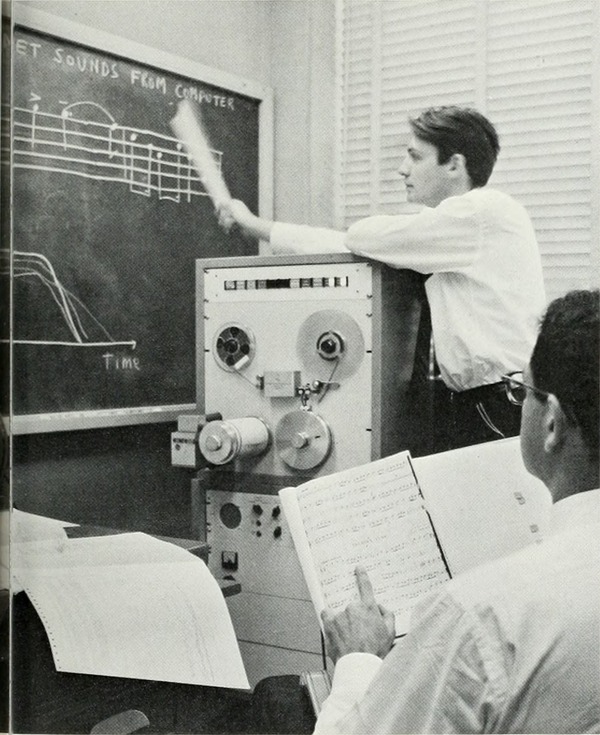
Claude Risset, a French physicist and composer, demonstrates a melody synthesized using a computer.
The piece incorporates various sound synthesis experiments. In the computer suite Little Boy, several musical instruments are simulated by the computer, which utilizes the results of these imitation experiments, particularly my research on brass instruments. However, the computer was also used to generate sounds that deviated from traditional instrumentation. In this work, the composer employed two key principles. Foremost among them is the (in)harmonic structure of timbre. Synthesis allows for the composition of spectra much like chords, giving them a functional role rather than merely a coloristic one.[1]
Harmony can continue in synthetic timbres, forming the foundation of melodic textures through «spectral analysis of the chord» from which the piece begins. Secondly, paradoxical sounds that go beyond the undefined chromatic scale of Shepard: sounds that descend or ascend infinitely through the scale but end below the original point. Synthesis allows for the creation of illusions by constructing sound structures specifically designed to engage certain perceptual mechanisms.[1]
CAMOUFLAGE EFFECT
Симфоническая поэма для 100 метрономов