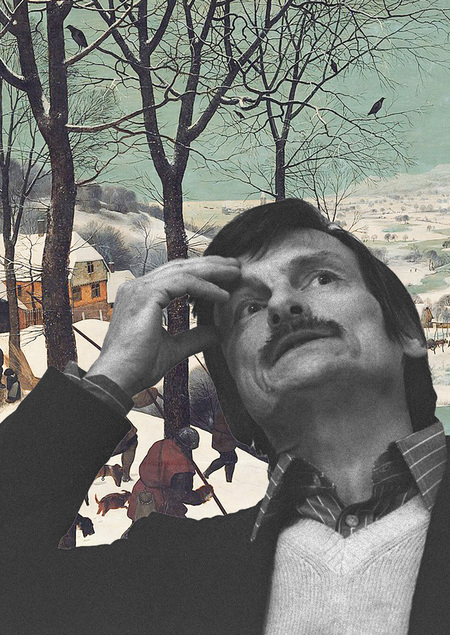
CONTENTS: 1. CONCEPT 2. HYPOTHESIS 3. SOLARIS 4. MIRROR 5. ANDREY RUBLEV 6. NOSTALGIA 7. CONCLUSION 8. SOURCES OF INFORMATION AND IMAGES
CONCEPT
Painting and cinema, despite differences in their forms and modes of expression, share much in their ability to convey emotion, ideas, and cultural contexts. In recent decades, the exploration of the relationship between these two art forms has become a relevant topic for many scholars and critics.
The analysis of the work of masters such as Andrei Tarkovsky is particularly fascinating; as one of the most significant directors of the 20th century, he utilized the visual codes of painting to create a unique cinematic language.
Tarkovsky’s films are not merely a visual experience, but a sophisticated intertwining of art and philosophy. He creates a space where painting, much like a film frame, serves as a stage for profound contemplation on life, spirituality, and existence. His works cannot be understood without considering the painterly context that inspired his creativity. They are filled with visual metaphors and symbols that can be correlated with the works of great masters of painting, such as Andrei Rublev, Albrecht Dürer, and Leonardo da Vinci, among others. These parallels open new horizons for analyzing and interpreting his films, allowing viewers and researchers to see not only cinematic but also pictorial elements within them.
Within this visual study, I will examine several key aspects related to the theme of painting’s influence on Tarkovsky’s creative work. I will draw parallels with Albrecht Dürer, whose works are distinguished by deep philosophy and meticulous attention to detail. The theme of humanity and nature, which is central to Leonardo da Vinci’s work, will also be analyzed within the context of Tarkovsky’s films, allowing for the identification of common motifs and ideas shared by both artists.
Furthermore, I will conduct a visual and comparative analysis of scenes from Tarkovsky’s films, juxtaposing them with masterpieces of painting. This will illuminate how Tarkovsky utilizes painting as a source of inspiration for creating his unique imagery.
HYPOTHESIS
In Andrei Tarkovsky’s work, visual metaphors and painterly elements create a unique cinematic language. A comparative analysis of his films against the works of masters such as Dürer and Da Vinci will help reveal shared philosophical motifs and the influence of painting on his art.
SOLARIS | 1972
«Solaris”—Andrei Tarkovsky’s film, based on Stanisław Lem’s novel. Psychologist Chris Kelvin travels to a space station where he confronts manifestations of his suppressed emotions in the form of physical entities. The film explores themes of memory, love, and human nature, posing questions about the meaning of existence.
A frame from the 1972 film Solaris.
Pieter Bruegel the Elder, «The Harvest» (1565) // Pieter Bruegel the Elder, «Smoky Day» (1565)
In this film, we see the value held by Dutch painters. Paintings by Pieter Bruegel the Elder from the «Seasons» series hang on the walls of the «Solarium» library instead of windows (one of the film’s characters notes this). They stand as symbols of the cyclical nature of life on Earth and its irreversibility.
Frame from the film «Solaris» (1972) // Peter Bruegel the Elder «Hunters in the Snow» (1565)
The work of the genius master Peter Paul Rubens, specifically the painting «Hunters in the Snow, ” becomes a pictorial allegory of nostalgic remembrance of home. It embodies the image of a distant dwelling, a dream-memory of one’s home planet, childhood, domestic comfort, and life itself.
Please note that the Bruegel painting uses the same colors as the costumes in the film: yellow, brown, gray, blue, and white. However, the blue in the painting and in the film differs because Tarkovsky intended to convey a completely different mood.
Frame from the film «Solaris» (1972) // Rembrandt. «Self-Portrait with Saskia on my Lap» (1635).
The Parable of the Prodigal Son. In the film, it becomes a cautionary tale about humanity and the Cosmos—a Cosmos that, according to Tarkovsky, can only be understood by ascending to a higher moral plane.
Still from the film Solaris (1972) // Leonardo da Vinci «Lady with an Ermine» (1489–1490)
Leonardo da Vinci’s painting, as one of the greatest masters of art, continues to influence not only painters but also representatives of other art forms. Andrei Tarkovsky’s films feature numerous poetic allusions and visual metaphors directly connected to da Vinci’s painting. The primary theme permeating both disciplines focuses on the interaction between humanity and nature, existential searching, and spiritual elevation.
In this frame, it is interesting to observe how Tarkovsky presented «The Lady with the Marten» in his own way. The purity of the marten is transferred to the woman’s white fur coat.
Frame from the 1972 film Solaris // Antonello da Messina, «Portrait of a Young Man,» c. 1475–1476
As in the works of Vinci and in the pieces of Antonello da Messina, Tarkovsky values the medieval dissolution of the human within nature. In this fragment, we see a parallel between the composition, the interaction with nature, and the facial expression, which conveys similar internal states of the characters.
A still from the 1972 film Solaris // Jan Breugel Sr. «Forest landscape with hunters and dogs overlooking the city across the river»
Another frame from a film that I found a certain visual similarity to the painting «Forest Landscape with Hunters and Dogs overlooking the City across the River.» This is evident in the composition of the shot, its multi-layered nature, the placement of the tree, its branches, and the color palette.
Still frame from the film Solaris (1972) // Andrei Rublev «The Trinity, ” circa 1411
On the hull of a spacecraft, far from terrestrial civilization, the icon becomes a kind of bridge between a distant past and an uncertain future.
Frame from the film «Solaris» (1972) // Rembrandt «The Return of the Prodigal Son,» c. 1666–1669