Navigation
- Concept
— Principles of Constructivism
— Constructivism in Practice
— «Letatlin»
— Conclusion
— Sources
Concept
Art has captivated humanity since the earliest times. It evokes within us a sense of the beautiful and the sublime. The works of gifted creators inspire us and often shape our understanding of various historical eras. Simply put, art serves many functions, but you are unlikely to describe a masterpiece by a genius artist as «practical, ” or a statue by a talented sculptor as „convenient.“ Objects possessing such attributes fulfill different functions, and we rarely label them as works of art. People do not seek profit or utility in art. Immanuel Kant, for instance, argues in his „Critique of Judgment“ that the pleasure derived from an object’s practical use and the aesthetic pleasure from its contemplation have distinct natures: „That which is pleasing to man is that which brings pleasure; that which is beautiful is that which is simply agreeable.“ This was the prevailing view for hundreds of years, and only recently, with the advent of the avant-garde, has the artistic individual begun to pose fundamental questions about their work. The avant-garde opened the door to countless new ideas, concepts, and movements. Artists began to re-examine how and what they were presenting in their creations. Thus, from these considerations, an intriguing question inevitably arose: „Can an object of art nevertheless possess a practical function, such as being a piece of furniture or part of a wardrobe? Moreover, could the very idea of the work—its entire conceptual value—derive directly from its functionality?“
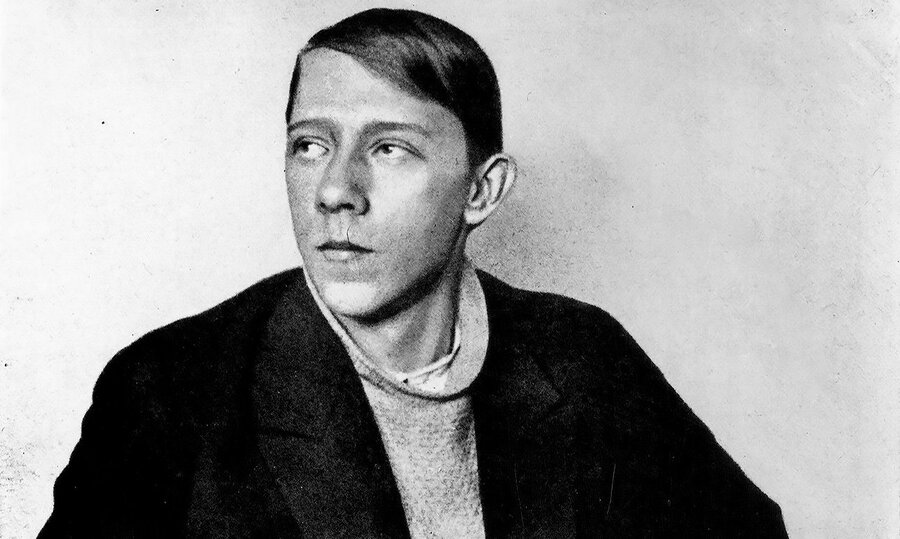
Vladimir Evgrafovich Tatlin (Date of photo: 1910–1920)
This question was once posed by the little-known Soviet artist Vladimir Evgrafovich Tatlin. The ideas of «functional» and «useful» art, which captivated Tatlin and many of his colleagues, gave rise to an entirely new movement known as Constructivism. In his works, Tatlin desperately tried to connect art with real life, achieving this first by rejecting the flat white canvas, and then by imbuing ordinary household objects with aesthetic value.
In my research, I will attempt to answer the question: «Was Vladimir Tatlin able to bridge the gap between the work of art and the functional object? Can practical purpose not merely coexist with aesthetic value, but become its very source?» To do this, I will analyze a series of the artist’s works, starting from his early pieces and moving toward his later endeavors, though I will not strictly adhere to chronological order. Due to the specific nature of my inquiry, I have been required to examine diverse types of works—ranging from small abstract compositions to monumental sculptures or even garments.
Principles of Constructivism
To answer the question above, we must first gain a closer understanding of the field in which Tatlin worked. If the goal of the Constructivists was the fusion of art and function, then our task now is to determine how they achieved this.
V. E. Tatlin «Contre-Relief» 1916 (Reconstruction)
Bas-reliefs are a series of multiple abstract compositions that preceded the advent of Constructivism, yet examining them will be the most convenient way to dissect the fundamental principles of this movement.
1. Materiality of «Contra-relief, ” 1913
V. E. Tatlin, «Counter-Relief, ” 1913
Generally, painting implies the imitation of some object. An artist often imitates real life on canvas, but Tatlin chooses not to imitate the object—he demonstrates it. Where another artist carefully rendered specific patterns to showcase a plaster texture, Tatlin uses the plaster itself, making it a part of his work. Every material in «Counter-Relief» has its own meaning and place within the system. Furthermore, the elements of the work do not aim to represent anything. The long wooden rod in «Counter-Relief» does not merely depict a line; it is an actual component of the structure, uniting its various elements—without which Tatlin’s work would simply collapse.
2. Constructivism — «Counter-relief» 1916
V. E. Tatlin, «Counter-Relief, ” 1916.
It is important to note that «Counter-reliefs» cannot be classified as sculptures. In sculpture, our focus is centered on the expressiveness of a specific object. Here, we are interested in the interaction of multiple objects within a deliberate system. Particular attention must be paid to the placement of the metal elements. They are not simply attached to each other haphazardly; rather, their multiplicity forms a composition—a distinct volumetric pattern.
V. E. Tatlin, «Contra-Relief, ” 1916
Thus, a crucial element of constructivism is the thoughtful interaction of multiple components within a work.
3. Spatiality — «Corner Relief» 1914
V. E. Tatlin, «Angular Relief,» 1914
Let’s return to the comparison with more traditional painting. Viewers are accustomed to observing an image confined by the boundaries of a canvas or a sculpture trapped by a pedestal. In Tatlin’s «Angular Contra-Relief, ” he demonstrates one of the principles of constructivism, shattering these established limitations. Tatlin’s construction not only lacks frames or boundaries—it actively engages with the surrounding space. The wooden element is literally affixed to the wall, and the tensioned lines of cables unify the composition, overlapping the corner of the room.
V. E. Tatlin, «Corner Relief,» 1914
The artwork exists through its interaction with its environment. In this piece, the white room is as integral an element to the work as the mentioned rope or wooden stick.
4. Rejection of external ornamentation, dynamism — «Counter-relief with a stool leg, ” circa 1915.
V. E. Tatlin «Contra-Relief with a Stool Leg» 1915 (reconstruction)
We have reviewed a number of pieces, and in my opinion, what immediately catches the eye is their dynamism. Stretched cables, rough forms overlapping one another. This «Counter-Relief» perfectly demonstrates the principle of dynamism found in Constructivist works. Numerous horizontal, diagonal, and vertical lines establish a complex system of visual directions. The construction remains static, yet its unique and even fragile structure creates the illusion of constant movement.
V. E. Tatlin, «Counter-Relief with a Chair Leg, ” 1915.
This next principle is particularly important to us. Constructivists deliberately eschewed ornamentation in their work. The beauty in the pieces of artists from this movement is manifested in other aspects, such as the interaction of different elements or their materiality, as described above. This idea is reflected most vividly in the «Counter-relief with a Chair Leg.» The artist does not simply use a detail from a piece of furniture in the work; they actively draw our attention to it. The immediacy and apparent simplicity of this concept imbue this counter-relief with a distinct sincerity and straightforwardness, qualities so characteristic of Constructivist works.
Constructivism in Practice