Concept.
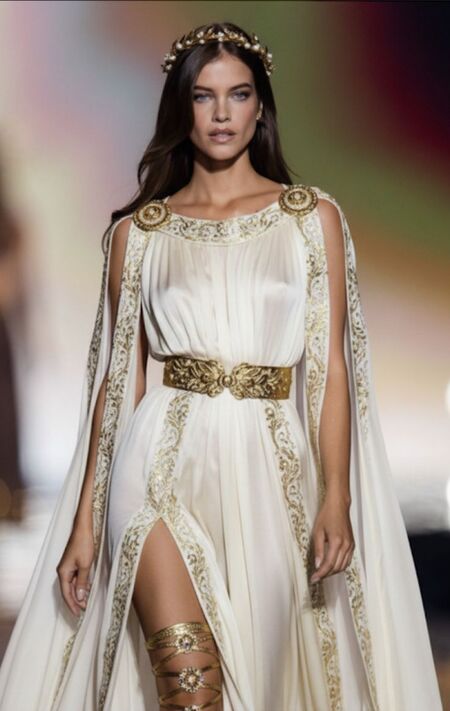
Relevance of the Visual Study: seeking a dialogue with ancient heritage in the age of information overload; searching for the possibility to slow down, to turn toward embodiment, toward quiet, elegant beauty in fashion; perceiving ancient heritage as a source of timeless values—harmony, measure, beauty that is independent of fleeting trends.Research Objective: to trace how the visual and aesthetic principles of Ancient Greek art are transforming into contemporary women’s fashion design. Tasks: To analyze silhouettes and tailoring. To determine which features are reflected in modern dresses, tops, and skirts. To compare how these silhouettes relate to the ancient ideal of beauty. To examine the color palette. To identify which colors predominated in ancient art and how they are reinterpreted today. To investigate in which contexts these shades function as a direct allusion to Greek aesthetics.Object of Study: the interconnection between the artistic heritage of Ancient Greece and current trends in women’s fashion.
Subject of Study: Specific artistic techniques, aesthetic principles, and conceptual ideas from ancient Greek art that have been reflected in contemporary women’s fashion trends.Research Methods: Analysis of literary sources; comparative analysis of historical and modern collections; historical-chronological principle; comparative method; study of fashion shows.
Introduction.Chapter 1. The Evolution of Styles and Forms in Greek Art. 1.1. The Archaic Period and Its Influence on Fashion. 1.2. The Classical Period: Modern Interpretations. 1.3. Hellenism and Its Reflection in Women’s Clothing.Chapter 2. Ancient Motifs and Their Impact on Contemporary Collections. 2.1. The Reception of Antiquity in the Work of Renowned Designers.Chapter 3. The Transformation of Ancient Greek Ideals in Modern Fashion. 3.1. Symbolism and Mythology in Contemporary Fashion. 3.2. Mythological Creatures in Modern Women’s Fashion Collections.Conclusion.
Introduction.
«Ancient Greece—a country that never existed. But that ancient civilization in southeastern Europe, which we call today, gifted us what we now perceive as true art. It was this civilization that shaped our understanding of the perfection of form, beauty, and realism. Today, humanity considers the realism of Ancient Greek art as something fundamental. The Greeks taught us to see a realistic world. Their vision grew out of the imaginative realm of heroic myths about gods and a passionate fascination with the human body, drawing from myths and legends of monsters. Ancient Greek art became a means of unifying and reconciling Eastern and Western cultures. For three millennia, it continues to captivate us with its exceptional perfection. Yet, in the last three hundred years, the influence of early Ancient Greek art extends beyond architecture and decoration; it is also utilized in the realm of fashion design.» [1] The art of Ancient Greece, with its unique aesthetics and philosophical concepts, has profoundly influenced numerous fields of human endeavor—including architecture, painting, sculpture, and, of course, fashion. This art remains an inexhaustible source of inspiration for world culture throughout the centuries—especially for women’s fashion design. In antiquity, a particular understanding of beauty took root: the emphasis was not on ornamentation, but on harmony, proportionality, naturalness, and the purposeful design of forms. The connection between Ancient Greek art and contemporary women’s fashion truly exists and manifests on various levels—from overarching aesthetic ideals to specific details in tailoring and accessories.
Ancient Greek art laid the foundations for understanding beauty as harmony, proportionality, and measure. These principles—the striving for an ideal where physical perfection is inextricably linked to the spiritual—became the bedrock for many modern conceptions of feminine aesthetics. There is a strong case to be made that many elements characteristic of Ancient Greek art persist in contemporary fashion trends, thereby creating a dialogue between the past and the present. One of the most crucial influences we will examine in this paper is the evolution of styles and forms in Greek art. From the Archaic period, which emphasized static form and symmetry, through the Classical period, which exhibits a move toward more natural and dynamic shapes, we will attempt to observe how these changes were reflected in the clothing and accessories worn by women of that era. The fabrics used in Ancient Greek fashion—such as linen, wool, and various draping techniques—created unique silhouettes that continue to inspire modern designers. Another vital aspect we will explore is the symbolism and mythology within ancient Greek art. The Greeks utilized myths and symbols not only in their artistic creations but also in their clothing, which served as a means of self-expression and a demonstration of belonging to a specific social group or culture. Consider mythological figures such as Aphrodite, Athena, and Hera.
Aphrodite, Athena, and Hera. [1]
They personified different aspects of femininity and beauty, which was reflected in women’s fashion preferences. We will also examine how these mythological images continue to influence contemporary fashion, shaping both art and its relationship with itself. We will analyze how modern designers incorporate ancient Greek motifs, creating new collections that retain the spirit and aesthetic of antiquity. The paper, «The Influence of Ancient Greek Art on Modern Women’s Fashion, ” is a timely attempt to understand the connection between ancient images and the styles that capture the attention and inspire designers around the world. Despite its diversity and dynamism, modern women’s fashion often looks back to its ancient roots, seeking inspiration there. Fabrics and silhouettes popular in Ancient Greece have become relevant in our time. This demonstrates that fashion is rich in both aesthetics and contemporary trends. In the face of rapidly changing fashion directions, referencing the heritage of ancient Greek art opens entirely new horizons for the evolution of women’s fashion, hairstyling, and jewelry. Studying this interaction not only highlights the significance of ancient traditions in modern design but also reveals how fashion—as a reflection of its time—shapes and transforms the social contexts in which it exists.
Ancient Greek Costume [1]
In this study, the subject of investigation is women’s fashion as a cultural phenomenon that undergoes transformations influenced by various historical and artistic movements. The influence of Ancient Greek art on contemporary women’s fashion is a deep and multifaceted topic. The ancient heritage is not merely quoted; it is creatively reinterpreted by designers, becoming a persistent source of inspiration. The objective of this research is to analyze Ancient Greek art’s impact on the development of women’s fashion, which will allow us to identify the historical and cultural connections between the ancient legacy and modern fashion trends. Thus, this work aims to demonstrate how Ancient Greek art continues to influence modern fashion and social norms, creating a dialogue between the past and the present.
Chapter 1.
The Evolution of Styles and Forms in Greek Art.
The evolution of women’s clothing in Ancient Greece represents a fascinating and multifaceted process—one that not only reflected the social and cultural shifts occurring within the society but also significantly influenced modern perceptions of women’s fashion. «Women’s fashion in Ancient Greece developed over several centuries, starting in the Archaic period (c. 800–500 BCE) and concluding in the Hellenistic period (c. 323–30 BCE). Fashion underwent significant transformations across different eras, yet it remained intimately connected to the cultural and social aspects of women’s lives. A crucial factor determining clothing style was the concept of beauty and the ideal body, which varied depending on the time and place.» [2]
1.1 The Archaic Period and Its Influence on Fashion.
Women’s attire in Ancient Greece adhered to the aesthetic ideals of the time: it needed to emphasize bodily harmony, dynamism, and freedom of movement, while also concealing figure flaws. «A key characteristic was that the garments were not tailored or sewn, but were created through the skillful draping of rectangular pieces of fabric.» [3] During the Archaic period, women wore simple clothing consisting of long, loose tunics known as chitons. What were the components of the costume? Chiton—the undergarment. Two main types are known: Doric chiton—an older variation, made from a single rectangular piece of fabric. «It was folded in half, the upper edge was turned up (diplodion), it was fastened at the shoulders with brooches (fibulae), and draped over the chest. Often, the side edges were left unfinished, allowing them to fall in pleats. Sometimes, an overlay (kolpos) was added above the waist.» [4]
Doryan’s Chiton. [2]
The Doric chiton was primarily worn by Spartan women. Because of its cut, which left the sides exposed, Spartan women were even nicknamed «phainomeres,» or «hip-showers.» Athenian women, however, preferred the wider and longer Ionic chiton. In ancient Greece, the first examples of fashion were created. Women wore long dresses with a deep neckline, and men wore togas. These garments are still used in modern fashion. The Greeks approached clothing with minimalism, valuing simplicity and the harmony of lines above all else. A woman’s dress, whether for formal events or weddings, was a piece of fabric wrapped around the body and secured with fastenings.
The Ionian chiton—a later and more widespread variation—consisted of two pieces of fabric. It was wider and longer, and it became fashionable in the 5th century BCE. The two pieces of fabric were fastened with clasps from the shoulders to the elbows, gathering the fabric into small, symmetrical folds; they were sewn at the sides and always cinched with a belt. «Married women wore a girdle under the bust, while young women wore it at the waist or hips. Sometimes the chiton was supplemented with a light scarf made of sheer fabric—a caliptrae.» [5]
Greek Luxury [2]
In addition to the scarf, chitons were often adorned with embroidery or painting; the ornament could run along the hem or cover the entire fabric. But the «kaliptra» served not only as an ornament but also as a practical accessory. The light fabric allowed the skin to breathe, and the scarf itself helped soften direct sunlight, protecting the face and hair from sunburn.» [5] The clothing of the ancient Greeks remained essentially the same in terms of construction throughout their history; only its size, fabric, trim, and ornamentation changed. The length of the clothing depended on age and social status: the older and more noble the woman, the longer the chiton. As we discovered, a belt was a mandatory element. Young women wore it around the waist, while married women wore it under the chest. Fabrics during this period were often decorated with complex patterns: stars, leaves, flowers, figures of gods, and hunting scenes. Colors held significance: white was considered privileged and was available to aristocrats; green, gray, and brown were worn by rural inhabitants and the urban poor, while black, dark green, and gray symbolized mourning. Mentions in Greek literature revealed various color nuances—such as dresses in «frog» or «apple» colors, amethyst, hyacinth, and saffron. The fabric was dyed using plant-based and animal dyes. In some regions, people wore clothes of a single color.
Textile dyeing was done using both mineral and organic dyes—derived from plants (such as terebinth fruits) and from animals (like kermes oak caterpillars). In some city-states, dyeing textiles was not customary. For example, the Spartans did not wear colored clothing, save for a red military cloak. Clothing was made from wool and linen, which were hand-woven on upright looms. As weaving and dyeing crafts developed, various patterned fabrics emerged. For a long time, fabric made from Ionic linen was popular, but wool later supplanted it, which the Dorians utilized. [3] «Accessories: Women wore jewelry (diadems—stefans, earrings, necklaces, bracelets) made of gold and silver, as well as simpler pieces made from bronze, lead, iron, or bone. Parasols and fans were used for sun protection.» [6]
Jewelry of Ancient Greece [3]
During the Archaic period, fashion evolved. «In the Early Archaic period, voluminous, complex chitons with pleating were common. Later, in the 6th century BCE, the Doric chiton was more voluminous than the Ionic, which became more popular and ultimately defined the Classical Greek style, forming its foundation. Furthermore, in Attica (the region dominated by Athens), a skirt was sometimes worn over the chiton during the Archaic period—perhaps influenced by older Cretan-Mycenaean fashions.» Thus, the complex, pleated chitons of the early period gradually gave way to more restrained forms. Wool and linen were used to create clothing, woven manually on upright looms; as weaving and dyeing crafts developed, various patterned fabrics emerged. For a long time, linen from Ionic regions was popular, but later it was superseded by wool, which the Dorians utilized. In this way, the Archaic period laid the groundwork for ancient Greek fashion, where the primary focus was not on the cut, but on the ability to create harmonious, elegant folds in the fabric.
1.2. Classical Period: Contemporary Interpretations in Women’s Wear.
During this time, the classic style of Greek dress emerged, combining elements of Dorian and Ionic styles. As time progressed during the Classical Period (c. 500–323 BCE), women’s fashion began to develop and grow more complex. During this era, the classic style of Greek attire took shape, melding features from both the Dorian and Ionic styles. The Classical Period of Ancient Greece (5th–4th centuries BCE) significantly influenced fashion, and its echoes can be seen in modern interpretations. The aesthetic of this era—built upon harmony, proportion, functionality, and connection to architecture—continues to inspire designers. «The classic style of Greek dress is truly recognizable—its key characteristic is the drapery: the fabric was not cut or sewn in the way we know it, but skillfully arranged in folds to emphasize the body’s natural lines. This silhouette was established during the Classical Period (5th–4th centuries BCE).» [7].
Women’s Garments of Ancient Greece [1]
A significant aspect of this period was that appearing in one chiton in public was considered inappropriate for a free adult. Therefore, when leaving the house, Greeks would wear an outer garment. For men, this was the himation—a large, rectangular cloak. It could be draped in various ways, and the style of drapery indicated age, status, or occupation.
Men’s Trench Coat [1]
Sometimes, tassels with lead weights were attached to the hems—to prevent the fabric from slipping and the folds from shifting. The aesthetic beauty of this garment lay in the cascade of drapes that softly fell, creating a flowing silhouette. «A chlamys or chlamida—a shorter cloak of oval or semi-circular shape. It was draped over the back and shoulders and fastened on the chest with a buckle. The chlamys was often worn by young men, warriors, and those who were traveling.»