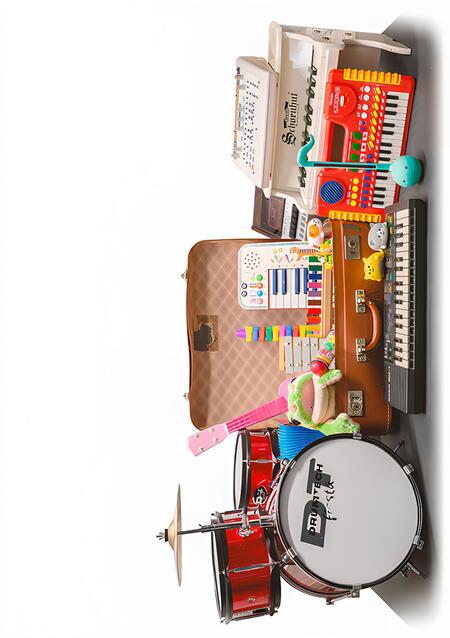
Concept
A toy is one of the first objects that produces sound in our childhood experience.
It requires no skill and does not demand an understanding of musical structure: it is enough to press a button or wind a spring. Unlike a musical instrument, the toy does not strive for tonal purity or precise tuning. Its sound is material, arbitrary, constrained by its construction—sometimes too sharp, sometimes nearly unmanageable—and it is precisely these qualities that are becoming interesting to sound designers and artists working with sound today.
Toys allow us to visualize the source of sound—a button, a lever, a wheel, a dropped ball—transforming the process of sound into a visible mechanism.
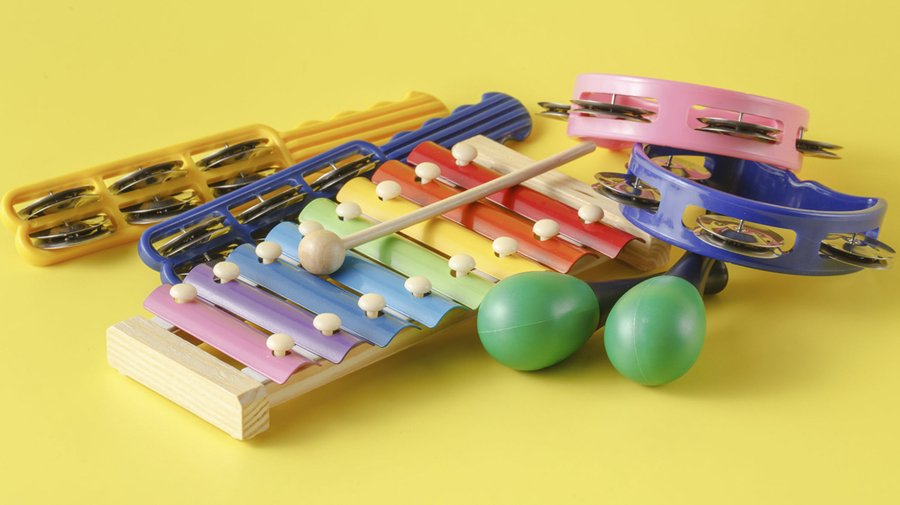
Children’s Musical Instruments
This conjunction of gesture and sound forms a distinct aesthetic logic in which timbre is understood as the trace of movement, and the mechanical structure becomes part of the composition. Artists turn to toys precisely because they restore physicality and the transparency of birth to sound.
As we grow up, we begin to view toys as imperfect instruments, but in artistic practice, this «imperfection» gains a new meaning. It transforms into a space for experimentation: artists modify toys, connect them with mechanisms, add motors, tamper with electronic circuits, and create ensembles from the simplest children’s playthings.
Thus, the toy ceases to be an object of play and becomes a full participant in sound culture—from performances to professional sound design.
The goal of this research is to trace how toys form a distinct sonic language, to identify the categories of working with them in contemporary practice, and to examine how the visual and material properties of toys influence sound.
1. Mechanical Play
Sound as a Trace of Motion
A toy is an object where sound almost always originates from movement. Marbles, levers, gears, elastic bands, handles, springs—all these elements create a mechanical rhythm before any musical meaning emerges. Here, timbre arises not from a predetermined note, but from physics itself.
Wintergatan — Marble Machine (a musical instrument utilizing 2,000 marbles)
In this construction, which resembles a giant mechanical toy, every detail—from the drum mallets to the trajectories of the balls—leaves an audible trace of its own movement. Mechanics becomes not merely a means of creating rhythm, but also a visual analog for sound. We observe complete transparency in the cause-and-effect relationship: the timbre emerges from the material’s contact with other material.
This allows us to formulate an important principle: in a mechanical toy, the sound is not hidden inside the instrument but arises on the surface, within the visible area. It is this visual openness that makes the toy a valuable object for sound design analysis—it shows how the physical structure determines the timbre.
2. Naivety of Perception
Simplicity as an Aesthetic Strategy
Children’s musical instruments, at first glance, appear to be simplified copies of the «real» ones: a small range, rudimentary mechanics, and an overly bright timbre. However, within the artistic sphere, it is precisely this deliberate imperfection that becomes valuable. The minimalist design shifts focus from the richness of the sound to the very principle of organizing the sonic material. Where a professional instrument offers a wide spectrum of expressiveness, the toy compels the user to work with texture, repetition, and rhythm—parameters that are usually obscured by the familiar «beautiful» sound.
This logic is especially clear in the practice of Igor Krutogolov’s Toy Orchestra—a group built entirely from toy instruments: plastic xylophones, children’s drums, whistles, miniature clarinets. The materials of their instruments—thin plastic, cheap wood, aluminum discs—establish a tonal character that cannot be mistaken for professional counterparts. Their compositions feature the clicks of keys, the roughness of the casing, and weak resonance. What is usually masked or corrected becomes part of the artistic language for Krutogolov.
Igor Krutogolov’s Toy Orchestra performs «A Little God In My Hands» by SWANS live
Using toy instruments allows the group to structure music not as movement through familiar melodic schemes, but as an engagement with materiality: each sound is perceived as a physical object with its own weight, density, and texture. The limitation of range transforms into modularity—any short sound becomes a building block that can be repeatedly layered, combined, or arranged.
Playfulness ceases to be an accusation of inadequacy and transforms into an independent sonic aesthetic.
This approach confirms that children’s instruments introduce a unique logic of sound production. Here, expressiveness arises not from timbral complexity, but from the precision of its organization. The toy sound does not strive to be «adult»; it retains its own characteristics, thereby opening up an alternative way of hearing music—through matter, texture, and physical limitations.
The simplicity of the children’s instrument does not diminish expressiveness; rather, it highlights the structure of the sound. Limitation becomes a tool for analysis and the foundation for a new artistic language.
3. Circuit Bending
Error as an Artistic Tool
Electronic toys are built upon the simplest microcircuits, capable of reproducing only a few basic signals—a beep, a sinusoidal tone, or a short musical snippet. These systems are inherently unstable: the frequency can drift, notes can falter, and the timbre can suddenly change. In everyday use, such deviations are perceived as defects, yet it is precisely these irregularities that create opportunities for artistic intervention.
Circuit Bent Toy Dinosaur