Navigation Menu
Concept..............................................3 Favorites..............................................12 Jealousy.................................................17 Duplicity.........................................21 Shift in Perspective...........................27 Weaponry..................................................30 Consequences of Battles...................39 Sexualized Image.........42 Conclusion.........................................50 Bibliography...........................52
Concept
In various forms of media, content creators—whether intentionally or not—frequently rely on certain tropes. These might include cliché Mary Sues or «classic» princes, warriors, and damsels in distress. Similar categories can also be observed in manga, which has gradually solidified certain archetypes in readers' minds, allowing characters from different stories to be mapped onto specific groups. One method of categorization is differentiating people based on how they express their emotions. For example, one of the most popular typologies involves the tsundere, yandere, and kuudere. These words share the component dere (デレ), an abbreviation of deredere (デレデレ), which can be translated as «being affectionate» or «being lovestruck.» Over time, many different dere variants have emerged, but at their core, they are various interpretations of these «three pillars.»
I’d like to break down the typical character archetype that generates the most debate—the yandere. Initially, the term «yandere» originated and was primarily used in Japanese pop culture, specifically in manga and anime during the 1980s. Tsundere refers to a character who is capricious on the outside but sweet on the inside, while Kuudere is cold on the outside but sweet on the inside. However, they are all «sweet» internally, whereas the Yandere is «sweet» on the outside and insane on the inside.
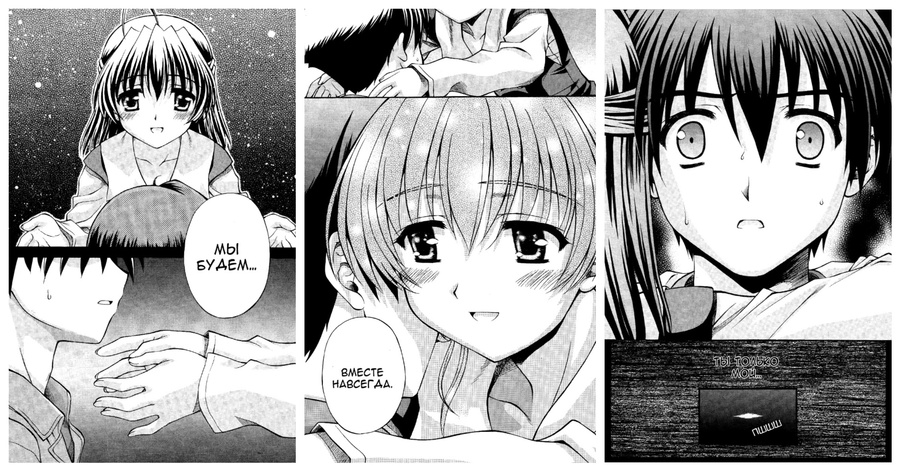
Collage of the last pages from the manga «School Days» by Homare Sakadzuki
Yandere is an abbreviation of yanderu deredere (病んでるデレデ), which can be literally translated into Russian as «sickly in love.» It is worth noting that this term completely describes the character’s nature, as yanderes become intensely attached to the object of their adoration, often crossing personal boundaries. Yandere characters are most frequently female, although there are male examples as well. However, they generally do not have the same level of popularity. Next, we will examine this character type in more detail (most examples will involve female characters due to their greater recognition).
A collage of characters from the manga Elfen Lied by Lynn Okamoto and the manga Tokyo Ghoul by Sui Ishida.
It is worth mentioning that in addition to the word «yandere,» you may encounter the term «yangire.» Yangire originates from yandere, sharing the same root as the first part of yandere, which means «to nip» or «to bite.» It is not a separate archetype but rather a subtype of it. The distinction between the characters is that the cruelty is inherent in the yangire, whereas in yandere, intense affection acts as a trigger. Furthermore, they do not simply wish to be near the person; the yangire desires complete ownership of that person. We will later examine an example of this behavior, where a character consciously prepares to transform the object of their affection into a helpless animal in order to control their beloved and care for them against their will. Yangire may act not only out of romantic impulses, and their actions «up to complete devotion» do not necessarily have to be innocent or romantic, unlike yandere. However, in my opinion, the two concepts should not be separated, since the term yandere encompasses yangire. After all, the meaning of «sick with love» already characterizes a mentally unstable person with obsessive tendencies.
I would like to examine this trope in manga from an artistic perspective. This archetype exhibits common expressive traits—one only needs to study the manga with this character a few times to easily recognize this type later on.
Favorites
Often, the yandere’s relationship with a manga character transforms into a form of idol worship due to obsession. The chosen person becomes the sole meaning of their existence. Emotions overshadow reason, and frequently, the characters must fight the object of their affection’s enemies to protect them. Yanderes are often drawn to protagonists who are inherently weak and dependent. Many readers make the following observation about them—"The protagonist is stupid and spineless.» In reality, this makes sense; otherwise, why would the character need to be saved, and how else could the yandere demonstrate the strength of their love? By helping, representatives of this archetype emphasize their own significance in the eyes of that person.
A collage featuring the main characters from the manga Future Diary by Esuno Sakae, School Days by Homare Sakazuki, and Elfen Lied by Lynn Okamoto.
As can be noted, the main characters are quite similar not only in character but also in appearance; they represent a composite type of the «average» young man, and often a school student.
Young women demonstrate a desire to help or protect the one they love.
Sometimes, the yandere character chooses a strong individual capable of defending themselves. In such instances, representatives of this archetype display their obsession through fits of intense jealousy or exaggerated concern when the character is vulnerable. In some cases, the manga’s protagonist can intelligently assess the yandere’s feelings and actions, leveraging them to their advantage.
Jealousy
Jealousy is an intrinsic quality of a yandere. As previously mentioned, at its core is the desire for complete possession of the person. Since the world ceases to exist for a yandere without their object of affection from the moment infatuation begins, yanderes are unwilling to share. The situation is especially aggravated if the object of affection falls in love with someone else—the pain and suffering quickly synthesize into a desire to destroy the rival.
Manga excerpt from «Future Diary» by Esuno Sakae
A fragment from the manga «School Days» by Homare Sakadzuki
Duality
Manga excerpt from «JoJo’s Bizarre Adventure» by Hirohiko Araki
One of the interesting traits of the yandere archetype is their inconsistency and explosive nature. Around those they love, they strive to be gentle and sweet, whereas with strangers, they can be rude, arrogant, or withdrawn. Influenced by their obsession, yanderes can express feelings very abruptly—suddenly throwing or breaking an object or striking someone.
Collage of fragments from the manga «School Days» by Homare Sakazuki
Psychological instability can be explained by a fragile emotional state and constant anxiety regarding their beloved and their feelings. Yandere are not «ready-made murderers.» Usually, we see the character evolve throughout the plot. At the beginning, this might be an ordinary girl living a completely normal life, but then, following a tragic event capable of «breaking» her, the character can transform entirely. In such cases, the infatuation becomes a kind of emotional outlet—an opportunity to experience positive emotions again. When the character manages to gain love, they cling to that feeling with everything they have.
A snippet from the manga «Future Diary» by Esuno Sakae
In reality, yandere characters simply see no point in diverting their attention to anyone other than the object of their obsession. When their world narrows down to a single person, everything else becomes irrelevant.
Shift in Perspective
Collage of characters from the manga «Fairy Tail» by Hiro Mashima, JoJo’s Bizarre Adventure by Hirohiko Araki, and Future Diary by Yuno Gasai, created by Sakae Suehiro.
Every manga fan will recognize this distinctive facial expression. The gaze suggests that something is about to happen. The characteristic changes include half-lidded, vacant yet determined eyes, a tightly set mouth, slightly raised brows, and an expression of detachment mixed with a dark aura. Primarily, this gesture signals that a yandere has set a goal to either destroy or, conversely, conquer someone.